

Is Sabrina Carpenter’s Man’s Best Friend album cover satire or self-degradation? A psychology expert explores our reactions
- Written by The Conversation
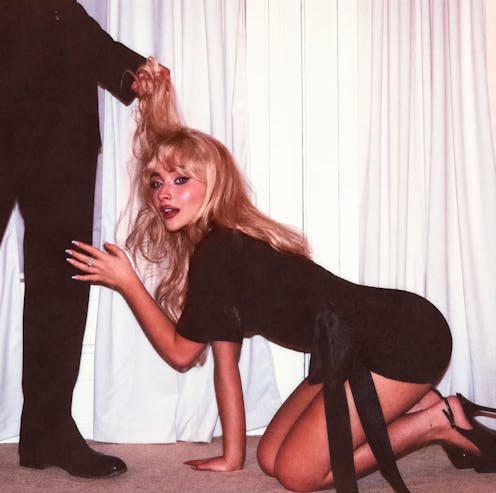
Sabrina Carpenter’s Man’s Best Friend album cover has fans divided.
Carpenter poses on all fours, her glossy blond hair grasped by a male figure cropped from the frame. Her wide-eyed expression intensifies an ambiguous performance of subservience, tapping into a visual language tied to female objectification, from classic pin-up imagery to contemporary pop culture.
The emotionally loaded image plays on her hyper-feminine, tongue-in-cheek pop star persona, forcing us to question where irony ends and objectification begins.
Is it satire, or self-degradation?
Up for debate
At first glance, the cover seems like just another stylised, provocative pop image. It delivers what we’ve come to expect: a bold, ironic twist on the exaggerated Juno-style pose she reinvents on stage.
To some fans, it’s clever satire: a pop star reclaiming and amplifying her image to mock industry norms. Satire uses exaggeration, irony, or humour to critique power structures – and Carpenter’s pose walks that tightrope.
To others it crosses a line, reinforcing regressive attitudes about women’s sexuality and drawing criticism from domestic violence advocates.
The debate reflects our unresolved discomfort about gender, power and control. There is a tension between Carpenter’s ironic persona and the submissive pose, creating uncertainty for the viewer.
We can use psychology to better understand this dichotomy.
The schema violation
This mismatch between expectation and perception is a schema violation.
A schema is a mental shortcut: a template built from experience and unspoken rules that helps us make sense of the world and predict what to expect. When something breaks that pattern, it’s called a schema violation.
Carpenter’s brand is cheeky, self-aware irony – so when she adopts a pose steeped in submission and hyper-femininity as in this album image, it feels off.
That can trigger cognitive dissonance: the mental tension we feel when two ideas (here, empowerment and obedience) don’t align.
To resolve the conflict, some fans reinterpret the image as feminist sarcasm. Others reject it, fearing it panders to outdated, dangerous norms.
Both reactions reflect our emotional and ideological investments in who Carpenter is or should be.
Exploring confirmation bias
Part of this conflicted reaction is driven by confirmation bias: our tendency to filter information to support what we already believe.
Fans who see Carpenter as witty and empowered interpret the image as intentionally ironic. Others – more sceptical of the industry’s history of exploiting female sexuality – view it as a throwback to damaging norms.
Either way, our interpretations often reflect more about ourselves than about Carpenter’s intent.
When her image contradicts both her public persona and our social values, it creates a gap between what we think is right and what we want to be right. So, we try to explain it away, by either defending the image or criticising it.
Satire and scandal
Carpenter’s cover follows a long tradition of female artists whose work straddles satire and scandal, complicating public reception.
Madonna’s Like a Prayer drew outrage for mixing religion with sexual imagery. Yet it positioned her as a provocateur – a woman resisting the lack of agency that so often defines sexualised media.
Miley Cyrus’ Bangerz era shocked fans with a bold shift from Hannah Montana innocence to hypersexualised rebellion, challenging the narrow roles women in pop culture are confined to.
Doja Cat’s shift from glam pop princess to glitch villainess unsettled audiences. Was it satire, rebellion, or just chaos?
These women, like Carpenter, force us to confront our own discomfort with women who won’t stay in one lane.
Performer and provocateur
Audience reaction is also shaped by emotional investment in Carpenter’s persona. Through carefully curated social media, interviews and lyrics, fans build intimate narratives forming parasocial relationships – one-sided emotional bonds with celebrities.
When an image contradicts that imagined persona, it can feel jarring, even like betrayal.
Audiences often expect idols to be empowering but not polarising, sexy but safe, to challenge norms – but only in ways that affirm our own values.
Carpenter’s image breaks that implicit contract, which creates discomfort for some viewers.
Carpenter’s cover raises uncomfortable but necessary questions about how much freedom female artists have to be both critical and complicit. Can they play with society and play along, to be both performer and provocateur?
This highlights the double bind many women face in media and popular culture. Female artists are expected to both subvert and satisfy; to entertain without offending; empower without alienating. The burden to be palatable and provocative is one male artists rarely face.
It’s what we make of it
Is Carpenter undermining herself or subverting the system? Perhaps both. Or perhaps the image isn’t the message: our reaction is.
The image forces us to confront not only our perception of Sabrina Carpenter but also our cultural discomfort with women who defy neat categorisation. Satire demands interpretation, especially when it comes from women addressing sex or power.
More than provocation, Carpenter’s cover mirrors our cultural struggle to accept women who defy simple labels of satire or submission. The image can reflect broader social ideals and tensions projected onto public figures.
What we see says more about our assumptions than her intent. Understanding those reactions doesn’t kill the fun – it deepens it.


