

Mommy dearest? Molly Jong-Fast’s blistering memoir of her ‘always performing’ mother Erica is hilarious and moving
- Written by The Conversation
My first boyfriend told me with some pride that he’d read Erica Jong’s Fear of Flying (1973), and Shere Hite’s The Hite Report (1976). Though they had been selling in the millions, I hadn’t yet read either, and was keen to find out what he had learned.
He was only 16 at the time, the mid 1970s, and was a proto male feminist. He was also tender, in defiance of Erica Jong’s famous expression for spontaneous one-night-stand sex: “the zipless fuck”.
The boyfriend was a nascent sculptor and carpenter: his hobby was to collect roadkill and then painstakingly clean and reconstruct the animal’s skeleton after removing the flesh and skin. His airy bedroom accommodated possums, rats, cats, birds and a wallaby. Their skeletons shed eerie shadows across us as we lay on his bed. He was genuinely interested in how things are made.
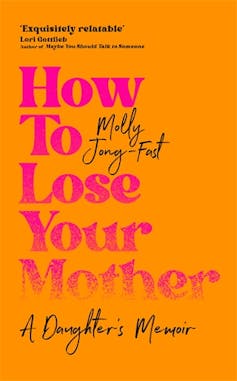
Review: How To Lose Your Mother: A Daughter’s Memoir – Molly Jong-Fast (Picador)
This is a core question in Molly Jong-Fast’s How To Lose Your Mother, which looks back from the vantage point of what she calls “the worst year” of her life. Her mother’s physical health and dementia are worsening, Jong-Fast is juggling a high-profile job as a political commentator (at MSNBC and CNN) with parenting three children, and her husband Max faces a series of life-threatening cancers. Then, she has to move her mother and stepfather (who also has dementia) into a nursing home.
At the book’s heart, though, is the question: How did my mother Erica Jong make me, and how have I struggled to remake myself?
Her book is also very much about caring for your ageing mother – and about fame, and what happens when you’re no longer famous – written by a funny, fast-talking daughter, who is also a political writer and public intellectual in her own right. Jong-Fast loves her mother fiercely, but is horrified by the way she was raised. The memoir is hilarious, moving and educative: Don’t, whatever you do, parent like this.
Fame made Erica Jong ‘very boring’
If you’ve ever wondered what it’s like for the famous afterwards, this daughter’s portrait is almost excruciating in the ways it details the sense of loss Erica Jong lived with for years: a disfigurement even, a kind of dysmorphia. Why does the world no longer see me as I am – notorious, relevant, desirable, important?
Molly Jong-Fast watches it all:
Because she was, at the time, famous, people gave her a lot of leeway. But such allowances are a favour to no one […] Being able to get away with everything made her, in fact, very boring.
Erica Jong became famous aged 31, with the publication of the novel Fear of Flying. She gave birth to her only child Molly five years later in 1978 – then lived with declining fame for ever after. Fame encouraged Jong’s highly self-absorbed tendencies, her belief everyone – the public and her daughter – wanted to hear whatever it was she wanted to say:
Eventually, Mom would answer, but never the questions I asked. She always seemed to have a sort of stock answer […] she was always performing.

Jong published many novels and works of nonfiction over the next 30 years, and was constantly speaking and touring, but she never again achieved the impact of Fear of Flying. By the late 1990s, when Molly was close to 20 years of age and had gone AWOL on drugs and drink and was expecting to overdose any day, Jong was truly famous only among those who’d also experienced the excitement and hallelujah of the iconic second-wave feminist texts.
Fear of Flying had ranked alongside Germaine Greer’s The Female Eunuch (1970), Our Bodies, Our Selves by Boston Women’s Health Collective (1970), Kate Millet’s Sexual Politics (1970), Anne Summers’ Damned Whores and God’s Police (1975), Adrienne Rich’s Of Woman Born (1976), Doris Lessing’s To Room Nineteen: Collected Stories (1979) and Angela Carter’s The Bloody Chamber (1979).

 Jenny Diski.
HarperCollins
Diski’s parents were shockers: her father was a drunk and violent, and her mother sexually abused her after the father left. She found her way into Lessing’s life in her house in Charrington Street, London. Lessing’s son Peter had moved out; in her escape from her marriage and Rhodesia (Zimbabwe), Lessing had left her older two children behind with their father. Allegedly, she felt an obligation to offer this very smart, underprivileged teenage girl a home.
Lessing’s caretaking of the teenage Diski took place during the height of British and American feminism’s rejection of the role of mothering – which still very much held sway in the theory and practices of the feminist movement Molly Jong-Fast grew up in.
In Diski’s representation, Lessing’s focus was on Diski’s potentialities. She was uninterested in the maternal, nurturing aspects of the carer relationship: those, Diski would have to do herself. Lessing provided her with shelter, meals and clothing, money to go to school with – and around the dinner table, intelligent conversations with politically active and aware adults.
It wasn’t enough for Diski, and she was less than the perfect ward. Surliness, sex, interruptions to her school studies, drugs, another breakdown: the young Diski was very much like the young Jong-Fast. Both got sober and became writers.
 Doris Lessing (right) at a demonstration in 1961, two years before she took in a teenage Jenny Diski.
Mirrorpix/GettyImages
Diski disappointed Lessing, but Lessing didn’t abandon her. They continued with their mother/daughter, carer/ward relationship until Lessing’s death. After which, it seems on the face of it, Diski felt free – and driven – to write about her. Diski was diagnosed with terminal cancer that same year; another reason to put her experience on the record. The essays comprised her final book, In Gratitude.
‘Thinking about my mother hurts’
Similarly, Molly Jong-Fast is now writing about Erica when her mother is no longer able to read what she has to say.
My mother was unattainable, but I tried. I keep trying. Now she is slipping away and our story really is over. Just in time to try and make sense of it.
Jong-Fast shuttles between her early-morning work as a TV political analyst and podcast host, her mother’s nursing home and Max’s hospital bed. The evident, sustained care she gives to Max, her own children, to her mother and Ken, her stepfather, go a long way to relieving the occasional desire for more restraint I felt on reading the curated, raw critiques of her mother’s and her own suffering:
There is a pain in me. Pain like a low ache […] like part of me is rotting or sick. Thinking about my mother hurts.
Quintana Roo Dunne – Joan Didion and John Dunne’s adopted daughter – is mentioned in passing: as a girl whom Molly knew, who was also a lonely, alcoholic only child, and the child of writers and famous mothers. She was as lost as Molly but she was not a survivor: she died, aged 39, after complications from pneumonia, following a lifetime of struggles with her mental and physical health.
 Unlike Jong, who spoke and wrote constantly about Molly, and Lessing (who, in Diski’s estimation, based a key character in her novel The Memoirs of a Survivor on Diski’s teenage self), Quintana rarely appeared in her mother’s writing. And when she did, it was after her death, when she was the subject of Didion’s Blue Nights.
But Didion could not or would not reflect on the reasons for Quintana’s suffering and early death: Andrew O’Hagan describes Blue Nights’ representation of Quintana as “strange, anaesthetised”. Indeed.
It is always harder for the mother to write of her own maternal grief, guilt and failings than it is for the daughters, the next generation, to write back. To tell how they were made by their mothers – and how they’ve remade themselves. In Jong-Fast’s memoir, there is the gratitude and the fury you would expect.
In her words:
I’m a writer, for better or worse. This is what I do. Yes, just like my mother […] it is my job to make sense of the past, of her life, our relationship.


