

Here’s how First Nations landholders can share the benefits of the NSW energy transition
- Written by The Conversation
The shift to clean, renewable sources of energy presents a rare opportunity for First Nations people, not only as energy users but as landholders.
We wanted to explore the potential for First Nations land in the energy transition across New South Wales. The transition is well underway, but the pace must accelerate to meet state targets for 2030 and beyond.
Our new report found the state’s 121 Aboriginal Land Councils have an opportunity to partner with renewable developers and build solar, wind or transmission lines on their own land.
Such projects can offer jobs during construction and a smaller number of ongoing positions, as well as annual payments. This is why farmers and other landholders often look to renewable projects as a reliable source of income.
To date, the 447 square kilometres of the state owned by Aboriginal Land Councils has not been actively used in the energy transition. As a result, First Nations involvement in the transition has been limited and the renewables boom has not flowed to these communities.
Making this opportunity a reality will require collaboration with governments, electricity networks and industry, as well as policy support.
The role of land councils
In NSW, land councils have been operating since 1983, the year the state government passed laws recognising Aboriginal land rights. About a third of Australia’s First Nations people live in NSW.
Each land council is governed by Aboriginal members, and they are located in most country towns and across Sydney.
Land councils have a statutory responsibility “to improve, protect and foster the best interests of all Aboriginal persons within the Council’s area and other persons who are members of the Council”. These councils manage their land to protect culture and heritage.
Generating wealth through the development of Aboriginal land is a key objective of Aboriginal land rights in NSW.
Aboriginal goals in the energy transition
Following analysis of the land potentially available to renewable energy projects, our research moved on to exploring what Aboriginal land councils want from the energy transition.
We ran workshops with three land councils: Tibooburra in the far northwest, Hay in the southwest and Brewarrina in the northwest of the state. Each had expressed interest in renewable developments and concern around exposure to extreme weather events.
In these workshops, land council members told us about their priorities for energy.
Reliable energy was a major concern for Tibooburra, far from the main electricity grid.
For Brewarrina on the Barwon River, energy security in the face of heatwaves and floods was front of mind. High energy bills in housing ill-equipped for extreme weather was another big issue.
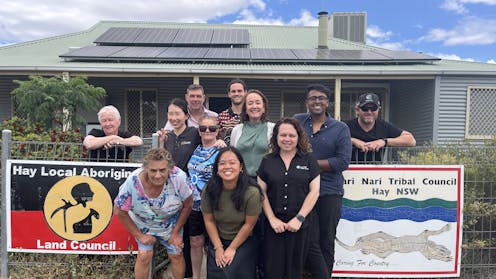
Members of Hay land council told us they wanted ownership and equity share in renewable energy projects. Their goal was to create opportunities to live, work and care for Country.

Renewable energy, First Nations land
Aboriginal land councils own and manage about 450 square km of land in NSW. Resolving outstanding land claims would further expand the estate.
Our analysis reveals current land holdings could host up to 11 gigawatts of solar or 1.6 gigawatts of onshore wind energy projects.
But several barriers stand in the way. There are long delays in the processing of Aboriginal land claims and the return of vacant Crown Land. This limits options for land councils to contribute to renewable energy development.
Realising opportunities in the energy transition
Our case studies demonstrate the potential for Aboriginal land to support the state government’s renewable energy efforts. This can also bring economic and social benefits to Aboriginal communities. But the opportunities will vary from place to place.
In areas at the edge of the grid, such as Tibooburra and Brewarrina, Aboriginal land could help meet regional energy demand through small to mid-scale wind and solar projects, microgrids and batteries.
Hay Local Aboriginal Land Council, on the other hand, is in the South-West Renewable Energy Zone. This is an area where new renewable energy projects, storage facilities and high-voltage transmission lines are already being constructed. Land under claim here holds huge economic potential for both mid-scale renewable energy (solar installations feeding into the local electricity network) and large-scale renewable energy projects.
Unlocking the power of renewable energy zones (NSW EnergyCo)How can authorities support land councils?
At present, local Aboriginal Land Councils need expertise and resources to turn this opportunity into reality.
Our report identified four broad areas for policy reform:
Build capacity for land councils to manage clean energy opportunities and risks on their landholdings. This could include establishing a dedicated government team to support interested land councils, and funding land councils to engage expertise and develop renewable energy projects.
Enable collaboration between electricity network distributors and land councils to set up microgrids. One case study, Tibooburra Local Aboriginal Land Council had land suitable for a microgrid and battery to support the energy provider. But early-stage support is needed to develop such projects.
Pilot programs to develop mid- and large-scale renewable energy projects on land council holdings. A partnership between lands councils and planning authorities could demonstrate a model for arranging approval processes. Programs by the Clean Energy Finance Corporation and the Australian Renewable Energy Agency have proven successful in the past. We recommend funding these organisations to run a program for land council-developer partnerships in large-scale renewables.
Strengthen recognition of Aboriginal rights to unlock the renewable energy potential of Aboriginal land. This could include expediting land claims and land transfers and providing incentives for cooperation between land councils and Traditional Owners.
The next five years will be crucial for NSW’s renewable energy transition. Getting the foundations right now could empower Aboriginal landholders and their regional communities to get the most out of this once-in-a-generation opportunity.


