

‘My greatest handicap was the attitude of normal people.’ Alan Marshall’s artful polio memoir, I Can Jump Puddles, turns 70
- Written by The Conversation
With vaccine sceptic Robert F. Kennedy Jr as United States Health Secretary and an outbreak in Papua New Guinea last month, polio – largely eliminated in most of the world – has been back in the news. It’s a potent sign of why vaccines are important. Mass polio vaccination began in Australia in 1956. Our last polio outbreak was in 1961 and Australia was declared polio-free in 2000.
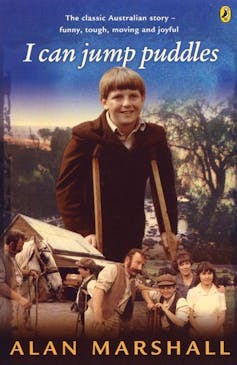
Australian disabled author Alan Marshall contracted polio in 1908, when he was six. In 2025, it is 70 years since he published his fictionalised memoir, I Can Jump Puddles: often framed by nondisabled people as an inspirational story of a boy overcoming polio. However, it was much more complex than that.
In 1955, Marshall had already been an author for 20 years. Using his writer’s toolbox, he carefully crafted his memoir to reflect the truth as he felt it, and key messages he was passionate about – including the importance of encouraging disabled children to take risks and learn. This influenced what he put in and left out.
A staple of many Australian school reading lists for decades, Puddles was translated into 30 languages, made into a movie (in Czechoslovakia) in 1971 and an ABC TV miniseries in Australia in 1981. Marshall narrated the text for ABC radio, too.
A 1900s childhood with polio
Marshall would continue to write for another 20 years, but Puddles was his most successful book by far. In the second half of the 20th century, he was one of Australia’s most famous disabled authors, both at home and abroad.

Puddles recounts Marshall’s childhood from when he contracted polio. We now know polio is a highly infectious condition that spreads through respiratory droplets, or faeces. We know some who catch polio will experience no symptoms, while others will be paralysed. And we know polio can be fatal if the paralysis effects the muscles needed for breathing. However, when Marshall was growing up in the early 1900s, polio had only recently been discovered in Australia.
Back then, it was called infantile paralysis. People did not understand how it was spread. Treatments were experimental, and there was no vaccine. For many children, including Marshall, it meant a long stay in hospital.
Ultimately, Marshall’s right leg was completely paralysed and his left leg was partially paralysed. So began his life on crutches. Once he was competent walking with them, he returned to his family in rural Victoria, and then to school. There, according to Puddles, he was an average student with both best friends and bullies, growing up in a small community who accepted him as he was.
A memoir of truth, not fact
Puddles is often regarded as an account of Marshall’s early life exactly as it occurred. However, as a skilled author, Marshall used everything he had learned in 20 years of being a writer to create a compelling narrative that represented his experience of childhood.

 Beginning in childhood, Alan Marshall was often discriminated against.
State Library Victoria
Beginning in childhood, Marshall was often discriminated against in many aspects of his life. As he later said (using the language of the time): “My greatest handicap was never my affliction but the attitude of normal people around me.” And since he knew many other disabled people, he knew this was a common experience.
He believed disabled people have grit, adaptability and creativity. He knew some did not have the opportunity to develop them until later life – though he had the good fortune of parents who wanted him to “try the lot no matter what the risk”. He wanted disabled children to have similar opportunities, as early in life as possible. In his book, he encouraged adults to support rather than restrict their children’s development. To emphasise this point, at times Marshall breaks from the narrative to write directly to the reader. For example:
The crippled child is not conscious of the handicap implied by his useless legs. They are often inconvenient or annoying but he is confident that they will never prevent him doing what he wants to do or being whatever he wishes to be. If he considers them a handicap it is because he has been told they are.
Indeed, Marshall’s commitment to affirming rather than constraining disabled children’s creativity is central to the narrative of Puddles. For most of the book, his father is a strong supporter of his son’s experimentations in skills development. However, when Marshall decides he wants to ride a horse, his father declares him incapable. Listening to his father, Marshall concludes: “He was always right; now for the first time he was wrong.”
Marshall’s horse-riding success is often described as the moment he overcame polio. However, as I have written previously, his success only becomes possible when he “gives up on trying to ride horses in a standard way, and develops a method that utilises his impairment as a resource”. Marshall’s father cannot think beyond a standard approach to horse-riding. Nevertheless, he has already given his son the tools to do that thinking for himself.
The reality of this event in Marshall’s life was not nearly as dramatic or conflicted – though Marshall’s construction of it in Puddles highlights its significance.
 Alan Marshall’s horse-riding success is often described as the moment he overcame polio – but the truth is more complex.
State Library of Victoria
Some childhood realities left out
There were aspects of having polio Marshall chose to leave out. One was the frequency and amount of pain he experienced. Even as a child, he knew how many assumptions people made about him as a person who used crutches. He did not want to be further disadvantaged by assumptions about pain.
This was an ongoing concern as Marshall wrote Puddles in his early fifties: polio-related pain often either continues or re-emerges throughout a person’s life. This is now referred to as post-polio syndrome. As fellow polio survivor Gayle Kennedy has described: “Post polio is horrendous. You think that you’ve gone through all the bad times and suddenly you find yourself getting weaker and begin experiencing pain and brain fog and fatigue.”
For Kennedy, the pain meant she had to leave a public service job. Yet it was also the catalyst for her to become an author. In 2006, her book Me, Antman & Fleabag won the David Unaipon award and it was recently re-released in UQP’s First Nations Classics series.
Puddles offers readers a complex narrative of disability, highlighting themes that are still relevant. It demonstrates Marshall’s commitment to advocating for the disabled community – as well as his skills as an author.


