

We all have kangaroos hopping around our coin purse – and they’ve been on money since 1795
- Written by The Conversation
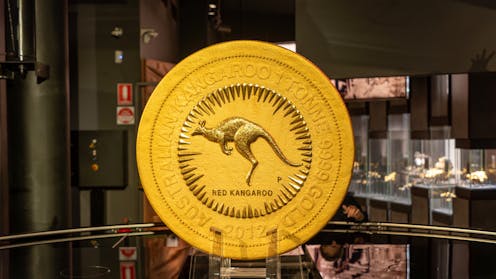
On the Australian one dollar coin, you will often find the famous representation of a mob of five kangaroos. But when did the kangaroo first appear on money?
My new research, published in the Australian Coin Review, tracks through history the iconic representation of kangaroos on numismatic items: coins, tokens, paper notes and other objects that can act as money to enable the effective trade of goods.
It turns out that the first representation of a kangaroo on money was not in Australia, but actually in England in 1795.
‘The kanguroo’
In 1795, Thomas Hall of City Road near Finsbury Square in London – a well known taxidermist and exhibitor of exotic animals – issued half penny tokens depicting three exotic animals: a kangaroo (spelt “The Kanguroo”), an armadillo, and a rhinoceros.
Trade tokens were used in the late 18th century in England (and also much of the 19th century in Australia and New Zealand) due to insufficient supplies of official coinage for small-scale transactions.
The depiction on Hall’s 1795 token was inspired by the painting The Kongouro from New Holland (1772) by the English painter George Stubbs.

Stubbs had been commissioned by the famous naturalist Sir Joseph Banks, based on an inflated skin of a kangaroo Banks had collected from the east coast of Australia during 1770. His sister, Sarah Sophia Banks, was an important collector of English tokens and ultimately bequeathed her entire collection of tokens to the British Museum.
The representation of a kangaroo with its head turned backwards looking over the shoulder on the Stubbs painting and the 1795 token is anatomically possible, but a less frequent depiction compared to a forward facing kangaroo common on modern coins.
Nevertheless, one kangaroo on our current dollar appears to hold a similar pose.
The Banks link
A McIntosh and Degraves Saw Mills, Tasmania, shilling token dated 1823 is one of Australia’s first and rarest numismatic items. It also represents a kangaroo looking over its shoulder.
An example of this rare token housed at Museums Victoria collection carries an attribution which says it was possibly minted at Boulton Mint in Soho, England.

If this is the case, the design may also be linked to the animal in the Stubbs painting.
Mathew Boulton from the Boulton Mint in England was a friend of Sir Banks, and the two men wrote to each other about the collection of Sarah Sophia Banks. The design element for representing kangaroos could have been passed on by Mathew Boulton to his son who ran the mint by the time the dated 1823 silver kangaroo token was made.
Thus the very first depictions of kangaroos on early money share links to Sir Banks and some of his contemporaries.
Tracing the evolution
A variety of depictions of kangaroos on trade tokens were employed during the 19th century in Australia.
Some, like the 1855 copper tokens from the John Allen General Stores in Jamberoo, New South Wales, are very rare and known by only a few surviving examples .
 John Allen General Stores (Jamberoo, NSW) token showing the Arms of New South Wales supported by a poorly formed kangaroo and emu.
Museums Victoria, CC BY
When I surveyed literature of known Australian tokens during the 19th century about 23% depicted a kangaroo – frequently as an incorporation into a coat of arms.
After federation, a distinctive official Australian currency emerged. This often used kangaroos as part of a coat of arms design.
 A mint state 1912 George V sixpence showing a representation of a forward facing kangaroo and emu as part of the coat of arms which was employed on all sixpence coins from 1911 through to 1963.
PGCS, Author provided (no reuse)
The first sixpence coins were issued in 1911 and carried a common design of a forward facing kangaroo and emu as part of the coat of arms through to 1963.
On florin coins, which were worth two shillings or 24 pennies in the pre-decimal money system that lasted up until 1966, the style was modernised from 1938 with a newer representation of a kangaroo and emu.
 A 1943 (S) Florin with coat of arms depicting a kangaroo was minted at the San Francisco Mint (USA) due to war time demand.
PCGS, Author provided (no reuse)
On pennies and half pennies from 1939 a forward facing kangaroo was the main reverse design and lasted until 1964 when pre-decimal currency began to be phased out.
New decimal currency was introduced on February 14 1966. Kangaroos appeared on the dollar note.
 A 1955(m) proof penny depicting a kangaroo. On half penny coins the kangaroo is shown bounding in the opposite direction.
PCGS, Author provided (no reuse)
The durability of the dollar note was short, however, meaning individual paper notes had to be frequently withdrawn from circulation and replaced. Production of one dollar notes was stopped in 1984.
The replacement dollar coins featuring the mob of kangaroos proved very durable, and 1984 examples of the coin can still be found in change today.
On our current decimal coins, that have been in use since the 1960s, the 50 cent piece shows another representation of a kangaroo and emu on the coat of arms that can be found in change over 50 years after their first release.
 The kangaroo and emu on the coat of arms has been on our 50 cent coins for over 50 years.
Wojciech Boruch/Shutterstock
Many decimal coins now have special issues featuring kangaroos, like the 2024 Paris Olympic Games two dollar coin series with fun kangaroos performing athletic tricks with icons of the Paris landscape in the backgound.
The kangaroo has truly become an iconic symbol of Australian numismatics, and now famous coins like the one tonne gold kangaroo coin at the Perth Mint are major tourist attractions showing how far we have come since the first representation in 1795.


