

Back to Back Theatre tackles an epic Shakespearian conflict – set in a factory, with cardboard props
- Written by The Conversation
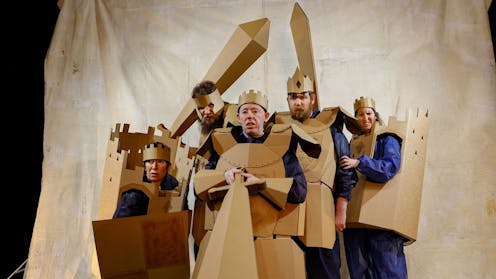
Back to Back Theatre is one of Australia’s national treasures. Over 30 years this dynamic Geelong-based company – an ensemble of actors who are perceived to have intellectual disabilities – has built a dynamic body of innovative work renowned for its formal experimentation.
Led by director Bruce Gladwin, the company is internationally acclaimed, including winning the International Ibsen Award in 2022 and the Venice Biennale Golden Lion for Lifetime Achievement in Theatre in 2024.
Commissioned by ACMI, Back to Back’s latest offering is a screen project that reenacts a section of Shakespeare’s Henry V: the battle of Agincourt.
Back to Back’s Agincourt draws from iconic film performances such as Laurence Olivier’s Henry V, but places the action in a factory in North Geelong. This industrial re-imagining is replete with hi-viz vests, concrete floors, and a very idiosyncratic costume design consisting of coats of armour made entirely out of cardboard.
Agincourt begins with the desperate English monarch Henry V (Sarah Mainwaring) calling to his exhausted troops to take up arms against the marauding French, who are marching determinedly down the suburban street towards them.
The English prepare for war, fortifying the factory space and gathering themselves for an inevitable onslaught, and a heinous confrontation ensues.
Language and time
More than 100 community members contributed to this work. A key aim was to ensure North Geelong residents and factory workers were given the opportunity to work as an artist, either in front of the camera or behind the scenes. The audition process included the proviso that every person made their own costume.
Gladwin works closely with cinematographer/editor Rhian Hinkley and the actors to employ the elements of language and time in very specific ways.
The performers’ natural speech patterns bring a real spaciousness in the vocal delivery to Shakespeare’s lines. There are also subtitles throughout the work.
At times a split screen is used which repeats action at slightly differing angles, often in extreme closeup.
These elements crystallise the audience’s focus, bringing a particular attention to the rich language of Shakespeare. We slow down, we read, we listen. We have time to let the words land, and to see the actors in their own unguarded, vulnerable moments.

The performances are strong. In particular, Mainwaring as a set-upon Prince Hal is compelling. Her laser stare is juxtaposed with a slightly wavering physicality which brings the first soliloquy into monumental, rousing proportion as she rallies the troops with the ominous pronouncement “We shall be remembered”.
Do-it-yourself aesthetic
Design and sound are front and centre in this 23-minute film. The actors worked with local company Boxwars to make their costumes and props, and Agincourt’s factory setting provides the background for the do-it-yourself aesthetic which features an impressive array of ornately decorated cardboard costumes.
Props are also made from cardboard and we see swirling maces, pointed lances, bows and arrows, and fearfully brandished swords. The detail is brilliant.
It is hard to describe the satisfaction of viewing a violent battle staged with cardboard – an inherently theatrical material which has the capacity to be firm and resilient but also to disintegrate spectacularly over time.
(If you aren’t aware of the delightful cardboard community that is Boxwars, I highly recommend checking out their numerous YouTube videos: you won’t be disappointed.)
A mythic, epic conflict
The idea of staging an epic conflict in such a playful way seems outrageous, but there is a mythic quality to the work – the call to arms, the messy scrabbling, the physicality – that transcends the silliness. In the end, there is a kind of gravitas to the action.
Over the course of the film, Agincourt moves from a grand and heroic sensibility to a sweaty, bloody depiction of war.
Helmeted riders on horses (made from old mattresses) are pushed into the fray amid forklifts, trolleys and pallets of yarn. Beautiful woven fabrics play backdrop to regal pronouncements as the bricked walls of this industrial space are transformed into a chaotic battlefield.

Gladwin uses his cast of thousands (and stunt directors) to great effect, creating phalanxes of archers raising bows in unison, or lines of soldiers in rows, swords at the ready.
These orderly patterns are juxtaposed with fight scenes which become more and more volatile as soldiers wade through pulped paper-mud and drag bodies across the concrete floor.
The sound design is suitably battle worn, accompanying the slow motion death scenes and bloodied faces with war cries, horses galloping and whinnying and the squelch of bodily disembowelment.
Towards the end of the film, the factory becomes, once again, a work space.
As the workers in this supported employment service go about their tasks – stripping mattresses, recycling materials, packaging kindling, objects deconstructed and re-purposed – a discussion ensues about how the workers want to be treated: as individuals … or as soldiers.
Agincourt can be read as a contemporary comment on the viciousness and futility of war. But it is also a charge to action for those whose influence has been underestimated.
Agincourt is at ACMI, Melbourne, until February 1 2026.


