

Can’t work out without music? Neither could the ancient Greeks and Romans
- Written by The Conversation
These days when you see people exercising, they’re usually also listening to music, whether they’re at the gym, or out jogging on the street.
It makes sense, as studies have shown listening to music can help you get the most out of a workout.
Somehow the ancient Greeks and Romans knew this too, long before modern science was there to back it.
A more than 2,000-year-old habit
In his oration To the People of Alexandria, the Greek writer Dio Chrysostom (40-110 CE) complained about a phenomenon he saw all the time.
Dio wrote people loved to listen to music in their daily activities. According to him, music could be found in the courtroom, in the lecture theatre, in the doctor’s room, and even in the gym.
“Everything is done to music […] people will presently go so far as to use song to accompany their exercise in the gymnasium,” Dio wrote.
But exercising to music wasn’t a new thing in his day. This practice has been recorded across the ancient Greek and Roman worlds from the earliest times, and as far back as the poems of Homer (circa 800 BCE).
Why exercise to music?
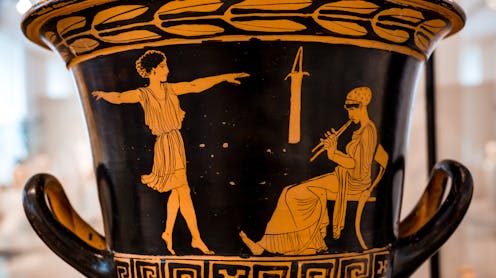
There are many depictions of professional athletes training, or competing, to the accompaniment of music in ancient Greek vase paintings.
In one vase painting from the 5th century BCE, a group of athletes trains while a musician plays the aulos, a type of ancient pipe instrument.

The ancient writer Plutarch of Chaeronea (46-119 CE) tells us music was also played while people wrestled or did athletics.
Athenian writer Flavius Philostratus (circa 170-245 CE) offers clues as to why. In a book about gymnastics, Philostratus wrote music served to stimulate athletes, and that their performance might be improved through listening to music.
Today’s researchers have proven this to be true. One 2020 study involving 3,599 participants showed listening to music during exercise had many benefits, such as reducing the perception of fatigue and exertion, and improving physical performance and breathing.
Singing and trumpets
Since ancient people didn’t have electronic devices, they found other ways to exercise to music. Some had music played by a musician during their exercise routine. Others sang while they exercised.
Singing while playing ball games was particularly popular. In Homer’s Odyssey (circa 8th century BCE), Nausicaa, the daughter of the King of Phaeacia, plays a ball game with her girl friends, and they all sing songs as they play.
Similarly, the historian Carystius of Pergamum (2nd century BCE) wrote the women of his time “sang as they played ball”.
Another popular activity was dancing to music. Dancing was widely regarded as a gymnastic exercise people could do for better health.
One famous advocate of the benefits of dancing as exercise was the great Athenian philosopher Socrates (circa 470-399 BCE). According to the historian Diogenes Laertius (3rd century CE), “it was Socrates’ regular habit to dance, thinking that such exercise helped to keep the body in good condition”.

Apart from individuals using music in their personal exercise, soldiers also did training exercises, and marched to battle, to the sound of trumpets.
Don’t skip leg day
There was a belief in ancient Greek and Roman that music and exercise played an important role in shaping and developing the body and soul.
The ideal was harmony and moderation. The body and soul needed to be balanced and proportionate in all their parts, without any excess. As such, doing one kind of exercise too often, or exercising one body part excessively, was frowned upon.
The physician Galen of Pergamum (129-216 CE) criticised types of exercise that focused too much on one part of the body. He preferred ball games as they exercised the whole body evenly.
Immoderation in music – that is, listening to too much, or listening to music that was too emotional – was also sometimes frowned upon.
For example, the Athenian philosopher Plato (circa 428-348 BCE) famously argued most music should be censored as it can stir the passions too strongly. Plato thought only simple and unemotional music, listened to in moderation, should be allowed.
If the ancients could see today’s people running along the pavement with music thumping in their ears, they would surely be amazed. And they’d probably approve – as long as it wasn’t being done in excess.


