

Cycling can be 4 times more efficient than walking. A biomechanics expert explains why
- Written by The Conversation
You’re standing at your front door, facing a five kilometre commute to work. But you don’t have your car, and there’s no bus route. You can walk for an hour – or jump on your bicycle and arrive in 15 minutes, barely breaking a sweat. You choose the latter.
Many people would make the same choice. It’s estimated that there are more than a billion bikes in the world. Cycling represents one of the most energy-efficient forms of transport ever invented, allowing humans to travel faster and farther while using less energy than walking or running.
But why exactly does pedalling feel so much easier than pounding the pavement? The answer lies in the elegant biomechanics of how our bodies interact with this two-wheeled machine.
A wonderfully simple machine
At its heart, a bicycle is wonderfully simple: two wheels (hence “bi-cycle”), pedals that transfer power through a chain to the rear wheel, and gears that let us fine-tune our effort. But this simplicity masks an engineering that perfectly complements human physiology.
When we walk or run, we essentially fall forward in a controlled manner, catching ourselves with each step. Our legs must swing through large arcs, lifting our heavy limbs against gravity with every stride. This swinging motion alone consumes a lot of energy. Imagine: how tiring would it be to even swing your arms continuously for an hour?
On a bicycle, your legs move through a much smaller, circular motion. Instead of swinging your entire leg weight with each step, you’re simply rotating your thighs and calves through a compact pedalling cycle. The energy savings are immediately noticeable.
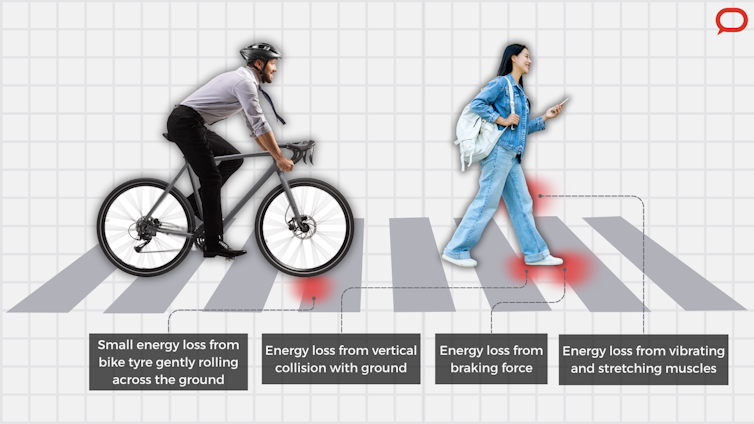
But the real efficiency gains come from how bicycles transfer human power to forward motion. When you walk or run, each footstep involves a mini-collision with the ground. You can hear it as the slap of your shoe against the road, and you can feel it as vibrations running through your body. This is energy being lost, literally dissipated as sound and heat after being sent through your muscles and joints.
Walking and running also involve another source of inefficiency: with each step, you actually brake yourself slightly before propelling forward. As your foot lands ahead of your body, it creates a backwards force that momentarily slows you down. Your muscles then have to work extra hard to overcome this self-imposed braking and accelerate you forward again.
Kissing the road
Bicycles use one of the world’s great inventions to solve these problems – wheels.
Instead of a collision, you get rolling contact – each part of the tyre gently “kisses” the road surface before lifting off. No energy is lost to impact. And because the wheel rotates smoothly so the force acts perfectly vertically on the ground, there’s no stop-start braking action. The force from your pedalling translates directly into forward motion.
But bicycles also help our muscles to work at their best. Human muscles have a fundamental limitation: the faster they contract, the weaker they become and the more energy they consume.
This is the famous force-velocity relationship of muscles. And it’s why sprinting feels so much harder than jogging or walking – your muscles are working near their speed limit, becoming less efficient with every stride.
Bicycle gears solve this problem for us. As you go faster, you can shift to a higher gear so your muscles don’t have to work faster while the bike accelerates. Your muscles can stay in their sweet spot for both force production and energy cost. It’s like having a personal assistant that continuously adjusts your workload to keep you in the peak performance zone.
Walking sometimes wins out
But bicycles aren’t always superior.
On very steep hills of more than about 15% gradient (so you rise 1.5 metres every 10 metres of distance), your legs struggle to generate enough force through the circular pedalling motion to lift you and the bike up the hill. We can produce more force by pushing our legs straight out, so walking (or climbing) becomes more effective.
Even if roads were built, we wouldn’t pedal up Mount Everest.
This isn’t the case for downhills. While cycling downhill becomes progressively easier (eventually requiring no energy at all), walking down steep slopes actually becomes harder.
Once the gradient exceeds about 10% (it drops by one metre for every ten metres of distance), each downhill step creates jarring impacts that waste energy and stress your joints. Walking and running downhill isn’t always as easy as we’d expect.
Not just a transportation device
The numbers speak for themselves. Cycling can be at least four times more energy-efficient than walking and eight times more efficient than running. This efficiency comes from minimising three major energy drains: limb movement, ground impact and muscle speed limitations.
So next time you effortlessly cruise past pedestrians on your morning bike commute, take a moment to appreciate the biomechanical work of art beneath you. Your bicycle isn’t just a transport device, but a perfectly evolved machine that works in partnership with your physiology, turning your raw muscle power into efficient motion.


