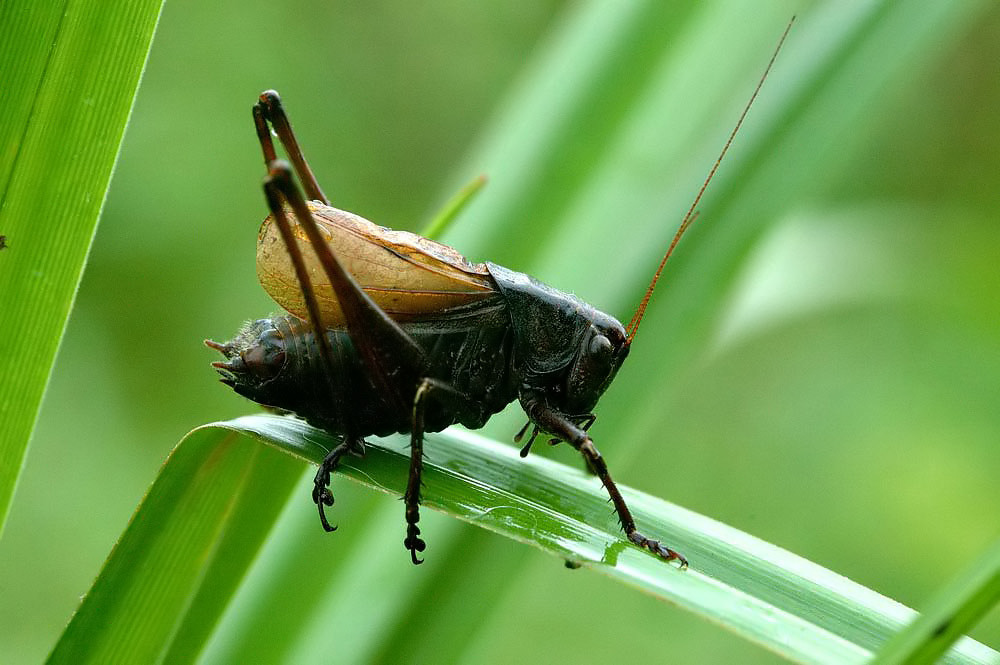
I created a Vivaldi-inspired sound artwork for the Venice Biennale. The star of the show is an endangered bush-cricket
- Written by The Conversation
It was late January when I got the call. I’m asked to bring my sound art to a collaborative ecology and design project, Song of the Cricket, for the Venice Biennale of Architecture. When such as invitation arrives, you have no choice but to jump in.
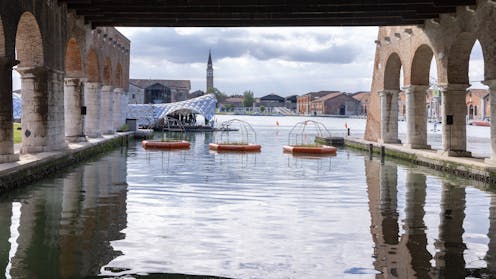
I see an image of the site for the project: the Gaggiandre at the Arsenale – a medieval shipyard that serviced the Venetian military at its imperial peak.
Once a resplendent hive of industry, it is even detailed by Dante Alighieri in The Divine Comedy:
As in the arsenal of the Venetians, all winter long a stew of sticky pitch boils up to patch their sick and tattered ships that cannot sail (instead of voyaging, some build new keels, some tow and tar the ribs of hulls worn out by too much journeying; some hammer at the prow, some at the stern, and some make oars, and some braid ropes and cords; one mends the jib, another, the mainsail)
The Gaggiandre is a cavernous, church-like space flanked by stone colonnades, wooden roof beams, and situated, in true Venetian style, on a bed of water. With long reverberation times, music in this space would need to be slowly unfolding, drawing the listener in and inviting them to meditate.
It is a place of reflection, both metaphorically and physically. To a sound artist, creating for the Gaggiandre is a dream.
Art and the Anthropocene
The Song of the Cricket exhibit has been on display at the Biennale since May. Its purpose is to bridge ecological research with sound art to raise awareness for our fragile biodiversity, with a focus on the critically endangered Adriatic bush-cricket, Zeuneriana marmorata.

What better place than Venice – a city slowly sinking – to reflect on where we stand in this moment of environmental collapse?
The exhibit was created by a large team of collaborators. It features several mobile habitats populated with Zeuneriana. Some of these habitats sit on the Arsenale lawn, while other symbolic habitats float on the water as life rafts. Alongside the enclosures, my pre-composed “sound garden” plays through speakers onto the lawn.
At the end of the Biennale, the team, led by landscape architect and ecologist Alex Felson, intends to use the life rafts to ceremonially transport incubated eggs to a new home on the mainland.

Sounds of nature and Vivaldi
On the lawn, the chirrup of live courting bush-crickets blends with pre-recorded sounds of their ancestors. These ancestral sounds might double as a lullaby for newly orphaned eggs, as adults only live a few months.
The accompanying sound garden is richly diverse, created from an array of fauna sounds drawn from Northern Italian wetland environments, including the Eurasian reed warbler, the cuckoo and, my personal favourite, the green toad.
My intention is for the soundscape to transport audiences to a different time and place: to a future where these species thrive in a healthy ecology.
There is a second element to the sound installation, created with support from sound technologist Monica Lim. Informed by the music of Antonio Vivaldi, this element serves to further activate the untapped airspace and enhance visitors’ experience of the site.
Born in Venice in 1678, Vivaldi is a ubiquitous and avoidable cliché for locals. Yet his music was the perfect inspiration for this project, as it encodes a hidden ecological story.
Vivaldi incorporated the literal sounds of nature into The Four Seasons (1723), with particular species’ songs annotated onto the score.
The Song of the Cricket borrows elements from Vivaldi’s Summer: Allegro non Molto. In the short section I drew from, the cuckoo, turtledove and goldfinch are all musically described and credited by Vivaldi.
And although they are not expressly mentioned, I imagine bush-crickets also pervade Vivaldi’s Summer movement, as we know they were once prolific in the Venice lagoon, and would have filled the summer air during his lifetime. You might hear them in the rapidly repeating (tremolo) string gestures.
The cricket’s song serves as a indicator of an ecosystem’s health. But the sound of crickets in Venice today is largely missing.
Our take on Vivaldi is slowed down 30 times, magnified and fragmented, voiced through synthesizers, and piped into the Gaggiandre through five speakers – creating an immersive experience that feels at once futuristic and Baroque.
 Mobile habitats awaiting the Zeuneriana marmorata eggs float on the water.
Marco Zorzanello
Bridging the past and an imagined future
The decision to borrow from music of the Western historical canon (in this case Vivaldi) fits into a burgeoning movement that composer Valentin Silvestrov coined “eschatophony”.
This is presumably a portmanteau of “eschatology”, the study of the end of the world, and “phony”, which in this case relates to sound (such as symphony). Here, we are left only to wrestle with and re-contextualise our musical past, to create “echoes of history”.
The inclusion of sound is still a novelty at the architecture Biennale. Of the 300 exhibits this year, I can count on one hand the projects that incorporated sound. All of them were special.
Sound creates a remarkable theatre, both through its immediacy, as well as its capacity to elevate a project beyond the prosaic, into the poetic.
Venice is a city where history pervades at every turn. The Song of the Cricket invites listeners in, offering them space to reflect, and to imagine a future where ecosystems might once again thrive.
This article is part of Making Art Work, our series on what inspires artists and the process of their work.