

Thinking of trekking to Everest Base Camp? Don’t leave home without this expert advice
- Written by The Conversation
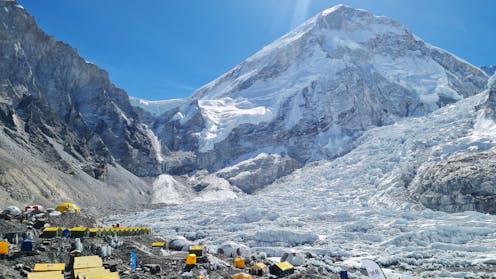
Tourists in Kathmandu are tempted everywhere by advertisements for trekking expeditions to Everest Base Camp. If you didn’t know better, you might think it’s just a nice hike in the Nepalese countryside.
Typically the lower staging post for attempts on the summit, the camp is still 5,364 metres above sea level and a destination in its own right. Travel agencies say no prior experience is required, and all equipment will be provided. Social media, too, is filled with posts enticing potential trekkers to make the iconic journey.
But there is a real risk of creating a false sense of security. An exciting adventure can quickly turn into a struggle for survival, especially for novice mountaineers.
Nevertheless, Sagarmatha National Park is deservedly popular for its natural beauty and the allure of the world’s highest peak, Chomolungma (Mount Everest). It is also home to the ethnically distinctive Sherpa community.
Consequently, the routes to Everest Base Camp are among the busiest in the Himalayas, with nearly 60,000 tourists visiting the area each year. There are two distinct trekking seasons: spring (March to May) and autumn (September to October).
High mountains require everyone to be properly prepared. Events which under normal conditions might be a minor inconvenience can be magnified in such an environment and pose a serious risk.
Even at the start of the trek in Lukla (2,860m), one is exposed to factors that can directly or indirectly affect one’s health, especially altitude mountain sickness or unfamiliar bacteria.
We interviewed 24 trekkers in May this year, as well as 60 residents and business owners in May 2023, to explore some of the safety issues anyone considering heading to base camp should be aware of.
Life at high altitude
First, it’s vital to choose goals within one’s technical and physical capabilities. While the human body can adapt to altitudes of up to 5,300m, the potential risk of altitude mountain sickness can occur at only 2,500m – lower than Lukla.
Proper acclimatisation above 3,000m means ascending no more than 500m a day and resting every two to three days at the same altitude. The optimal (though rarely followed) approach is the “saw tooth system” of climbing during the day but descending to sleep at a lower level.
Residents of the Khumbu region (on the Nepalese side of Everest) are familiar with the problem of tourists not acclimatising, or not paying attention to their surroundings. As one hotel owner said, pointing to a trekker setting out:
He’s going uphill and it’s already late. It’s going to get dark and cold soon. He won’t make it to the next settlement. We have to report this to the authorities or go after him ourselves.
Inexperienced trekkers should hire a local guide. Several we interviewed had needed medical evacuation, including a woman in her mid-20s who had to leave base camp after one night. She found her guides – not locals – online. But they never checked her vital signs during the trek:
[The doctors] said that I had high-altitude pulmonary edema […] it was just really important to come down the elevation. And if I had tried to go higher, it probably would have been really bad.
Health checks throughout the trek are imperative. This includes assessing the four main symptoms of altitude mountain sickness: headache, nausea, dizziness and fatigue. If they appear, the trekker shouldn’t go higher and might even need to descend.
Take time to adapt
Using a reputable local trekking agency might be more expensive, but it will help ensure safety and also familiarise the visitor with the local culture, helping avoid negative impacts on the host community.
Too often, the primary goal of trekkers is a photo on the famous rock at base camp. Once obtained, many simply take a helicopter back to Kathmandu. As a helicopter tour agency owner said:
They don’t want to get back on their feet. The goal, after all, has been achieved. In general, tourists used to be much better prepared. Now they know they can return by helicopter.
Helicopter travel can be dangerous on its own, of course. But this tendency to view the trek as a one-way trip also affects host-guest relations and can irritate local communities.
It’s also important to monitor your food and drink intake and watch for signs of food poisoning. Diarrhoea at high altitudes is particularly dangerous because it leads to rapid dehydration – hard to combat in mountain conditions.
Low air pressure and reduced oxygen exacerbate the condition, weakening the body’s ability to recover. Also, the symptoms of dehydration can resemble altitude mountain sickness.
When travelling in other climate zones or countries with different sanitary standards, there is inevitable contact with strains of bacteria not present in one’s natural microbiome.
A good solution is to spend a few days naturally adapting to bacterial flora at a lower altitude in Nepal before heading to the mountains. Also, try to eat the local food, such as daal bhat, Nepal’s national dish. According to one hotel owner in Pangboche:
Tourists demand strange food from us – pizza, spaghetti, Caesar salad – and then are angry that it doesn’t taste the way they want. This is not our food. You should probably eat local food.
Most of the trekkers we interviewed during this spring season reported experiencing gastrointestinal issues, often for several days.
Overall, diarrhoea-related infections are the leading cause of illness among travellers, including base camp trekkers. Studies conducted in the Himalayas show as many as 14% of mountain tourists contract gastroenteritis, accounting for about 10% of all helicopter evacuations.
In the end, the commonest cause of failure or accident in the mountains is overestimating one’s abilities – what has been called “bad judgement syndrome” – when the route is too hard, the pace too fast, or there’s been too little time spent acclimatising.
A simple solution: walk slowly and enjoy the views.


