

After 70 years, twisted gothic thriller The Night of the Hunter remains as disturbing and beguiling as ever
- Written by The Conversation
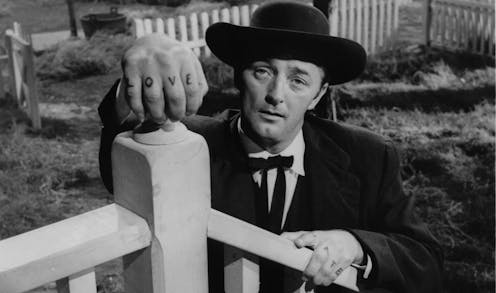
In 1955, director Charles Laughton crafted one of the darkest, strangest fairytales ever to come out of Hollywood. The Night of the Hunter remains visually exquisite and profoundly unsettling.
Shortly before Ben Harper is hanged for robbing a bank and killing two men, he hides the $10,000 loot in the toy doll of his young daughter Pearl. Only Pearl and her brother John know the secret – until the deranged serial killer-priest Harry Powell hears about the money and sets out to recover it.
Harry marries Willa, Harper’s widow, and then, after killing her, pursues John and Pearl relentlessly across West Virginia.
Set in the Depression-hit 1930s, The Night of the Hunter is, to quote film critic Pauline Kael, “one of the most frightening movies ever made”. Mitchum’s depiction of pure evil is one of cinema’s most vivid creations, with LOVE and HATE tattooed on the fingers of each hand.
But this is no simple chase film. It’s about the fight for the souls of two children between the forces of evil and good.
Gothic nightmares
Laughton was an odd choice to adapt Davis Grubb’s original 1952 novel – the Oscar-winning British actor had never directed before. Yet Laughton’s “outsider” status meant he wasn’t bound by Hollywood convention and could follow his surreal instincts.
The film draws heavily from German Expressionist cinema, especially in the use of stark black-and-white contrast and exaggerated shadows. Cinematographer Stanley Cortez described it as his best work, and rightly so: the film often feels more like a dream (or a nightmare).
Laughton and Cortez craft a series of remarkable images: Pearl and John fleeing down the river, watched over by owls, frogs and rabbits; Powell’s looming shadow cast across a bedroom wall; the slain Willa’s blonde hair floating under the river after her death.
The film is deeply allegorical. It plays with Christian imagery, ideas of sin and salvation and the vulnerability of the innocent.
Laughton’s masterstroke was to pit the predatory adult world against the instinctual wisdom and resilience of children.
Powell (played by Robert Mitchum in his greatest role) is no monster or madman, but a religious fanatic who murders under the guise of righteousness. He embodies the Gothic trope of the corrupt or false preacher. His looming menace turns small-town America into a place of paranoia, dread and moral confusion.
Rachel Cooper (the silent film star Lillian Gish, never better), who protects the children in the second half of the film, stands as the maternal, angelic counterpoint to Powell’s demonic figure. Her role emphasises another key point of the film: the redemptive, almost sacred, power of kindness.
A perfect performance
As Powell, Mitchum drew on his uncanny knack at exuding charm and menace. Many actors would have clashed with Laughton’s expressionistic style, but Mitchum hit the perfect tone: heightened and theatrical, but never camp.
His delivery is hypnotic, musical and terrifying.
At a time when many stars were protective of their public image, Mitchum had no problem playing a child-killing religious maniac.
Known for his rebellious streak and brushes with scandal (including a marijuana arrest in 1948), Mitchum wasn’t bound by Hollywood’s moral expectations. That gave him the freedom to push into darker territory with no vanity.
That moral delusion, delivered with conviction, is what makes Powell so frightening. Mitchum’s Powell anticipates later predators like Norman Bates (Psycho) or Max Cady (the role he would play in the 1962 version of Cape Fear), but he also echoes much older archetypes: the Big Bad Wolf, the false prophet and the devil in a black coat.
A flop turned masterpiece
The film was a critical and commercial failure. Laughton’s bold and unconventional choices were risky. His blend of German Expressionism, Southern Gothic Americana and psychological horror was unlike anything American cinema had seen before.
It did not align with the mainstream tastes of the era – the top grossing Hollywood films of 1955 were family-friendly, comforting offerings like Oklahoma! and Lady and the Tramp.
Audiences and reviewers didn’t know what to make of this abnormal mix of fairy tale logic, nightmarish imagery and biblical allegory.
So heartbroken was Laughton by the savage reception the film received (“a horrible yarn […] a repulsive picture”, one reviewer called it), he never directed again. Yet the reputation of his one-hit wonder has only grown over time.
Successive generations of critics and filmmakers have caught on to its brilliance. Critic Roger Ebert said it was “one of the greatest of all American films”. In 2008, French film magazine Cahiers du cinéma voted it as the second-best film of all time, behind only Citizen Kane (1941).
A long-lasting legacy
Margaret Atwood, David Lynch and the Coen Brothers have all cited the film as a major influence. Spike Lee paid homage to LOVE and HATE in Do The Right Thing (1989). And surely James Cameron admired it, for what is Terminator 2 (1991) if not a rehash of Powell’s insistent chase-down of children?
Its depiction of a charming, violent manipulator speaks to contemporary fears about religious hypocrisy and the abuse of moral authority. And it reminds us the bucolic innocence of rural America can hide evil in plain sight.
It’s often the case that films which are misunderstood on first release are ahead of their time, and never fully appreciated until many years later.
That’s the case with The Night of the Hunter. It remains unsettlingly modern, 70 years on.


