

This stone tool is over 1 million years old. How did its maker get to Sulawesi without a boat?
- Written by The Conversation
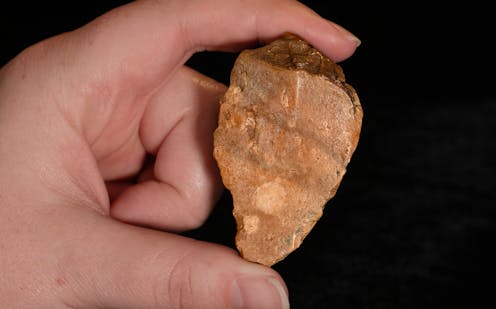
Stone tools dating to at least 1.04 million years ago have been found on the Indonesian island of Sulawesi. This means early hominins made a major sea crossing from the Asian mainland much earlier than previously thought – and they likely didn’t have any boats.
This discovery, made by a team of Indonesian archaeologists working in collaboration with Australian researchers, is published today in Nature.
It adds to our understanding of how extinct humans once moved across the Wallace Line – an imaginary boundary that runs through the Lombok Strait in the Indonesian archipelago.
Beyond this line, unique and often peculiar animal species – including hominins – evolved in isolation.
Hominins in Wallacea
The oceanic island zone between the Asian and Australian landmasses is known as Wallacea.
Previously, archaeologists have found hominins lived here from at least 1.02 million years ago, thanks to discoveries of stone tools at Wolo Sege on the island of Flores. Meanwhile, tools dated to around 194,000 years ago have been found at Talepu on Sulawesi.

The human evolutionary story in the islands east of the Asian landmass is strange.
The ancient human species that used to live on the island of Flores were small in stature. We know this thanks to the fossils of Homo floresiensis (popularly known as “hobbits”), as well as the 700,000-year-old fossils of a similar small-bodied hominin.
These discoveries suggest it could have been the extinct Asian hominin Homo erectus that breached the formidable marine barrier between this small Wallacean island and mainland Southeast Asia. Over hundreds of thousands of years, their body size reduced in what’s known as island dwarfism.
To the north of Wallacea, the island of Luzon in the Philippines has also yielded evidence of hominins from around 700,000 years ago. Just recently, fossils of a previously unknown diminutive hominin species, Homo luzonensis, were found here.
So how and when did ancient human species cross the Wallace Line?
The Sulawesi stone tools
Our new study reveals the first evidence a sea crossing to Sulawesi may have happened at least 1 million years ago. That’s much earlier than previously known, and means humans reached here at about the same time as Flores, if not earlier.
A field team led by senior archaeologist Budianto Hakim from the National Research and Innovation Agency of Indonesia (BRIN), excavated a total of seven stone artefacts from the sedimentary layers of a sandstone outcrop in a modern corn field at Calio in southern Sulawesi.

In the Early Pleistocene, there was a river channel nearby. This would have been the site of hominin tool-making and other activities such as hunting.
The Calio artefacts consist of small, sharp-edged fragments of stones (flakes) that the early human tool-makers struck from larger pebbles they most likely found in nearby riverbeds.
To produce these flakes, the hominins hit the edge of one stone with another in a controlled manner. This would fracture the first stone in a predictable way.
This tool-making activity left telltale marks on the stones that can be clearly distinguished from naturally broken rocks. So we can say unequivocally that hominins were living in this landscape, making stone tools, at the time the ancient river sediments that comprise the sandstone rock were accumulating.
And that was a very long time ago. Indeed, the team confirmed an age of at least 1.04 million years for the stone artefacts based on paleomagnetic dating of the sandstone itself, along with direct dating of a pig fossil found alongside the artefacts.
 Excavations at the Early Pleistocene site of Calio in South Sulawesi, Indonesia.
BRIN
Excavations at the Early Pleistocene site of Calio in South Sulawesi, Indonesia.
BRIN
Who were these hominins and how did they get to Sulawesi?
As noted earlier, previous research has shown that archaic, stone tool-making hominins managed to get across from the Asian continental landmass to colonise at least some islands in Wallacea.
The discovery of the extremely old stone tools at Calio is another significant new piece of the puzzle. This site has yet to yield any hominin fossils, however. So while we now know there were tool-makers on Sulawesi 1 million years ago, their identity remains a mystery.
Indeed, there are many fascinating questions that remain unanswered, including how these hominins were able to cross the Wallace Line in the first place.
When sea levels were at their lowest, the shortest possible distance between Sulawesi and the nearest part of the adjacent Asian landmass would have been about 50 kilometres.
This is too far to swim, especially since the ocean currents are far too strong. It’s also unlikely these archaic hominins had the cognitive ability to develop watercraft capable of making sea voyages. Setting sail over the horizon to an unseen land would have required advanced planning to gather resources – something they probably weren’t capable of.
Most likely, then, they crossed to Sulawesi from the Asian mainland in the same way rodents and monkeys are suspected to have done – by accident. Perhaps they were castaways on natural “rafts” of floating vegetation.
Our discovery also leads us to wonder what might have happened to Homo erectus on the world’s 11th largest island. Sulawesi is more than 12 times the size of Flores, and much closer to the adjacent Asian mainland.
In fact, Sulawesi is a bit like a mini-continent in itself, which sets it apart from other Wallacean islands. If hominins were cut off in the ecologically rich habitats of this enormous island for a million years, would they have undergone the same evolutionary changes as the Flores hobbits? Or might something completely different have happened?
To unravel this fascinating story, we will continue to search the islands of Wallacea – especially those close to the Asian mainland – for ancient artefacts, fossils and other clues.


