

Dagger beaks and strong wings: new fossils rewrite the penguin story and affirm NZ as a cradle of their evolution
- Written by The Conversation
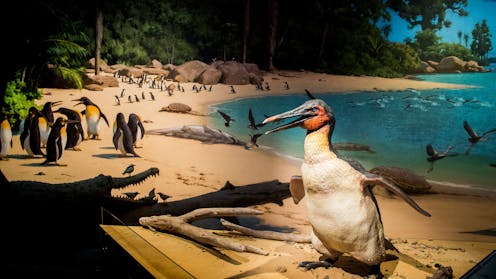
Remarkable new fossil discoveries in New Zealand are driving a significant reassessment of our understanding of the early evolution of penguins.
We know Antarctica was home to at least ten species, including giant penguins, during the Eocene epoch from about 56 to 34 million years ago.
Now, our latest findings based on fossils from a site in North Canterbury reveal an even richer and earlier period of diversification.
These discoveries are reshaping the 66-million-year story of how penguins evolved in the wake of the devastating Cretaceous-Paleogene mass extinction which followed the cataclysmic asteroid impact that wiped out most dinosaurs and many terrestrial and marine organisms.
For a long time, the early evolutionary journey of penguins remained largely shrouded in mystery. The fossil record for these seabirds was very sparse, particularly for the crucial period immediately after the mass extinction event.
This made it difficult to piece together how and where penguins first developed their distinctive aquatic adaptations. Our previous knowledge was limited to a mere handful of specimens, revealing only fragments of the group’s deep past.
But the new fossils help us track how penguins evolved from their earliest ancestors into the iconic divers we recognise today.
The Waipara Greensand: a palaeontological goldmine
An hour north of Christchurch in New Zealand’s South Island, North Canterbury’s Waipara Greensand is a true palaeontological treasure trove.
This unique geological formation spans a critical time period from about 62.5 million to 58 million years ago. Historically, it yielded few vertebrate fossils. But recent intensive collecting efforts have unearthed multiple exceptionally preserved specimens of ancestral penguins as well as of the earliest known representatives of other marine bird lineages, including tropicbirds and extinct bony-toothed birds.
Our latest study reports on a wealth of new ancestral penguins from this locality. We’ve identified four new species that lived around 62 million to 57 million years ago, during the Paleocene. These range from just bigger than little penguins to the size of an emperor penguin.
Crucially, we also found significant new material for known ancient species, including the first complete skull of Muriwaimanu tuatahi, one of the earliest described penguin species from the Waipara Greensand. These remarkable fossils significantly expand the known diversity and size range of early penguins.
The Waipara Greensand fauna now includes at least ten distinct penguin species, with the biggest standing about 1.6 metres tall. These primitive penguins likely emerged after the extinction of large marine reptiles, suggesting they may have flourished by capitalising on newly opened ecological niches, free from formidable mammalian competitors or predators.
The evolution of diving adaptations
Our findings show early penguin evolution primarily focused on profound changes to their wings, pectoral girdle (shoulder bones) and feet. All were optimised for powerful underwater propulsion.
Unlike their modern counterparts, these early forms likely possessed more flexible, “auk-like” wings with a movable carpal joint, rather than the rigid, stiff flippers we see today.
A key piece of evidence comes from the humerus (upper arm bone). The earliest species had a shorter attachment point for the supracoracoideus muscle. This lengthened progressively in later species, providing compelling evidence of increasing specialisation for wing-propelled diving, as this muscle is crucial for elevating the wing during the powerful underwater stroke.
These rapid evolutionary changes in the wing apparatus during the Paleocene likely represented a major adaptive leap. It paved the way for further radiations of penguins later in the Eocene.
Intriguingly, these early forms sported exceptionally long, dagger-like beaks, suggesting a vastly different feeding strategy compared to modern penguins. It possibly involved spearing fish rather than actively pursuing prey with shorter, more robust beaks.
This represents a profound shift in feeding ecology that unfolded over millions of years. The beak length remained surprisingly stable for more than 20 million years during early penguin evolution while limb morphology was refined rapidly.
In a truly exciting discovery, we also recorded gastroliths (stomach stones) for the first time in these ancient penguins. Living penguins ingest these stones regularly, and the finding offers vital clues about the diet and potentially the buoyancy control of ancient species.
New Zealand as a cradle of penguin evolution
The succession of increasingly more modern looking penguin forms found within the Waipara Greensand fossils supports New Zealand as a critical region for penguin evolution.
The newly discovered species span a broad range, with some of the oldest forms also being the smallest. This suggests early forms were likely outcompeted by later, more advanced ones, indicating strong selective pressures drove early penguin evolution.
New Zealand’s ancient environment, characterised by a notable absence of larger terrestrial predators, likely provided a setting conducive to the evolution of flightlessness in various avian lineages, including penguins.
The refinement of the wing apparatus probably enabled these early penguins to disperse beyond the New Zealand region towards the late Paleocene, colonising new waters.
The Waipara Greensand stands as one of the most productive fossil sites globally for understanding the earliest stages of penguin evolution. This locality promises to deliver more discoveries and further enrich our understanding of how these iconic seabirds came to be.
The authors thank Gerald Mayr at the Senckenberg Research Institute and Museum in Frankfurt for his help in preparing this article.


