

Impressive performances and production values – but Joanna Murray-Smith’s The Talented Mr. Ripley doesn’t quite land
- Written by The Conversation
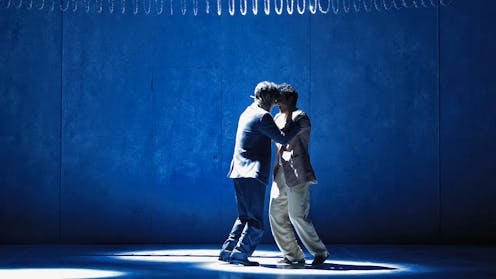
Playwright Joanna Murray-Smith has a long held fascination with the brilliance of Patricia Highsmith, who published the classic novel The Talented Mr. Ripley in 1955.
In 2014, Murray-Smith’s Switzerland explored Highsmith’s life, directed by Sarah Goodes for the Sydney Theatre Company. Now, Goodes directs Murray-Smith’s new adaptation of Highsmith’s novel, continuing their engagements with the author’s morally ambiguous characters.
Murray-Smith describes Tom Ripley as “the world’s most famous serial killer […] waiting for his moment in the spotlight”. And while this accolade could be disputed, it reveals Murray-Smith’s fascination with the psychological and ethical complexities of the Ripley novel.
The story follows Ripley (played neatly and commendably by Will McDonald), a man in his 20s who lost his parents young and was raised by a poor but nasty aunt.

A surprise encounter sees Ripley sent to Europe by a wealthy shipping magnate (astutely played by Andrew McFarlane) to bring back his wayward son, Dickie Greenleaf (Raj Labade) – an inciting incident not unlike Henry Jame’s novel The Ambassadors. The publisher describes the novel as “a blend of the narrative subtlety of Henry James and the self-reflexive irony of Vladimir Nabokov”.
In Italy, Ripley becomes thoroughly enamoured with Greenleaf and his glamorous life. Labade plays the laid-back Greenleaf with spades of charm and panache, and Claude Scott-Mitchell plays Greenleaf’s girlfriend, Marge, with tremendous poise, increasingly wary of the interloping Ripley.
Mr. Ripley’s “talent” is mimicking others, and he starts using his talent to take over Dickie’s identity.
As Ripley and Greenleaf take vacations around Italy, Ripley’s deceptions graduate to murder and identity theft. While his motives are framed around class envy, he seems motivated more by the dread of returning to his mundane life.
Ripley does not commit murder because he wants to become Dickie Greenleaf, so much as he assumes Dickie Greenleaf’s identity because this proves the most expedient way of escaping his despised past.

A filmic production
The performances and production values are impressive, but the play itself does not quite land. The inescapable need for Ripley to narrate his own tale directly to the audience breaks the golden rule of theatre: show don’t tell. As Anton Chekhov reputedly said, “Don’t tell me the moon is shining. Show me the glint of light on broken glass.”
The need for pace and momentum sees the narration interspersed with performed vignettes, rather than fuller dramatic scenes. This becomes more filmic than theatrical, lacking tension, dramatic stakes, subtext and climax.
Ripley’s backstory seems important to his psychology, but the snippets we receive didactically through narration make his motives seem trite. When Tom crumples to the floor and sobs because Dickie Greenleaf doesn’t see him, it is difficult to connect with: framed as a standalone vignette that arises from nowhere.
 The narration is interspersed with performed vignettes, rather than dramatic scenes.
Prudence Upton/Sydney Theatre Company
The narration is interspersed with performed vignettes, rather than dramatic scenes.
Prudence Upton/Sydney Theatre Company
Unlike Shakespeare’s disgruntled villains Richard III and Edmond the Bastard, it is difficult to accept Ripley’s motives. Perhaps if Ripley was given more charismatic soliloquies of self-justification like Richard and Edmond, we could better attend his plight.
The bare set offers dynamic opportunities for clever stagecraft and lighting (sets by Elizabeth Gadsby, lighting by Damien Cooper), helping to facilitate these quick vignettes (sunny umbrellas for the beach, snazzy lights for a nightclub, a yellow dinghy for an ocean jaunt). But these values only add to the filmic effect.
Good theatre should do things films can’t do, not emulate their fluent realism.
Reworking old stories
The artistic genesis of this adaptation seems to gratify a programming trend more than an ardent need to tell this particular story.
It has been unnerving to see so many adaptations staged by major theatre companies of late. In recent years, the Sydney Theatre Company has staged many adaptations of novels: Bram Stoker’s Dracula (2024), Pip Williams’ The Dictionary of Lost Words (2023), Nevil Shute’s On the Beach (2023), Wong Shee Ping’s The Poison of Polygamy (2023), and Ruth Park’s Playing Beatie Bow (2021), to name a few.
In 2019, playwright Ross Mueller critiqued this trend of “risk-averse programming”, acknowledging that “selling new plays is tough”, but noting it’s much easier for theatre companies if playwrights “can write plays with titles that we can all google”.
Today’s playwrights, Muller writes, “compete for programming with films, novels and fully developed and proven Broadway hits and West End darlings”. And this unusual demand for adaptations comes on the back of staging less Shakespeare to make room for new plays by local writers.
 Tom Ripley is played neatly and commendably by Will McDonald.
Prudence Upton/Sydney Theatre Company
Tom Ripley is played neatly and commendably by Will McDonald.
Prudence Upton/Sydney Theatre Company
Some of these adaptations have worked, drawing critical acclaim and box office success. But it seems short shrift to have so much narration in a theatrical adaptation of a novel. Would we not rather buy and read the novel? And save our precious theatre pennies for attending new original plays or classics?
Those familiar with the book might enjoy yet another rendition, but this The Talented Mr. Ripley moves too swiftly through its plot points; telling the story, but scant on forging connections with the audience.
The Talented Mr. Ripley is at the Sydney Theatre Company until September 28, then Arts Centre Melbourne from October 28 to November 23.


