News Daily


Men's Weekly

Australia

  • Written by The Conversation
Why capping food prices won't work – and will actually make things worse

Australian shoppers are facing a crisis in the fresh-food aisles.

Iceberg lettuces that cost $2.80 a year ago have doubled, or tripled, in price. Brussel sprouts that cost $4 to $6 a kilogram are now $7 to $14. Beans that cost $5 to $6 a kilogram are now more than double – and five times as much in remote areas.

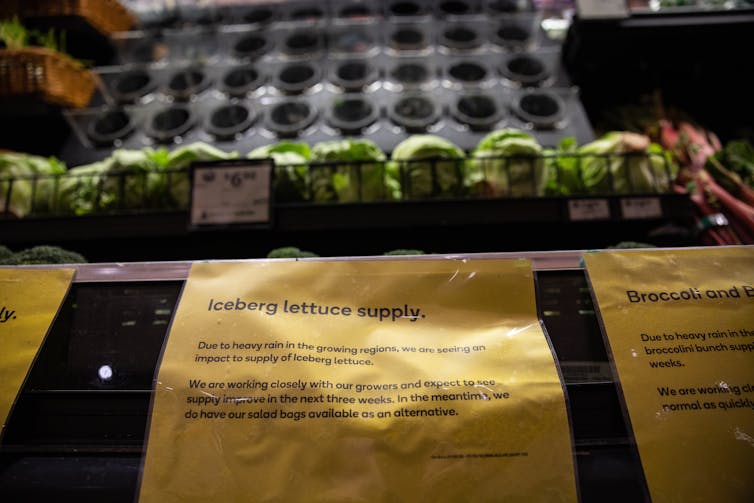
That’s if you can even find such produce. Supermarket shelves for leafy greens are often bare.

This is a strong hint as to why prices have risen so much. As well as growers facing higher input costs – in line with pressures pushing up food prices globally – these price hikes are being driven by lack of supply – with crops and stores wiped out by rain and floods in eastern Australia.

Read more: Why is lettuce so expensive? Costs have shot up, and won't return to where they were

The price hikes have led to calls for supermarkets to impose price caps to ensure shoppers can still afford to feed their families healthy food.

But price ceilings on goods or services rarely, if ever, work. Prices play an important role in allocating resources efficiently. They send a signal to both customers and suppliers. To arbitrarily reduce prices would only increase shortages – both now and in the longer term.

Notification of lettuce shortages in a Melbourne supermarket, June 15 2022.
Notification of lettuce shortages in a Melbourne supermarket, June 15 2022. Diego Fedele/AAP

Supply, demand and market equilibrium

The laws of supply and demand are fundamental concepts in economics. The law of demand says buyers will demand less of an economic good the higher its price. The law of supply says sellers will supply more of a good the higher the price. There are some rare exceptions, but generally these laws describe all markets.

British economist Alfred Marshall was the first to illustrate the interaction of these two laws graphically, in his 1890 book Principles of Economics. Market equilibrium (balance) occurs at the price and quantity where demand equals supply.

Simple demand and supply curve
Wikimedia Commons, CC BY If the quantity supplied falls, the market response is for prices to rise, achieving a new equilibrium. If the quantity supplied falls but prices remain the same, demand will outstrip supply, leading to shortages. Fresh fruit and vegetables are particularly prone to significant price fluctuations because they are perishable and cannot be easily stored for a long time. This why seasonal price fluctuations are common. Higher prices provide a signal both to consumers and producers. They tell consumers to buy less and switch to alternatives. They provide an incentive for producers to grow more – though this process is fairly slow given the time needed to grow and harvest fruit and vegetables. But eventually, if the market is left to its own devices, prices will eventually return to “normal”, consistent with historical prices. Capping the price, on the other hand, will benefit those lucky enough to grab supplies when they available. But it will likely reduce supply even further, by affecting the decision of producers unwilling to supply at below-market prices. It could also lead to a “black market”, with some customers sourcing supplies by other means at higher uncapped prices. Evidence from rent controls The economic theory of price caps is well supported by empirical evidence. The best-known involve rent controls, which are used in US cities such as New York City and Los Angeles, and in European cities such as Stockholm, Berlin and Dublin. New York City's rent controls are world famousm - but not to be emulated.
New York City’s rent controls are world famous – but not to be emulated. Shutterstock

Rent controls mean some are lucky enough to find an affordable apartment. Many others miss out – or engage in “deals” with landlords to get around the controls. The most disadvantaged tend to lose out most since landlords can discriminate in favour of what they consider the “more desirable” tenants.

As Stanford University economist Rebecca Diamond has written:

While rent control appears to help current tenants in the short run, in the long run it decreases affordability, fuels gentrification, and creates negative spillovers on the surrounding neighborhood.

As with housing, so too with broccoli and cabbage.

Read more: Why the NZ government is right to rule out rent controls as a housing crisis solution

We’ve seen this all before

So generally price caps are to be avoided.

If there are suspicions of wholesalers or retailers exploiting shortages, this is best handled by the Australian Consumer and Competition Commission. Though “price gouging” is generally not illegal, the consumer watchdog can prosecute companies for makes misleading claims about the reasons for price increases and for unconscionable conduct (in the case of extreme gouging for an essential good).

What else can be done? Only what consumers have always done, which is to substitute relatively cheaper goods for those becoming more expensive.

We’ve seen this before. Queensland’s floods in 2011 destroyed vast crops of bananas and watermelons, causing prices to skyrocket. Shoppers switched to other fruits. Banana farmers recovered. Prices dropped.

These high prices for lettuce and such now may be a shock, but they are not a sign of market failure requiring intervention. If we let the market do its thing, shortages will end and prices return to “normal” – at least until the next natural disaster.

Read more https://theconversation.com/why-capping-food-prices-wont-work-and-will-actually-make-things-worse-185492

Steel Cutting Services: Precision That Shapes Modern Construction

In today’s construction, manufacturing, and fabrication environments, steel cutting services play a vital role in turning raw steel into practical, usable components. From large-scale infrastructure projects to bespoke architectural features, the accuracy and quality of steel cutting directly influence the... Read more

Lighting Stores Perth: Expert Guidance for Inspired and Functional Spaces

Choosing the right lighting can completely change how a space feels, functions, and flows. Trusted lighting stores Perth play a crucial role in helping homeowners and businesses make confident lighting decisions that go beyond appearance alone. Lighting influences mood, productivity, comfort... Read more

Why Retail Cleaning Plays a Key Role in Customer Experience

In retail environments, cleanliness directly shapes how customers perceive a brand. Retail cleaning is not just about appearance but about creating a space where shoppers feel comfortable, confident, and welcome. From small boutiques to large shopping centres, a clean retail environment... Read more

Cleaner Floors, Healthier Homes: Lefant M3L Arrives as Australians Prioritise Pet-Friendly Hygiene

As pet ownership continues to rise, Australians are placing greater emphasis on maintaining a hygienic indoor environment for both family members and their animals. Issues such as dander, loose fur, and tracked-in dirt require consistent cleaning to support better home... Read more

How Home Removalists Save Time, Money, and Energy During Your Move

Moving to a new home is an exciting chapter in life, but the process of getting there can be overwhelming. From packing and organizing to transportation and unpacking, relocation involves a long list of tasks that can consume both your... Read more

Fulfilment Australia: Streamlining ECommerce Operations for Business Growth

As eCommerce continues to thrive, efficient order fulfilment has become one of the most critical components of customer satisfaction and business success. Companies across the nation are turning to professional fulfilment Australia providers to manage inventory, packaging, and shipping operations... Read more