

Lakeshore shallows can be biodiversity hotspots – but warming is changing their complex ecology
- Written by The Conversation
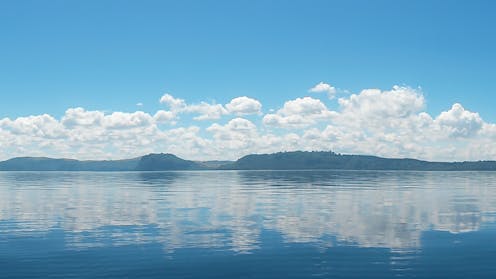
The 19th-century American naturalist Henry David Thoreau described the small freshwater lake at Walden as “Earth’s eye” – a measure of the complexity of ecological interactions.
Our new research at Lake Taupō, New Zealand’s largest body of freshwater renowned for its clearity, reiterates this notion of lake ecology.
We examined the links between nutrient cycles and biodiversity and found that a strong breeze blowing across the lake can result in more food for native freshwater mussels up to a year later.
In lakes, ecological effects can often be obscured by multiple interactions. In this case, the effect of the wind on the mussels had five degrees of separation.
The wind blowing across the lake pushed warm, buoyant surface water to the down-wind shore.
The down-wind movement of all the warm water displaced cool bottom water, squeezing it upwind where it was pushed up to the surface.
Because nutrients accumulate in bottom water, this cool water brings fresh nutrients with it as it is pushed up.
These nutrients are quickly absorbed by plants growing on the lake bed. Even though the water brought up from the depths is rapidly mixed across the lake, the nutrients it carries remain where they first arrived along the shore.
Once absorbed by the plants and algae on the lake bed, these nutrients support healthy growth and provide a long-term food supply for kākahi, a threatened species of freshwater mussel.
The mussels and other organisms living along Lake Taupō’s shorelines absorb and recycle the nutrients received from the upwelling.
Because the prevailing south-westerly winds across the lake result in more upwelling along the lee shore, kākahi in the south-western bays retain the signature of a diet supplemented by deep-water nutrients throughout the year. They turn a sporadic event into a hotspot for biodiversity.
We have known for some time that the shallow margins around lakes (the littoral zones) punch well above their weight when it comes to supporting fish and native biodiversity.
Our study adds to this knowledge by showing how these littoral zones are able to support biodiversity. It helps us identify areas that may be disproportionately important for freshwater conservation – including regions of local upwelling.
Our work also provides a framework for considering how climate change will affect threatened taonga species in lake habitats.
One of the most important physical characteristics in lakes is stratification – the seasonal layering of water into distinct temperature and density bands as the sun warms the surface.
Climate change is making lake stratification longer and stronger, which could result in fewer and weaker upwelling events. We know that even subtle variations in the timing of stratification onset and break-up can have major ecological effects, mainly by changing the availability of light, nutrients, carbon and oxygen to organisms.
Climate change is also making deep water in lakes more prone to low dissolved oxygen levels as prolonged stratification prevents the remixing of oxygen from the air and warmer water holds less oxygen.
There is a risk these upwelling events, which currently provide nutrients to support organisms, could in the future inject water that suffocates these biodiversity hotspots.
Littoral zones appear to be far more sensitive to climate change than offshore habitats. While we are good at monitoring lake water quality in the centre of lakes, we need more tools to enable littoral monitoring at the same scale.
The Our Lakes Our Future research team is currently working on tools to better monitor important littoral habitats to enable better protection and restoration. It has traditionally been time consuming and expensive to count biodiversity in lakes but new molecular tools such as environmental DNA allow us to see what lives there, and even what organisms are doing.
You may ask why it is important to have data to understand how the margins of lakes work. Effective protection of biodiversity at risk is only possible if we have a robust understanding of cause and effect – from the catchment to the species living along the shoreline – even if ecological interactions go through multiple steps and take a long time to play out.


