

Could an Apple watch really tell you if you have high blood pressure?
- Written by The Conversation
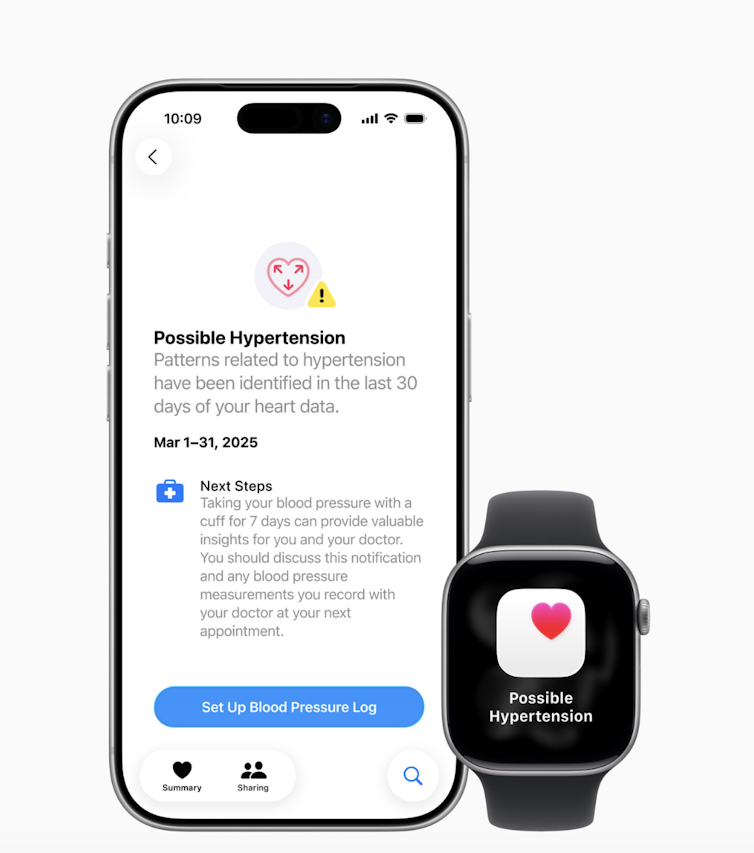
Apple has announced a package of health features, alongside the launch of the new Apple Watch Series 11, including an alert that the wearer may have high blood pressure, also known as hypertension.
Around 1.3 billion people worldwide have high blood pressure. But almost half are unaware of their diagnosis.
This lack of awareness is often due to limited access to regular medical care, the absence of noticeable symptoms or warning signs, and because a single blood pressure reading could miss the condition.
Better detection of high blood pressure could help prevent heart attacks, strokes, kidney disease and dementia.
But can the Apple Watch really tell if you have high blood pressure?
How does it work?
Limited details are available so far.
But we know the Apple Watch’s high blood pressure indicator is based on analysis of changes in blood volume as your heart beats. These are detected using the light sensor on the back of the watch.
This is not new technology; a number of other companies, such as Samsung and Aktiia, use similar approaches.
When the sensor and underlying algorithm identifies a significant change in blood flow, the user will get an alert that they may have high blood pressure. This is done without a conventional blood pressure cuff that tightens around the arm.

However, if a user receives a “possible hypertension” notification, this is not a diagnosis, as their blood pressure has not yet been measured and confirmed by a health-care professional.
From what we know so far, it seems users won’t be given blood pressure numbers straight from the Apple Watch.
What does the evidence say?
Cuffless blood pressure monitoring devices can be more comfortable and convenient than using arm cuffs. Without a cuff, they can also more easily monitor blood pressure continuously during daily activities.
However, the evidence to show whether these technologies accurately estimate blood pressure remains scarce and with many limitations.
Unlike traditional cuff-based blood pressure devices, there is no standard protocol for manufacturers to test cuffless devices for accuracy, and to ensure they live up to their claims. Without such a protocol, it’s difficult to evaluate and compare their performance.
This is particularly important for cuffless devices, because accuracy depends on how well the signal picks up changes in blood flow – which can vary across different skin tones – and how well it performs in everyday settings, such as when a person is awake or asleep, sitting or standing, active or resting.
Nevertheless, some companies have received clearance from government regulatory agencies to market and sell these technologies as medical devices. Apple has received such clearance for its hypertension technology.
However, cuffless devices for measuring blood pressure are not currently recommended by any clinical guidelines based on the uncertainty about their accuracy. So it’s important to have your blood pressure checked regularly by a health-care professional and potentially also at home using a validated cuff-based device.
There is no evidence yet of how well these technologies would work when used clinically and with real patients. Studies are underway.
What are the challenges?
While these devices hold promise for improving individual and population health, they also pose some challenges.
Alerts for “possible hypertension” are just that: a sign for a potential health concern that needs to be evaluated and confirmed in a health-care setting.
Knowing the breadth of Apple’s market share and the prevalence of undiagnosed hypertension, these alerts have the potential to overburden existing health-care systems and cause patient anxiety.
As these devices become more mainstream, health-care systems may need to adapt to accommodate the growing number of patients seeking care.
What if you want to use it?
If you start using the new Apple Watch and receive the hypertension notification, you should check your blood pressure with a cuff-based monitor over three to seven days and take these readings to your doctor.
The fine print on Apple’s website notes this “possible hypertension” feature should not be used by people under 22 years old, those who are pregnant or those previously diagnosed with hypertension.
Cuffless devices have the potential to improve detection of high blood pressure – an urgent need – and these devices may be the future of optimal heart health. But this potential must be matched by rigorous efforts to confirm their accuracy and relevance for patients and clinicians.


