

High-tech cameras capture the secrets of venomous snake bites
- Written by The Conversation
For more than 60 million years, venomous snakes have slithered across Earth.
These ancient, chemical weapon-wielding reptiles owe their evolutionary success in part to the effectiveness of their bite, which they deliver at an astonishing speed before their prey can escape.
Now, a study I coauthored reveals, in astonishing detail, exactly how these bites work. Published today in the Journal of Experimental Biology, it is the largest study of its kind to-date, and uses advanced video techniques to show how various snake species have evolved very different strategies to deliver their deadly bites.
Thousands of snakes on Earth
There are approximately 4,000 species of snake on Earth – about 600 of which are venomous.
Scientists started visually recording the strikes of these snakes to better understand them in the 1950s, when high-speed photography and cinematography were first developed.
Since then, these technologies have improved dramatically, allowing scientists to capture and study the action of venomous snake bites in much greater detail. For example, past research has shown there are clear differences between strikes to capture prey, versus those used for defence.
But most recent studies that have examined snake bites have been limited by a number of factors.
Firstly, they have captured the bites using only one camera. This means we only get a side-on view, whereas the snakes can slither in all directions. Secondly, the recordings have been of a relatively low resolution – in large part because they were made in the field with low lighting conditions. Thirdly, they have often focused on a single snake species or a limited number of species. This means we miss out on seeing how many other species may behave differently, or strike faster.

Welcome to Venomworld
For our new study, my colleagues and I studied the bites of 36 different species of venomous snakes. These species were from the three main families of venomous snakes: vipers, elapids and colubrids. They included western diamondback rattlesnakes (Crotalus atrox), blunt-nosed vipers (Macrovipera lebetinus) and the rough-scaled death adder (Acanthophis rugosus).
All the snakes we studied were housed at an institution in Paris, France, called Venomworld. There, we built a small experimental arena consisting of plexiglass panels lined with a cardboard floor, in which we placed the individual snakes.
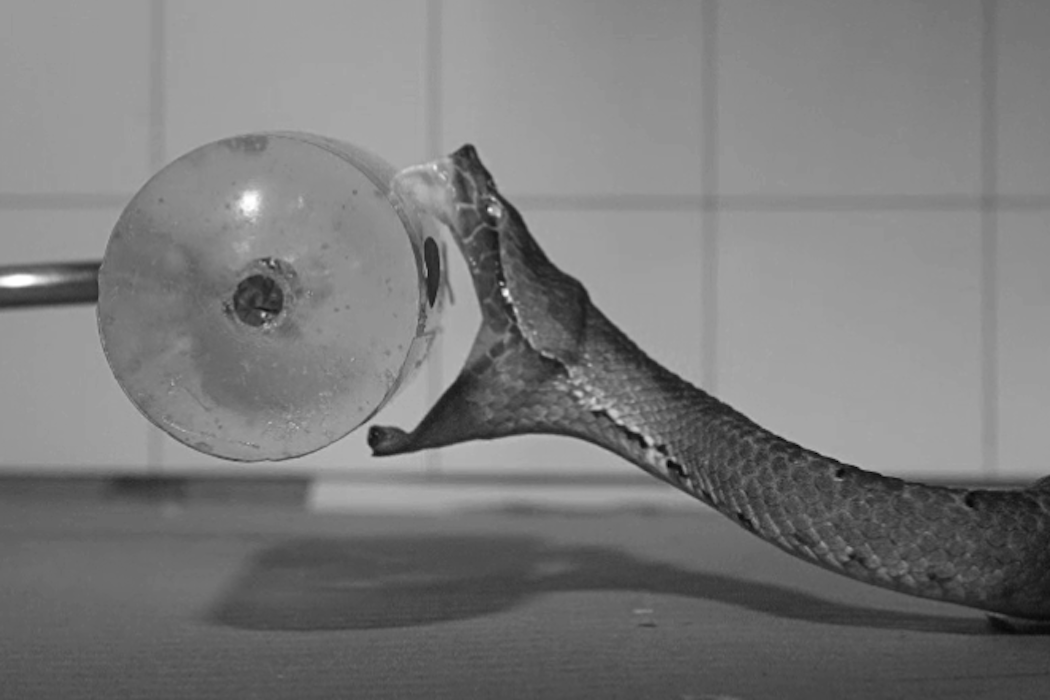
We presented the snakes with a simulated food source – a cylindrical hunk of medical gel, heated to 38 degrees so it resembled prey for those that can detect heat.
Two high-speed cameras, placed nearby at different angles, automatically captured the snakes striking the gel at 1,000 frames per second.
Using the footage from these two different views, we recreated the strike in 3D to investigate, in detail, its various components such as its duration, acceleration, angle, and how fast the snake’s jaw opened.
In total, we captured 108 videos of successful strikes – three for each of the species included in the study.
Striking and slashing
There were major differences between the strikes of the snakes we studied.
Vipers struck the fastest, moving at speeds of more than 4.5 metres per second before sinking their needle-like fangs into the fake prey. Sometimes they would quickly remove and reinsert their fangs at a better angle. Only when the fangs were comfortably in place did the snakes shut their jaws and inject venom.
Some 84% of the vipers included in the study reached their prey in less than 90 milliseconds. This is faster than the average response time for a startled mammal – the preferred prey of many vipers in the wild.
On the other hand, elapid snakes, such as the Cape coral cobra (Aspidelaps lubricus), crept towards the fake prey before lunging and biting it repeatedly. Their jaw muscles would tense, releasing venom.
Colubrid snakes, such as the mangrove snake (Boiga dendrophila), which have fangs farther back in their mouths, lunged towards the prey from further away. With their jaws clamped over it, they’d make a sweeping motion from side to side. In doing so, they tore a gash in the gel to inject the maximum amount of venom.
Our previous research highlighted how the shape of snakes’ fangs is closely tied to prey preference. We can now show how they use these deadly weapons in the blink of an eye – and why they have been able to survive for so long on Earth.
Read more https://theconversation.com/high-tech-cameras-capture-the-secrets-of-venomous-snake-bites-267738


