

Why are screen villains always drinking milk?
- Written by The Conversation
Whether its Alex DeLarge from A Clockwork Orange (1971), Hans Landa from Inglourious Basterds (2009), Homelander from The Boys (2019–), or Anton Chigurh from No Country for Old Men (2007) – there’s no denying there’s something sinister about onscreen milk drinkers.
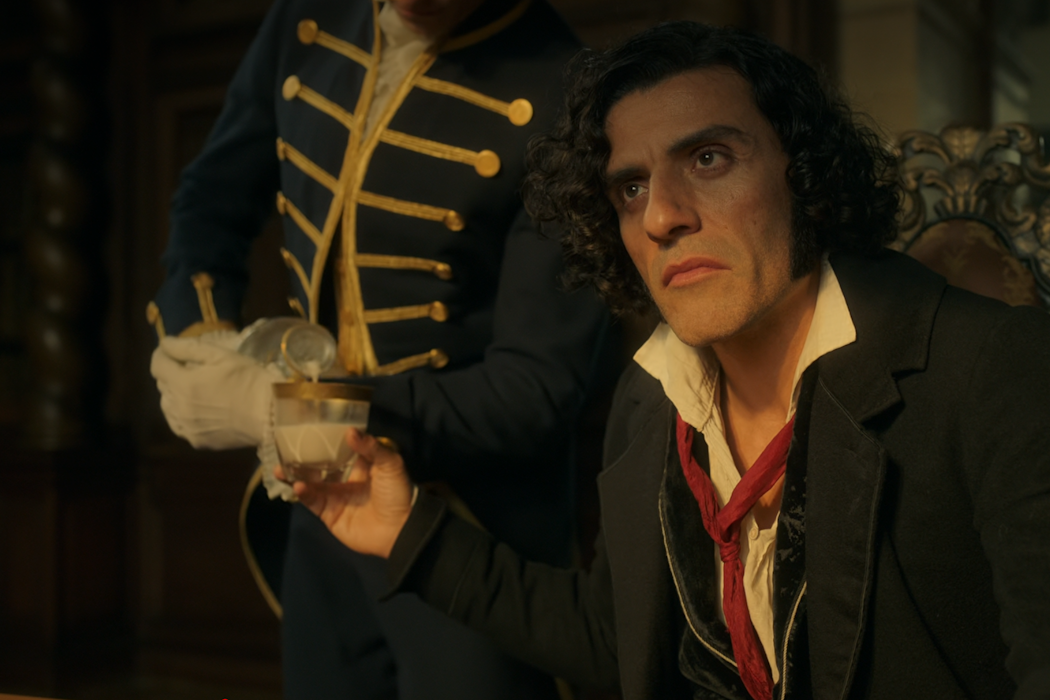
The most recent character to join these ranks is Victor Frankenstein, as imagined by Guillermo del Toro in the new Netflix film adaptation of Mary Shelley’s 1818 novel.
At first glance, del Toro’s Frankenstein is a mistreated child-turned excited inventor. However, his ambition swiftly turns to cruelty when he fails to recognise intelligence in his creation, in the same way his own father failed to recognise his intelligence.
In imbibing milk, Frankenstein signals he is both the neglected child, and the adult man capable of inflicting neglect on others.
An image of purity
As professor of English literature Matthew Beaumont has previously argued:
milk is a liquid that, in a symbolic sense, is superficially secure in its identification with innocence and purity.
For Victor, whose doted-upon mother dies in childbirth when he is still a child himself, the choice of milk could be viewed as a desire to be mothered. Yet his younger brother, William, who grows up without a mother at all, is never seen drinking milk.
In one scene, William Frankenstein, his fiancé Elizabeth, and her uncle sit at the dinner table with Victor. All three drink red wine, while Victor nurses his milk and discusses plans to create life from death.
In this case, the “the milk drinker” trope suggests to audiences they ought not to trust the seemingly innocent person onscreen.
The Frankenstein of del Toro’s imagining is perhaps the most villainous version of the character I have seen. He is obviously mad, and is cruel in that madness, even as a child. As such, our typical associations between milk and innocence are complicated by his character.
I, too, am a milk drinker. So why does it make my stomach turn to watch Frankenstein slosh it back while other characters sip on their wine?
Consumption as destruction
In his 1972 essay Wine and Milk, French literary theorist Roland Barthes argues milk is a symbol of strength.
In comparing milk to wine, which Barthes claims is a “galvanic substance”, he argues:
milk is the opposite of fire by all the denseness of its molecules, by the creamy, and therefore soothing, nature of its spreading. Wine is mutilating, surgical, it transmutes and delivers; milk is cosmetic, it joins, covers, restores. Moreover, its purity, associated with the innocence of the child, is token of strength, of a strength which is not revulsive, not congestive, by calm, white, lucid, the equal of reality.
Not all characters that drink milk are evil. Take the goofy and lovable Joey Tribbiani from Friends (1994–04) who claims, and then proves, he can drink a gallon of milk in under a minute.
More recently, in the miniseries Fellow Travelers (2023), Jonathan Bailey’s character Tim is told by his lover to “shut up and drink your milk”, which he gladly does. Indeed, milk does hold us a symbol of innocence when shown through such characters.
However, I would argue if milk is the symbol of innocence, then a consumer of milk can’t themselves be innocent or, at least, can’t remain innocent – since their consumption of the substance (and symbol) could also be viewed as a destruction of it.
Overwhelmingly, when milk is consumed onscreen, a game of power and control is played out. In Babygirl (2025), for example, Nicole Kidman’s character is delivered a glass of milk which has been ordered for her by a much younger but dominant lover as a test of her submission.
Then there’s the example of actor Christoph Waltz who plays perhaps the most famous milk drinker in cinematic history – the Nazi “Jew-hunter” Hans Landa – in Quentin Tarantino’s film Inglourious Basterds (2009).
In one early scene, Landa sits at the table of Perrier LaPadite and, although he is offered wine by his host, requests a glass of milk. Minutes later he has his men execute almost the entirety of a Jewish family who are hiding beneath the farmhouse’s floorboards.
In a recent interview with YouTube channel Mythical Kitchen, Waltz is asked what he thought “makes a villain drinking a glass of milk so uniquely terrifying?” He replies:
I’m not thinking about these things in these terms… I’m just thinking about, you know, this is the character and now I drink a glass of milk, and that distance between is what I negotiate. And that’s it.
Sounds to me like something a milk drinker would say.
Read more https://theconversation.com/why-are-screen-villains-always-drinking-milk-269191


