

What do stingrays actually eat? New study reveals some only prefer a single type of prawn
- Written by The Conversation
As an ecologist who studies stingrays, people always ask me: what do these creatures eat? It may well be the reason I’ve spent the past three years tackling this very question.
We do know that, generally speaking, stingrays like eating benthic invertebrates – creepy-crawlies buried in the sediment along the sandy bottom. But there’s much we don’t understand about how the diet varies among different species depending on their size and where they live. In short, it’s more complex than you’d think.
My colleagues and I at James Cook University published a new study in Marine Ecology Progress Series that adds to this growing body of knowledge about what’s on the menu for these “flat sharks” – and what this could mean for protecting threatened species.
A smorgasbord of invertebrates
Shallow beach flats across Australia serve as nursery grounds for a variety of ray species, which is unsurprising given they also offer a smorgasbord of buried invertebrates.
However, due to high abundances of young rays, these areas may be more competitive than communal. Therefore, targeting different food items is a good strategy for reducing competition as well as starvation risk.
Figuring out how their diets gel with competitiveness isn’t just academic curiosity. Rays, including stingrays and their relatives, now rank among the most threatened vertebrate groups on Earth. However, we can’t properly identify valuable nursery habitats without a clear understanding of their underlying resources.
For juveniles in particular, information on what they eat has always been scarce, since this generally involves catching mass numbers of them and dissecting their stomachs to get their “last supper”. The good news is we now use other, non-lethal methods to fill in the gaps.
My team and I spent the better part of two years catching nearly 200 rays at Lucinda Beach in North Queensland. Lucinda was a model location for this dietary campaign and home to four ray species: the Australian whipray (Himantura australis), cowtail stingray (Pastinachus ater), brown whipray (Maculabatis toshi), and the giant shovelnose ray (Glaucostegus typus).
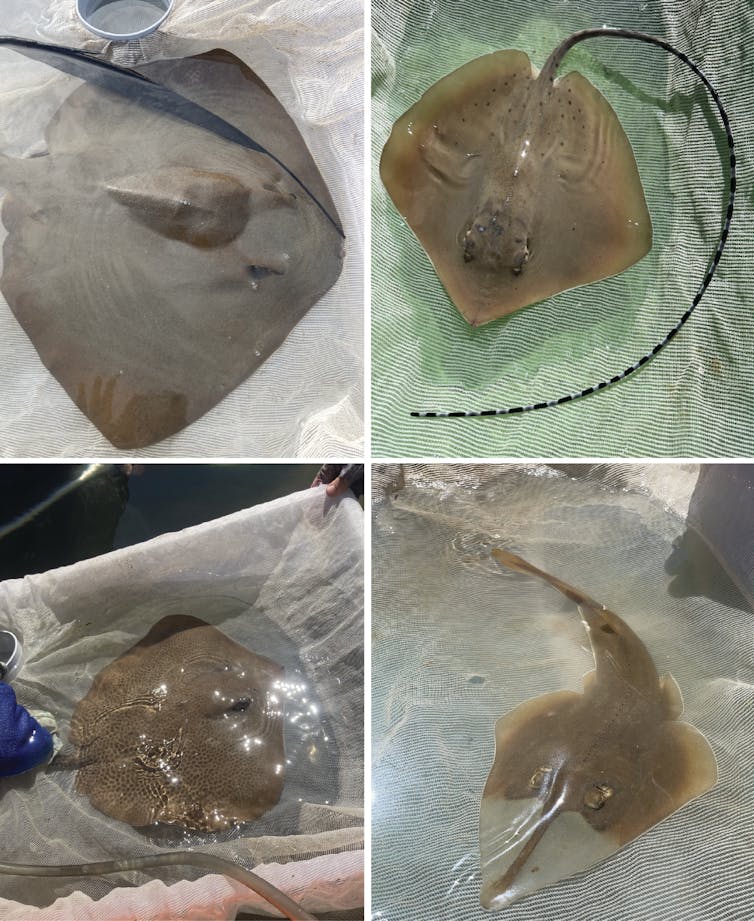
Once captured, we gently flushed their stomachs with a battery-powered water pump to extract freshly consumed items. We also collected muscle tissue samples for an analysis of carbon and nitrogen, which is another method for determining how much their diets overlapped.
What emerged was a surprisingly nuanced picture of who eats what and why.

Picky eaters
Aligning with other dietary studies from Australia, rays ate a mix of benthic crabs, prawns, molluscs and worms – yet diets varied at the species level.
For example, Australian whiprays showed a clear preference for prawns, shrimp and small crabs. In contrast, the cowtail stingray had the most generalised diet, regularly eating polychaete worms, bivalves and snails alongside the occasional prawn.
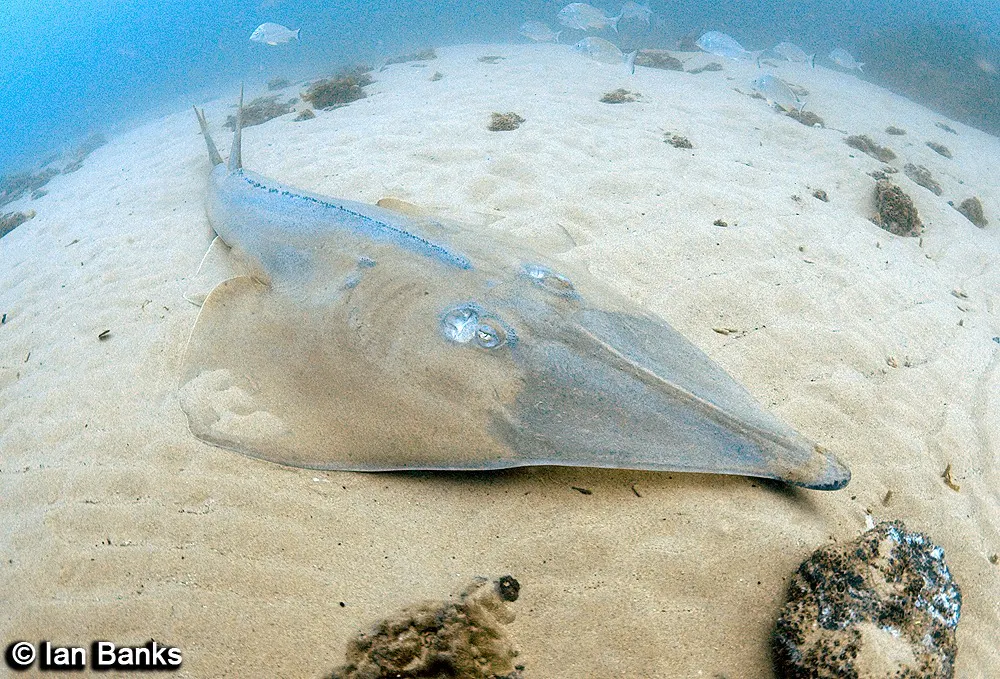
Notably, giant shovelnose rays and brown whiprays were both highly picky eaters, specialising almost exclusively on one type of prawn.
Does this support the idea of a competitive nursery environment? Most likely yes. The cowtail stingray has carved out its own niche by preferring prey that other species largely ignore, while Australian whiprays maximise their chances by consuming various crustaceans.
As for the two specialists, including the critically endangered giant shovelnose ray, they’re essentially betting their survival on a single menu item.
What makes rays choose their foods?
While it’s difficult to pinpoint a single cause for dietary differences among species that live in the same place, the answer lies partly in body shape, unique foraging behaviours, and prey availability.
In terms of tooth and jaw shape, some species like the cowtail stingray have hexagonal plated teeth that are more adept at crushing hard-shelled items than other species.
Body size is another factor because larger species have greater mechanical power for digging than smaller ones. We suspect this is why the two smallest species in our study – brown whiprays and giant shovelnose ray – were limited to feeding on prey found in the surface layers of the sediment.
Finally, prey availability shapes what’s on offer to nursery competitors. Rather than being an all-you-can-eat buffet, invertebrates are patchily distributed. This further influences the best places for rays to forage and their access to nutritionally rich morsels.
 A swarm of soldier crabs on the Lucinda sand flat. These crabs are highly abundant but deeper burrowers, making them inaccessble to many predators.
Jaelen Myers
Survival in a changing world
These findings open new avenues for both ecological understanding and ray conservation. Rather than treating the dietary needs of all rays the same, this shows a need to account for species-specific requirements.
While we can count on generalists adjusting their diets to be able to live in different habitats, the dietary pickiness of specialist feeders could be their weakness in a rapidly changing world.
The upside is that identifying nursery habitats based on prey availability, such as for the giant shovelnose ray, could give us clear conservation targets.
We are yet to answer several key questions. How long do young rays stay in a nursery? How do their movements reflect feeding opportunities? What extent does resource limitation influence habitat use? For threatened species running out of time, these answers can’t come soon enough.
I would like to acknowledge Aliah Banchik from the Sydney Institute of Marine Science for her creative contributions to this piece and to all student volunteers at James Cook University who made the study possible.


