

Through the mill: Tokoroa’s tough year was about much more than job losses
- Written by The Conversation
For Kinleith Mill, cycles of new owners, restructuring and retrenchment have been a fact of life since the 1980s. Each ownership change and downsizing has affected the mill’s workforce – and, inevitably, the Tokoroa community.
In July this year, foreign-owned Oji Fibre Solutions closed the mill’s last paper machine, effectively stopping all manufacturing. Not long after, Carter Holt Harvey announced it was also shutting its Tokoroa plywood plant.
The double impact and loss of 249 jobs was seen by many as simply the latest blow to a dying forestry company town.
Elsewhere, the sale of Fonterra’s consumer brands and the closure of Carter Holt Harvey’s Nelson-Tasman sawmill seemed to underscore the fragility of New Zealand’s manufacturing base.
These decisions were no doubt justified commercially: competing with international firms that enjoy cheaper production and larger consumer markets has become increasingly difficult.
And, as ownership of major industrial facilities has shifted overseas, those making the decisions have become further removed from the local context – and from the communities that bear the consequences.
But it hasn’t always been this way. Building the forestry industry was central to Aotearoa New Zealand’s postwar economic and employment strategies. As our research has shown, community identity and cohesion cannot be easily separated from that political and economic history.
Life of a forestry town
When the government issued its first pulp licence in 1943, it had two clear aims: to create jobs for returning servicemen after World War II, and to make use of the forests planted during the Depression-era work schemes of the 1930s.
The establishment of the privately-owned Kinleith mill, and the development of Tokoroa, fitted neatly within these national priorities. The mill was entirely funded by private equity, common in the United Kingdom and United States but very rare in Aotearoa New Zealand at the time. Tokoroa became one of the country’s rare “company towns”.
Once the mill was operating, Tokoroa grew quickly. People were drawn to the town, actively recruited by both mill management and the government from across New Zealand and overseas.
For a time, it was the fastest-growing town in the country, peaking at more than 19,000 people, with over 5,000 employed at Kinleith. Tokoroa became one of the first destination towns under the Pacific Migration Scheme of the 1960s, introduced to ease labour shortages.
By 1972, around 20% of the town’s population – double the national average – had migrated from the Pacific Islands, including about 2,000 from the Cook Islands alone.
For many of the people involved in our research, the mill wasn’t just a job, it was the reason they came to New Zealand or moved to Tokoroa.
Their sense of identity, especially among those who had migrated from overseas, was bound to the town, the company (in all its ownership iterations) and the mill.
Many described strong family ties to Tokoroa and a deep connection to its history. Second- and third-generation Cook Islands participants, for example, referred to Tokoroa as their “home away from home”, yet didn’t feel that same familial connection to New Zealand as a whole.
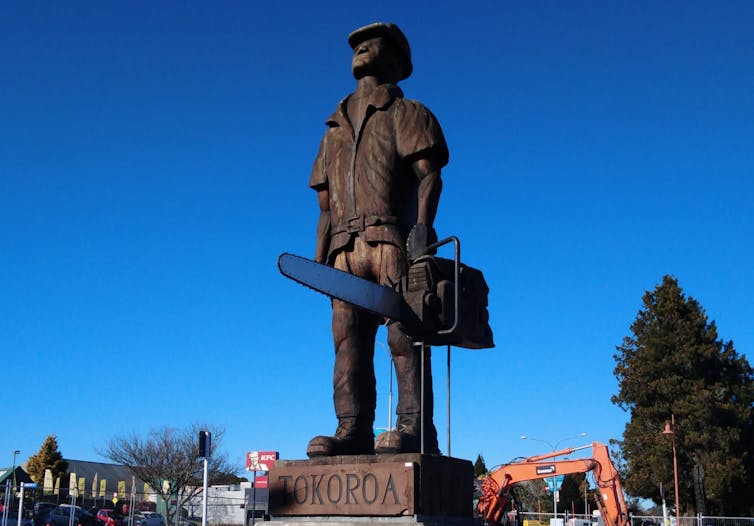
Distant decisions, local lives
None of this fits easily with successive governments’ messaging that Tokoroa residents could easily move to other places for employment.
Indeed, people we interviewed also recalled a time when employees, unions, the company and the government worked together in ways that are difficult to imagine now.
One example many offered was the building of Tokoroa Hospital. Not only did unions raise funds through their organisers, but union members helped plan the new facility alongside company leaders and government officials.
The collaboration remains a defining chapter in the town’s story and is still vivid in the memories of first-generation residents and long-serving mill workers.
For them, especially, the prospect of losing local hospital services during the health system restructuring of the 1990s and 2000s reignited a deep sense of town ownership – a town many long-time residents helped build from the ground up.
Today, however, the impact of more than 30 years of globalisation and creation of complex international value chains has separated workers from the people and institutions that determine their jobs and working conditions – and the future of the towns they helped shape.
Our research is a reminder to political leaders and company executives that their choices are never just abstract financial calculations. They ripple through the lives of real people – workers, families and communities with long histories, deep attachments and complex reasons for calling places like Tokoroa home.
The story of Kinleith and Tokoroa is far from unique. Around the world, small towns built around a single industry or company are feeling the effects of decisions made far beyond their borders.
Absentee owners and governments can’t ignore the history embedded in these communities, and the significant contributions their residents have made – and continue to make – to national economic and social policy.
We also urge everyone to challenge the familiar narrative that these towns are simply “run down”, with limited futures. Instead, we should acknowledge the complexity, pride and strong sense of community their residents hold, and recognise the value of the places they have spent decades building.


