

Why is Trump so obsessed with Venezuela? His new security strategy provides some clues
- Written by The Conversation
Two centuries ago, US President James Monroe declared the Western Hemisphere off-limits to European powers in what would became known in history books as the “Monroe Doctrine”.
The proclamation established the foundation for a new era of US dominance and “policing” of the region.
In the decades that followed, almost a third of the nearly 400 US interventions worldwide took place in Latin America. The United States toppled governments it deemed unfavourable or used force later ruled illegal by international courts.
In 2013, then-Secretary of State John Kerry announced “the era of the Monroe Doctrine is over”. It signalled a shift towards treating the region as partners rather than a sphere of influence.
Now, however, the National Security Strategy released last week by the Trump administration has formally revived that old doctrine.
It helps explain the administration’s interventionist actions in the region over the past couple months, from its deadly boat strikes in the Caribbean to its selective use of sanctions and pardons.
Why Latin America is so important
In typical hubristic fashion, the document openly announces a “Trump Corollary” to the Monroe Doctrine, elevating the Western Hemisphere as the top US international priority. The days when the Middle East dominated American foreign policy are “thankfully over”, it says.
The document also ties US security and prosperity directly to maintaining US preeminence in Latin America. For example, it aims to deny China and other powers access to key strategic assets in the region, such as military installations, ports, critical minerals and cyber communications networks.
Crucially, it fuses the Trump administration’s harsh rhetoric on “narco-terrorists” with the US-China great power competition.
It frames a more robust US military presence and diplomatic pressure as necessary to confront Latin American drug cartels and protect sea lanes, ports and critical infrastructure from Chinese influence.
How the strategy explains Trump’s actions
For months, the Trump administration has been striking suspected drug boats in the Caribbean Sea and eastern Pacific Ocean, killing dozens of people.
International law experts and human rights officials say these attacks breach international law. The US Congress has not authorised any armed conflict in these waters, yet the strikes have been presented as necessary to protect the US from “narco‑terrorists”.
Venezuelan President Nicolás Maduro has also been branded a “narco‑dictator”, though Venezuela is a minor player in the flow of drugs to the US.
On December 2, President Donald Trump told reporters that any country he believes is manufacturing or transporting drugs to the US could face a military strike. This includes not just Venezuela, but also Mexico and Colombia.
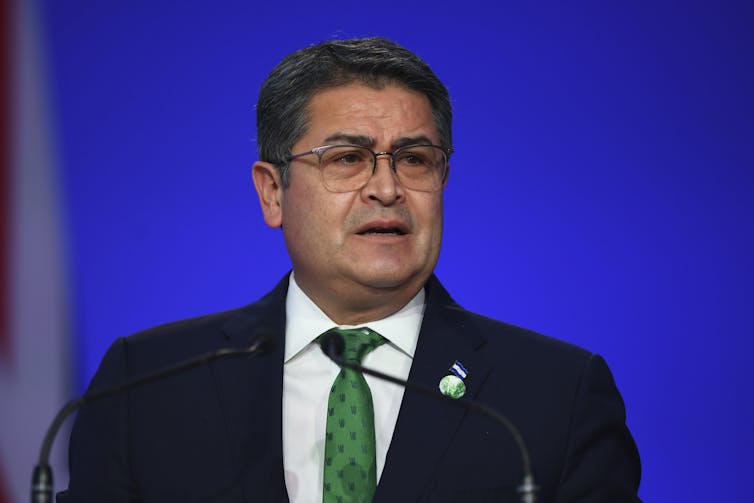
On the same day, Trump also granted a pardon to Juan Orlando Hernández, Honduras’ former president. He had been sentenced to 45 years in prison for helping move hundreds of tons of cocaine into the US.
The new National Security Strategy attempts to explain the logic behind these contradictory actions. It emphasises the need to protect US “core national interests”, and stresses:
President Trump’s foreign policy is […] not grounded in traditional, political ideology. It is motivated above all by what works for America — or, in two words, ‘America First’.
Within this logic, Hernández was pardoned because he can still serve US interests. As a former president with deep links to Honduran elites and security forces, he is exactly the kind of loyal, hard-right client Trump wants in a country that hosts US military personnel and can help police migration routes to the US.
The timing underlines this: Trump moved to free Hernández just days before Honduras’ elections, shoring up the conservative networks he once led to support Trump’s preferred candidate for president, Nasry Asfura.
In Trump’s “America First” calculus, pardoning Hernández also sends a couple clear signals. Obedient partners are rewarded. And power, not principle, determines US policy in the region.
The obsession with Venezuela
The new security strategy explains Trump’s obsession with Venezuela, in particular.
Venezuela has the world’s largest proven oil reserves and a long coastline on the Caribbean Sea, which is a vital sea lane for US goods travelling through the Panama Canal.
Under years of US sanctions, Venezuela signed several energy and mining deals with China, in addition to Iran and Russia. For Beijing, in particular, Venezuela is both an energy source and a foothold in the hemisphere.
The Trump administration’s National Security Strategy makes clear this is unacceptable to the United States. Although Venezuela is not named anywhere in the document, the strategy alludes to the fact China has made inroads with like-minded leaders in the region:
Some foreign influence will be hard to reverse, given the political alignments between certain Latin American governments and certain foreign actors.
A recent report suggests the Maduro government is now attempting a dramatic geopolitical realignment. The New York Times says Maduro’s government offered the US a dominant stake in its oil and gold resources, diverting exports from China. If true, this would represent a clear attempt to court the Trump administration and end Venezuela’s international isolation.
But many believe the Trump administration is after regime change instead.
The Venezuelan opposition leader, María Corina Machado, who won the 2025 Nobel Peace Prize, is pitching a post‑Maduro future to US investors, describing a “US$1.7 trillion (A$2.5 trillion) opportunity” to privatise Venezuela’s oil, gas and infrastructure.
For US and European corporations, the message is clear: regime change could unlock vast wealth.
Latin America’s fragmented response
Regional organisations remain divided or weakened, and have yet to coordinate a response to the Trump administration. At a recent regional summit, leaders called for peace, but stopped short of condemning the US strikes off Latin America.
Governments are instead having to deal with Trump one by one. Some hope to be treated as friends; others fear being cast as “narco‑states”.
Two centuries after the Monroe Doctrine, Washington still views the hemisphere as its own backyard, in which it is “free to roam” and can meddle as it sees fit.


