

Stories from traditional knowledge combined with archaeological work trace 2,300km of Songlines
- Written by The Conversation
All over Australia, Songlines, or Dreaming tracks, connected First Nations people in one place with those in another through ritual, song and storytelling, which told of their shared beliefs.
In our newly published research, we have used material evidence to establish such links where they were disrupted by the violent past.
Isabel’s mother, Mrs Hansen, told stories from the traditional knowledge of her tribe, the Wangkamadla people, that Isabel passed on to her daughter Avelina.
We have combined these with the archaeological work of Iain in different parts of Australia, to extend the connectivity of those songs and tracks from one region to another.
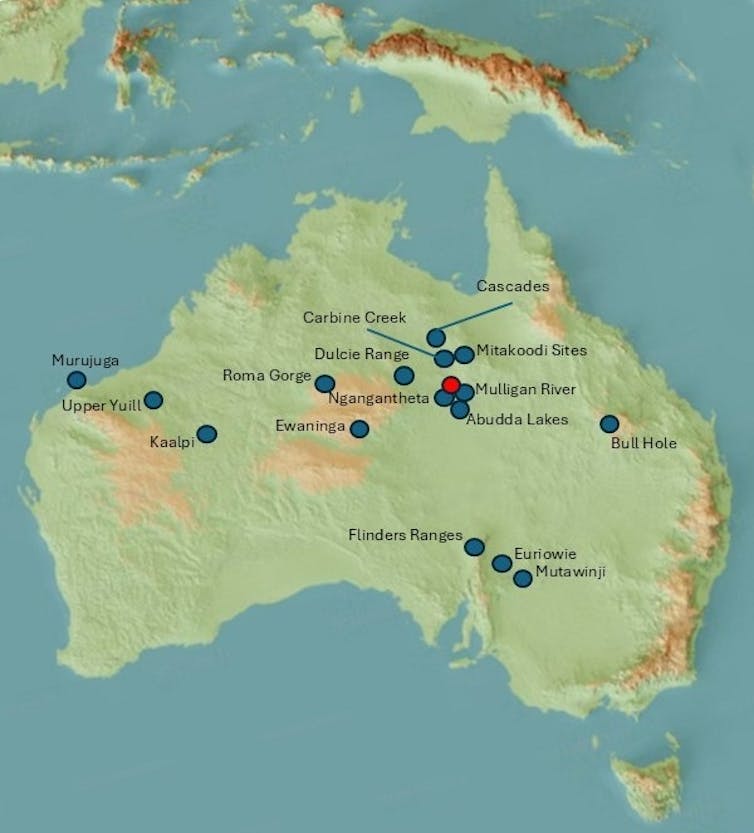
Rock art images in one region show Songlines reached from Murujuga beside the Indian Ocean to the eastern Simpson Desert 2,300 kilometers away.
Maintaining sacred sites
Mrs Hansen (first name, Annie) and her husband Jack (also known as Snapshot) were born about 125 years ago and brought up on their own First Nations Country on the edge of the Simpson Desert of far western Queensland.
The Hansens were employed at Glenormiston Station in the Channel Country, and from time to time would visit sacred sites in the region to maintain them and retell their songs and stories.
The people of the station referred to this as “going walkabout” as if it was trivial, but it was an important part of maintaining their connection to Country. Isabel was brought up on that Country.

In 1982, Mrs Hansen led a party of people on a tour of such sites. The group included Iain, and Isabel and her husband Ramón Tarragó. Some were ceremonial sites, such as the nest of cobbles, others were art sites.
At these, Mrs Hansen would tell us stories associated with the sites.
During that trip, Mrs Hansen sang songs for Isabel in the language she learned with her tribe and accompanied the songs with sand drawings.

Her stories told of connections to the west through the Songlines or Dreaming tracks associated with the travels of Dingoes from the West and Emus from the Southwest, and she talked to us about connections to Western Australia.
Our studies of the images in the art show the same images can be found right across Australia from the Simpson Desert to the Indian Ocean.
Finding connections
The map of sites with related imagery was made up of smaller regions with interconnected networks of relationships and stories.
Often, these regions had a different range of motifs, but the geometric signs with coded meanings were present among them.
We show in the map of the Boulia region, that, according to stories told us by First Nations Yulluna man Tom Sullivan, there were more local Dreaming tracks or Songlines (in these cases of the Yellow Belly fish from Wonomo Waterhole and the Rainbow Serpent from Woodul Rockhole both further north).
 The tracks of stories from both First Nations people, as well as other connections across the region from trade in Pituri and the exchange of message sticks.
Davidson, Sullivan and Tarragó.
These stories aligned with the mythology along the trading routes moving north for the narcotic drug Pituri for which the ceremonies were owned by Mrs Hansen and related women.
We have also traced archaeological evidence of axes from the quarries around Cloncurry and Mount Isa moving south along these same routes, and there are other links through message sticks collected in the 19th century.
On rock faces and in caves are paintings and carvings that white men have never seen. In that Country lie the bones of my people.
All over Australia, there are sites with paintings or carvings which have been damaged by weathering during the passage of time. The repeated use of the rock at different times, and the different weathering of the art over time, shows the places were likely to have been part of a long tradition of ceremony and ritual.
 One of many panels of carvings at Nganganterra on Wankamadla Country, showing signs were carved on the rocks and some are older than others.
Iain Davidson
The repeated marking of the rocks with similar signs suggests the stories, such as those told by Mrs Hansen, provided coded meanings.
We can compare some of the images on the edge of the Simpson with those as far west as Murujuga in Western Australia, as well as in between. This allows us to see meanings were encoded in similar ways and the connections gave meaning to the rituals that accompanied the stories.
Similar signs are found in the rock art right across Australia from the Indian Ocean to the Simpson Desert, and stretching to the north around Cloncurry and to the south at Mutawinji. These likely provide the common coded meanings in ceremonies.
When Mrs Hansen and Jack Hansen “went walkabout”, it was not a trivial matter, as people on the station thought. Rather it was an important part of maintaining their ritual relationships with Country, long after pastoralism had destroyed much of the context.
Through such relationships we can identify the reach of the Songlines Mrs Hansen spoke about.


