

Inequality alone doesn’t cause civil unrest – but internet access adds the crucial spark
- Written by The Conversation
The gap between rich and poor has reached historic highs. According to the World Inequality Report 2026, released in recent weeks, the richest 10% of the global population now receive 53% of all income and own a staggering 75% of all wealth.
The poorest half of humanity, meanwhile, receive just 8% of income and own 2% of wealth.
Looking at these stark figures, it is easy to assume such extreme inequality is a guaranteed recipe for revolution. If people are struggling to survive while a tiny elite prospers, you’d think they would eventually rise up.
However, history and data tell a more complex story. Many deeply unequal societies remain politically stable for decades, while others with moderate inequality erupt into chaos. Why does economic grievance boil over in some places but not others?
As geopolitical tensions rise – from the “Gen Z uprising” in Asia to civil unrest in the Middle East – understanding the trigger for conflict is urgent.
Our new study, published in the Scottish Journal of Political Economy, suggests inequality alone is rarely enough to drive instability. Instead, we found a crucial accelerant that transforms economic grievance into political action: the internet.
The missing link
For years, political scientists have debated the link between inequality and conflict. Some studies found a strong connection; others found none.
To help solve this puzzle, we analysed data from more than 120 countries from 1996 to 2020.
We looked at income inequality (measured by the Gini index) and paired it with political stability scores from the World Bank. We then introduced a third variable: how much of the population uses the internet.
We found digital connectivity acts as a moderator. This means the internet changes how inequality affects society.
In countries with low internet access, higher inequality does not lead to higher political instability. In fact, we found that in such relatively unconnected societies, inequality is sometimes associated with greater stability.
This may be because marginalised groups lack the information to compare their lives with others, or the tools to organise effectively.
The tipping point
Our analysis identified a specific “tipping point”. We found income inequality begins to significantly drive political instability only when roughly more than 50% of the population uses the internet.
In highly connected societies – where more than half the population is online – the relationship between inequality and unrest becomes positive and significant.
This pattern holds true even when we control for other factors that usually cause conflict, such as youth unemployment, corruption and excess profits from natural resources (such as oil rents).
We also robustly tested these findings using data on actual conflict-related deaths, rather than just perception-based stability scores, and the results remained consistent.
So, why can internet connection fuel conflict? Why does the internet make inequality so combustible? Our research points to two main mechanisms: information and coordination.
The visibility of wealth
Before the digital age, a person living in poverty might compare their living standards only to their immediate neighbours. If everyone around you is poor, your situation might feel normal, or at least tolerable.
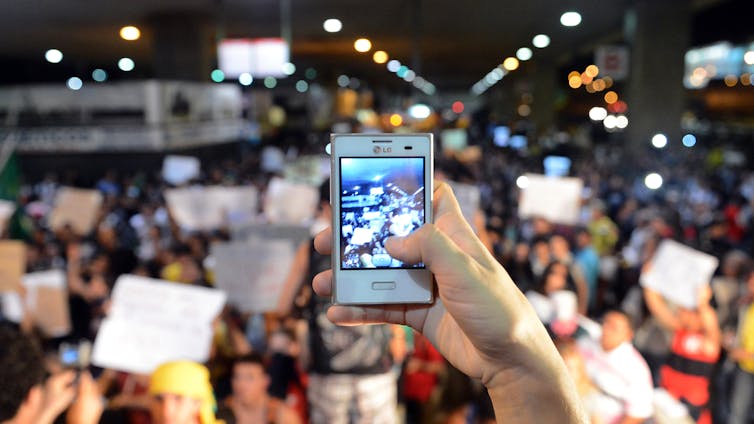
The internet destroys this isolation. It provides a window into the lives of the wealthy, both domestically and globally. Social media platforms act as a relentless showcase of luxury, creating a sense of “relative deprivation”.
When citizens – particularly young, underemployed men and women – can see the vast gap between their reality and the lives of the elite on social media, it generates psychological strain.
Grievances move from abstract statistics to visceral, daily reminders of what they lack.
Read more: Deadly Nepal protests reflect a wider pattern of Gen Z political activism across Asia
Lowering the cost of protest
Feeling angry is one thing; doing something about it is another. Historically, organising a mass movement was dangerous, expensive and slow.
The internet, specifically through social media and encrypted messaging apps, solves the collective action problem. It drastically lowers the coordination costs for dissatisfied citizens.
We have seen this play out repeatedly. During the Arab Spring of 2011, Facebook was used to help mobilise protesters against regimes in Egypt and Tunisia.
In Iran, social media was vital in spreading the “Woman, Life, Freedom” movement of 2022, allowing citizens to bypass state media blackouts.
Just months ago in Nepal, a country where about 56% of the population uses the internet, what began as protests over a social media ban quickly escalated into a nationwide anti-corruption movement. This resulted in dozens of deaths, substantial economic disruption and the resignation of the prime minister.
In these contexts, the internet did not create the grievance. Inequality, corruption and repression did that. But the internet provided the spark and the fuel that turned grievance into fire.

Grappling with inequality
As the World Inequality Report warns, wealth concentration is rising while public wealth stagnates. At the same time, global internet use continues to climb, reaching nearly 71% of the global population in 2024.
As more developing nations cross the 50% digital threshold, governments can no longer rely on lack of awareness or lack of coordination to maintain order in unequal societies.
Some regimes may be tempted to shut down the internet to maintain stability. However, our research suggests a different path.
If governments want to ensure political stability in the digital age, they cannot simply police the internet. They must address the economic grievances it reveals.
Policies that reduce income disparities such as progressive taxation, investment in public services and control of corruption are no longer just economic ideals. They are security imperatives.


