

How hot is too hot? Here’s what to consider when exercising in the heat
- Written by The Conversation
If you like to exercise outdoors, summer gives you more chance to catch the daylight. It’s often easier to get out of bed and still light when you finish work.
But what about when it gets really hot?
Regular exercise throughout the year is crucial for maintaining good health. But in summer you might feel yourself sweating more and wonder if it’s actually risky.
So, how hot is too hot? Here’s what to keep in mind when exercising in the heat.
What are the health risks?
Normally, the body maintains a core temperature around 37°C. But exercising – especially when it’s hot and humid – can put more strain on these processes.
Even seemingly small changes in core temperature, of around 3°C, can potentially lead to exertional heat illness. This is when your body becomes overwhelmed trying to control a rapid rise in core temperature, especially during strenuous activity.
Mild symptoms can include headaches and feeling faint. Severe cases can lead to seizures, loss of consciousness or even death.
So, how hot is too hot?
It would be great if there was a definitive temperature cut-off we could point to. But the answer isn’t so straightforward.
Environmental factors that can lead to exertional heat illness involve more than just the air temperature. Humidity, wind speed, and solar load (meaning how much cloud cover there is) can interact and affect how hot it feels and how well your body copes.
For example, in humid weather, the amount of moisture in the air makes it harder for sweat to evaporate off the skin’s surface – which is the body’s best cooling mechanism.
Does the type of exercise matter?
How long and hard you train will also affect how much heat your body stores.
The American College of Sports Medicine recommends non-continuous exercise – such as football – can go ahead in hotter conditions than continuous exercise, such as long-distance running or cycling. This is because breaks help the body cool down.
You can check your risk with Sport Medicine Australia’s online tool, which uses your location and the sport to provide a “sport heat score” and key recommendations, such as hydration and cooling interventions.
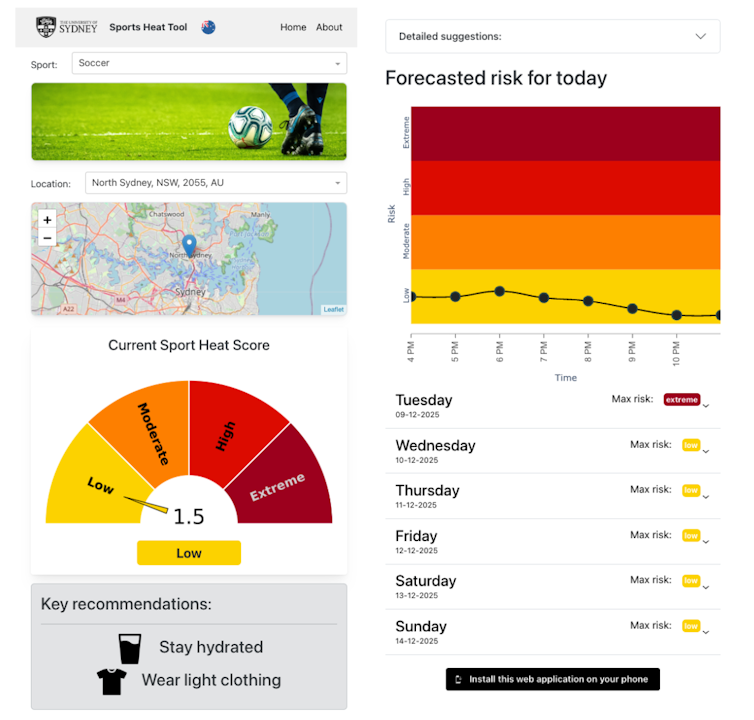
Other factors can also play a role in your risk of exertional heat illness:
clothing (for example, thick clothing that covers more of the body)
how acclimatised you are to hot conditions (for example, elite endurance athletes typically have a greater level of heat tolerance)
your age (older adults are generally at greater risk).
How to stay cool
When we’re dehydrated, it’s harder for our bodies to lose internal heat. So staying hydrated is important – and drinking cold or iced water is also one of the easiest ways to cool down.
Scientists have found many people unknowingly start their activity dehydrated. So make sure you drink plenty of water not only while you exercise, but beforehand as well.
To reduce your body temperature, you want to expose as much of your skin as possible to something that can cool it, such as a portable fan or ice wrapped in a towel.
Wearing light, breathable clothing specifically designed for sport will also interfere less with heat being released from the body.
For organised sport, additional breaks in play can help. If you are exercising alone, consider taking more breaks than normal.
Can you get used to exercising in the heat?
Yes, it’s possible to adapt to exercising in the heat, for example, if you need to train for an event held in hot or humid conditions.
Evidence suggests your body can begin to adapt after just a few sessions of training the heat.
As you get used to hot conditions, you might notice that you sweat more and maintain a lower heart rate for the same effort, while also feeling more comfortable in the conditions.
But you should take it slow to begin with. Gradual exposure might help reduce the risk of exertional heat illness. This means gradually increasing the volume of exercise (how much you do) and its intensity (how hard you go).
You may also need to adjust your goals. For example, when it’s hot you can’t expect to perform endurance exercise, such as long distance running and cycling, at the same level – at least straight away.
If you have the flexibility, training during a cooler part of the day or exercising indoors can be also be good alternatives.


