

News Daily


Men's Weekly

Australia

  • Written by The Conversation

Omar Musa’s new book, Fierceland, ranges across five distinct geographies and covers a period of some 170 years. It is told from at least ten perspectives and encompasses prose, poetry and visual art. It is, in every way, an epic endeavour.

Review: Fierceland – Omar Musa (Penguin)

There has been a welcome tendency towards scale and ambition in Australian literature of the last few years. The centrepiece of this shift to grandiosity is Alexis Wright’s Praiseworthy: a book that attempts not one, but four or five separate epics in 780 pages.

This is the sort of work required by a period of polycrisis – ecological collapse, widening inequality, catastrophes of famine and genocide. It also calls for a different sort of criticism. As critic Northrop Frye said of John Milton’s epic poem Paradise Lost, Milton’s genius was not in the execution, so much as the grandiosity of his theme.

For Wright, our multiple armageddons push and break the limits of traditional literature. Praiseworthy keels and splutters, devastates individual characters’ claims to resolution, raising the suspicion that something like a unified modern story may be impossible.

The epic novel runs amok in Omar Musa’s Fierceland
Omar Musa. Boyz Bieber/Penguin Random House

Fierceland is maybe the first Australian (or Australian-adjacent) book to take up Wright’s literary challenge. Musa seems keen to position himself in the tradition of epic writers, particularly the masters of the Global South: Gabriel García Márquez, Chinua Achebe and Salman Rushdie.

The novel alludes to this in its meditation on the idea of the Hikayat – a Malay form of folk epic which tells of heroic acts. At the centre of the story is a properly epic project – a “Song of the Forest” that Musa has written and then translated into many of the unique local languages of the Malaysian regions of Sabah and Sarawak.

At the same time, Fierceland is a novel invested in the personal fortunes and psychological complexities of its characters. It tells the stories of a family’s individual fates: the father Yusuf, the mother Jenab, the aunt Nurhanizah, the uncle Hamid, the father’s henchman Jibrail, the upriver worker and guide Salam. These narratives and perspectives are focused through the children, Rozana and Harun, and framed by the apostrophes of the speaking forest.

The tension between the novelistic attention to psychology and detail and the epic tendency to breadth of scale and form makes – and unmakes – this book.

Epic perspectives

As an epic, Fierceland sings. The story mostly moves between Malaysia, Australia and America. But it also tracks back and forth across the coming-of-age of Rozana and Harun, following them from childhood to adulthood. The story creates a sense of mystery around a central trauma in their shared past and describes their attempts to reconcile themselves with it.

The fragmentation of the narrative into multiple voices also gives the novel a powerful chorality. Musa is not an amateur harmonist. He shows serious cleverness in modulating his prose style between each character. From Roz’s lapses into drug-fuelled hypotaxis to Harun’s staccato observations and uncle Hamid’s lyricism, there is a Joycean sense that each character has their own language.

Musa alludes to this idea of the fragmented, polyphonic epic when talking through his “Crazy Auntie” about the traditional Malay concept of “amok” (from the word mengamuk, meaning a frenzied attack):

There are Javanese epics where the gods can choose when and where to amok. People going amok against colonisers. Which tells me, if there’s a good reason for it, then amok is justifiable.

Through this amok of perspectives runs the story of Malaysia’s journey to modernity. With attention to regional disparities and the growth of ethno-nationalism and corruption, Fierceland uses the patriarch Yusuf to trace the ways the synthetic nation borrowed from other postcolonial success stories. Yusuf’s journey to Nigeria is a barely disguised, but ably handled, narrative of the importation of the oil palm to Asia.

These sections feel a little like Mulk Raj Anand or César Vallejo’s “supply-chain” novels of the mid-20th century, which make personal narratives of global processes.

The song of the forest

Tying together the galloping history and geography is the figure of the forest. The jungle of north Borneo speaks throughout the book in an interrupted monologue. This provides a structural anchor and serves as the supreme moral perspective. The forest operates a bit like Wright’s use of “Country” in Praiseworthy: it is the point from which every other finite story is judged and overwhelmed.

The actual forest sections, however, are problematic. On the one hand, Musa doesn’t push the idea of the forest’s speech beyond vaguely ornamental lyricism. He struggles to balance the urgency of the book’s pace with the meditative idylls of its more poetic moments.

More importantly, giving a voice to the forest settles the book’s moral questions in advance. Preserving the wilds of north Borneo becomes an imperative that outstrips all others. It is fine for an epic to have a straightforward allegorical core like this. But the forest provides little wiggle room for the moral perplexities of a novel.

Musa’s attempts to construct subtle and contradictory portraits of his characters founder on Fierceland’s ethical transparency. People in the novel are given their worth on a clear and easy spectrum, from the powerful to the exploited and marginalised.
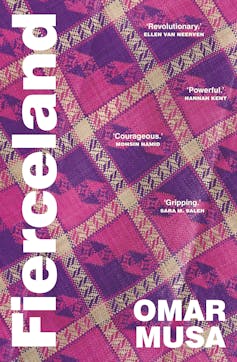
The epic novel runs amok in Omar Musa’s Fierceland
This is not the only time the epic and novelistic clash in the book. Problems of detail in the historical narrative are easily forgiven in a grand tale – for example, when a Venetian glassblower makes portraits of revolutionary Guiseppe Garibaldi and politician Camillo Cavour in 1847, 14 years before the unification of Italy known as the Risorgimento. But they become conspicuous when held to the standard of the novel’s reality principle. The portrait of Harun as a tech bro is smudged at the edges. So are the strained attempts at making Rozana into a visual artist. Maybe the most conspicuous feature of Fierceland’s strange inner drama is its use of the supernatural. It has been modish in Australian literature to extend reality by tweaking the probable since at least the 1990s. I would call this a “mannerist” distortion rather than “magic realism”, as it tends to lack a properly social content. It isn’t used to show the infractions of modernisation in Indigenous lives, as with Achebe or Marquez. Nor is it used to bracket a common historical experience, as with Rushdie. In Musa’s work, the marvellous feels closer to these original practitioners of magic realism than in most Australian literature. But it is used more often than not to signify a personal experience – usually guilt or trauma. It wavers between hallucination, virtual reality and poetry, without ever really becoming a collective experience or question. Running amok Fierceland runs amok between two impulses. On the one hand, there is the political drama of breadth, outlining the totality of the world system. On the other, there is a microanalysis of the modern malaise and the psychological claustrophobia of trauma. The novel tends to dampen the moments of intense action with reflection, while rendering the inner turmoil of the characters laughable from a historical perspective. The difficulty in fully evaluating Fierceland is that Musa seems to be aware of these stakes. The novelistic world of the individual is thrown in all its futility against the harsh reality of a fanged economic and political system. Harun and Rozana are told to “listen” and “do the work” and let the marginalised speak for themselves. Near the end of the book, a character questions the protagonists’ need to expiate their personal guilt for historical wrongs. An ethic like this poses a problem for critics. If we take it seriously, then the book’s own existence is suspect: it is yet another attempt to personalise historical problems. If, however, we allow the book to deconstruct itself, we might see the personal narratives and individual psychology early in the story work as a grand setup for a joke at the novel’s expense. It might be that Fierceland dramatises a problem that demands political action rather than aesthetic mediation. Fierceland shows us something important about the inadequacy of literature in an age of polycrisis. This doesn’t excuse its own inadequacies: the miscalculations of style, the laxity of detail, the rather convenient and elastic politics. The book fails to rise to its historical task, but in a certain way this is true of all the major work that tries to confront the complexity of modern politics, including that of Wright. The Song of the Forest alone is an undertaking that carries Musa’s novel out of the usual orbit of Australian literature. Fierceland is a tenacious reckoning with an impossible situation.

Read more https://theconversation.com/the-epic-novel-runs-amok-in-omar-musas-fierceland-266790

Why Retail Cleaning Plays a Key Role in Customer Experience

In retail environments, cleanliness directly shapes how customers perceive a brand. Retail cleaning is not just about appearance but about creating a space where shoppers feel comfortable, confident, and welcome. From small boutiques to large shopping centres, a clean retail environment... Read more

Cleaner Floors, Healthier Homes: Lefant M3L Arrives as Australians Prioritise Pet-Friendly Hygiene

As pet ownership continues to rise, Australians are placing greater emphasis on maintaining a hygienic indoor environment for both family members and their animals. Issues such as dander, loose fur, and tracked-in dirt require consistent cleaning to support better home... Read more

How Home Removalists Save Time, Money, and Energy During Your Move

Moving to a new home is an exciting chapter in life, but the process of getting there can be overwhelming. From packing and organizing to transportation and unpacking, relocation involves a long list of tasks that can consume both your... Read more

Fulfilment Australia: Streamlining ECommerce Operations for Business Growth

As eCommerce continues to thrive, efficient order fulfilment has become one of the most critical components of customer satisfaction and business success. Companies across the nation are turning to professional fulfilment Australia providers to manage inventory, packaging, and shipping operations... Read more

Evaporative Cooling Cleaning Melbourne: Keeping Your System Fresh, Efficient, and Healthy

As Melbourne’s summers grow hotter, many homes rely on evaporative cooling systems to stay comfortable. While these systems are energy-efficient and environmentally friendly, they require regular maintenance to perform at their best. Professional Evaporative Cooling Cleaning Melbourne services are essential... Read more

4 Benefits of Exploring Australia in an Off Road Caravan

Australia’s vast landscapes offer a kind of freedom that can only be fully experienced on the open road. For travellers seeking caravans for sale, choosing one built for adventure can transform any journey into a memorable one. This article will... Read more