

There are 94 million craters on Mars. Scientists found the one this meteorite called home
- Written by The Conversation
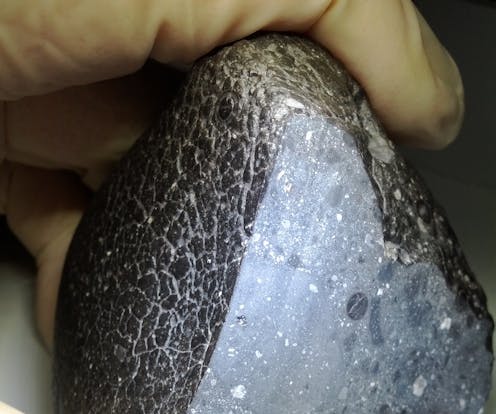
In 2011, a small meteorite was found in the Sahara Desert. Designated Northwest Africa (NWA) 7034 or “Black Beauty”, the blackened chunk of volcanic crystal turned out to be a little piece of Mars, flung into space by an asteroid impact.
But where on Mars had it come from? If we knew that, the meteorite could give us crucial clues into how our Earth-like neighbour had formed.
The red planet is covered in countless asteroid impact craters, and until recently it seemed there was no way to tell which one was the home of Northwest Africa 7034.
In new research, we sifted through more than 94 million craters to identify the origin of the rocky Martian visitor: a crater in our neighbouring planet’s southern hemisphere, created by an asteroid impact between 5 million and 10 million years ago.
Why is Earth so special?
Roughly 4.5 billion years ago, a disk of gas, dust and ice collapsed, forming the Sun, the planets, their moons and the rest of the Solar System. A few million years later, molten blobs of matter began to cool down to form rocky planets.
We know very little about this early stage of planetary evolution on Earth. Erosion and the movement of tectonic plates make it very difficult to find rocks that old.
We would like to know more about how planets form and evolve over time, because it would help us understand why Earth is so different from other planets.
Looking to Mars
To learn more about the origin of planets, space agencies are sending a plethora of probes and rovers to Mars to unravel its geological past.
Mars is often considered Earth’s sibling. In the past it hosted liquid water, forming lakes and seas, and also experienced volcanic activity for prolonged periods.
Read more: There is water on Mars, but what does this mean for life?
However, Mars has no plate tectonics and little recent erosion, so its ancient rocks are better preserved than those on Earth.
One key objective of the next generation of Mars missions is to collect samples from one particular location, the Jezero crater, and return them to Earth for analysis.
Martian meteorites
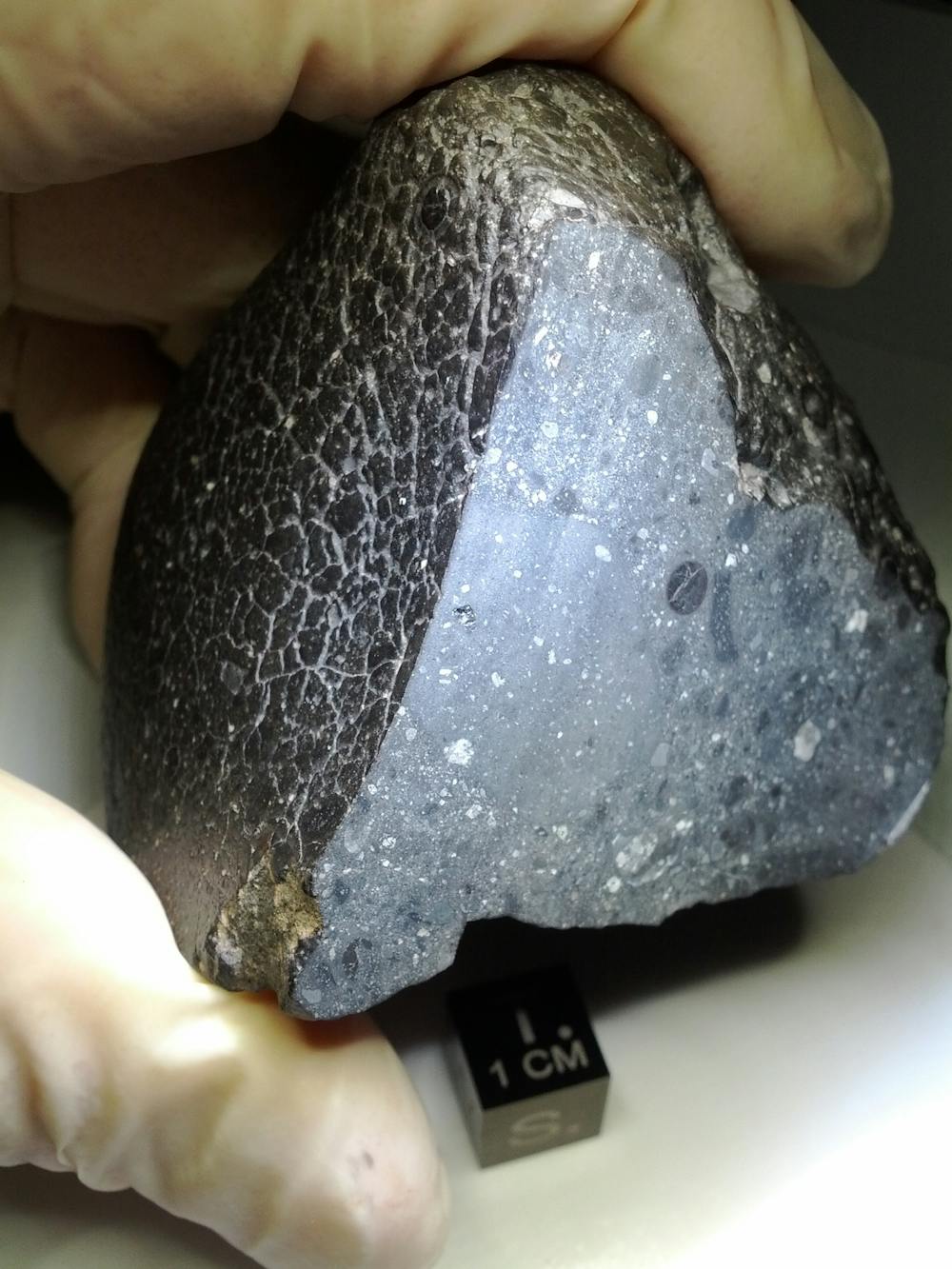
However, we already have some samples of Mars that we can thoroughly investigate. There are around 300 pieces of Mars in laboratories around the world in the form of meteorites, and they have been intensively studied over the past 30 years.
These meteorites were launched from the surface of Mars by around a dozen asteroid impacts over the past 20 million years. However, the exact locations of the sources of the only Martian rocks available on Earth are unknown.
Finding the precise origins of these meteorites would be equivalent to several free sample return missions, so researchers have been trying for decades. Only now has it become achievable, due to the introduction of machine-learning techniques.
Cataloging craters
Our research, reported this week, unveils the origin of one of the most interesting known Martian meteorites: NWA 7034, the most studied sample from Mars to date.
Using the supercomputer at the Pawsey Supercomputing Research Centre in Perth, we analysed a colossal volume of high-resolution images of Mars. With a machine-learning algorithm we developed, we identified more than 94 million impact craters.
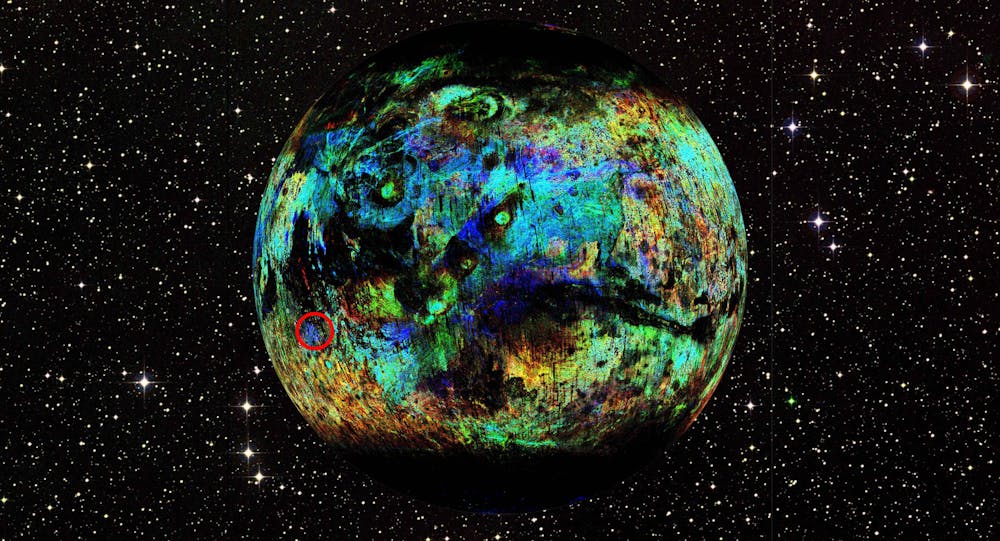 Part of the crater map of Mars, with the origin of NWA 7403 circled in red.
Anthony Lagain, Author provided
Part of the crater map of Mars, with the origin of NWA 7403 circled in red.
Anthony Lagain, Author provided
This catalogue of craters is the largest ever created and allows us to understand the history of their creation at a resolution never equalled before.
We discovered that the smallest craters, less than 100 metres in diameter, are distributed as rays, pointing outward from 19 large and very young impact craters. Those small impacts are called secondary craters, and result from the fallback of debris following a large impact.
Knowing this meant we could rule out around 80,000 craters as potential sources of the Martian metorites, as they would not have been able to eject rocks into space. We were left with only those 19 large craters.
Finding Karratha crater
Next we compared the characteristics of the NWA 7034 meteorite (essentially its age, composition and magnetic properties) with that of the surface surrounding the 19 craters, inferred from spacecraft data in orbit around the planet.
My team and I realised that only one, previously unnamed, crater could explain all the characteristics of the meteorite: a 10 km crater located in the Terra Cimmeria-Sirenum province, in the southern hemisphere of Mars.
The crater was unnamed because no-one had previously thought it was very interesting. We proposed the name Karratha, in reference to the town in Western Australia near the oldest rock ever dated from Earth.
The most exciting thing about this discovery was to establish a link between this rare sample of Mars and the unique characteristics of the Terra Cimmeria-Sirenum region.
A window onto ancient Earth
From laboratory analyses performed on this meteorite, we know it contains ancient minerals: zircons around 4.48 billion years old, older than the oldest zircons found on Earth, located in Western Australia.
The composition of some pieces of the meteorite is also very intriguing: they are comparable to today’s Earth continents. This tells us that Terra Cimmeria-Sirenum is an ancient crust hosting rocks 4.5 billion years old, with chemical and magnetic characteristics distinct from anywhere else on Mars.
Sending future missions to this identified region would enable scientists to explore what happened on Mars 4.5 billion years ago, a few million years after its formation. As the Earth lost its old surface mainly due to plate tectonics, observing such a setting in extremely ancient terrains on Mars is a window into the ancient Earth we lost a long time ago.
Read more: Does a planet need plate tectonics to develop life?


