

Indonesia says its giant sea wall will stop flooding. Is this climate adaptation or a costly folly?
- Written by The Conversation
Indonesia plans to build a “giant sea wall”, more than 500 kilometres long, to defend Java’s north coast from rising sea levels.
The proposal includes a large lagoon behind the colossal concrete wall, raising significant questions about the feasibility and cost of such a giant project.
Indonesian civil society groups say the sea wall could prompt more sand mining, degrade mangroves and affect livelihoods of fishing communities. There are fears the project will worsen existing ecological destruction caused by industrialisation. While desperate to avoid flooding, these groups don’t see a wall as the solution.
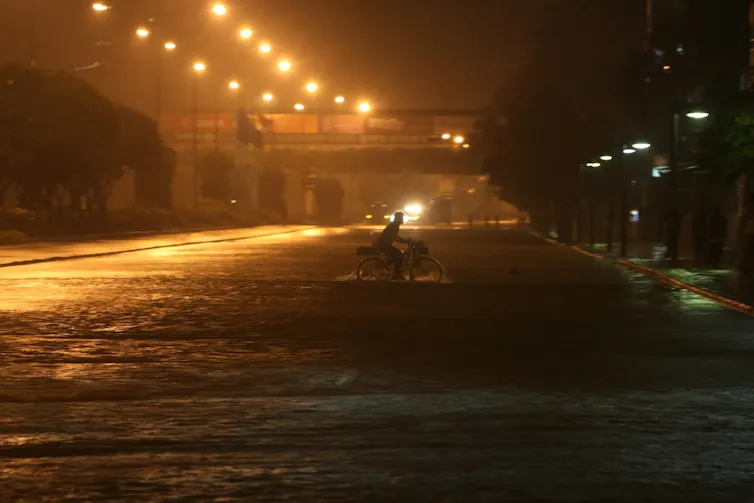
Indonesia is significantly affected by climate change, often in the form of severe and regular floods.
So, what is the best way to respond?
What is Indonesia proposing?
The sea wall plan has been framed as a flagship economic project on Java’s north coast. It will cost at least US$80 billion and take decades to build. Construction is planned to start in September 2026.
The sea wall will be overseen by several government agencies and subject to scrutiny from Indonesia’s Corruption Commission (KPK). Whether such scrutiny will be effective is an open question.
The massive cost is slated to come from provincial and national budgets, along with public-private partnerships with countries such as the United Arab Emirates. There are concerns about who will foot the large bill for long-term maintenance of the sea wall.
The rising sea
Indonesia has a long history of managing flooding by building infrastructure such as canals and dykes, reclaiming land, and deepening or straightening rivers. But such solutions often either exacerbate the problem or are only a stopgap measure before sea-level rise overtakes subsiding land.
Indonesian media and academics are pressing for a different strategy. This would include consultation with affected communities, integrated coastal management, wastewater upgrades and river cleanup, so the future lagoon does not become a low-oxygen moat behind a wall.
For Australia, Indonesia’s closest neighbour and a key strategic and economic partner, how Jakarta manages this project will shape regional security. Historically, the Department of Foreign Affairs (DFAT) has closely collaborated with its Indonesian counterpart (BAPPENAS) on infrastructure such as water projects.
Failing to consult properly with Indonesian stakeholders could lead to political fallout, while inaction might lead to food insecurity as vast tracts of rice fields become saline. Both create a less stable Indonesia, something Canberra wants to avoid.

A island under pressure
On the north coast of Java – the world’s most populous island and the economic heart of Indonesia – flood risk is driven by land subsidence and land use.
Subsidence (the gradual sinking of land), and related coastal erosion in Java is common. It is caused by a range of factors, such as excessive and unregulated groundwater extraction, building load, mangrove deforestation, the construction of seawalls, and increases in soil moisture.
In our recent research, we show the way different levels of government communicate these problems change how people understand these messages, potentially undermining imperatives to reduce groundwater extraction.
What does the evidence show?
Recent modelling suggests offshore structures can reduce storm surge heights in some locations, but outcomes varied by location and the local underwater environment. These types of coastal adaptation projects have historically been sites of political argument and corruption.
Our ongoing work with Indonesian researchers in three villages in Kendal, central Java, shows how flooding defences such as seawalls, raised roads, and home grants can partially address the risk, but not solve it.
Grants of around A$2,000 helped some households lift floors, walls and roofs, but rarely covered the full cost. Poorer families sometimes declined once they understood the co‑financing burden.
Meanwhile, raised roads and flood walls channelled water into nearby low‑lying homes. This reshaped livelihoods, neighbourhood interactions and community dynamics. We also recorded saltwater intruding onto productive land that had previously avoided regular tides.
In short, works that don’t also address the causes of subsidence can redistribute harm and entrench inequity. They can also affect one of the stated reasons for building the giant seawall: addressing Indonesia’s food security.
Can this sea wall work?
The best question is not “wall or no wall”, but if it is possible to construct as giant sea wall that works as intended.
If it is possible to regulate and enforce groundwater extraction, clean rivers, and design coastal works with local communities, the unintended consequences of flood infrastructure can be minimised.
With those reforms, Java’s giant sea wall could be a useful part of a wider adaptation portfolio. Without them, it risks becoming an expensive folly.
We would like to thank Rusli Cahyadi and Yogi Setya Permana (Indonesian National Institute of Research and Innovation - BRIN), and Muhammad Lukman Arifianto and Lukman Hakim (The University of Queensland) for their feedback on this article.
Correction: This article originally stated the wall would be constructed from cement, rather than concrete.


