

'We felt like we're nothing': increasing voting among Australians experiencing homelessness
- Written by The Conversation
At every federal election, there is a moment when election-watchers turn their attention to the seat of Eden-Monaro in New South Wales. Between 1972 and 2013, the party that formed government won Eden-Monaro. It was (and for some, still is) considered a bellwether seat – what happens in Eden-Monaro is representative of the Australian electorate at large.
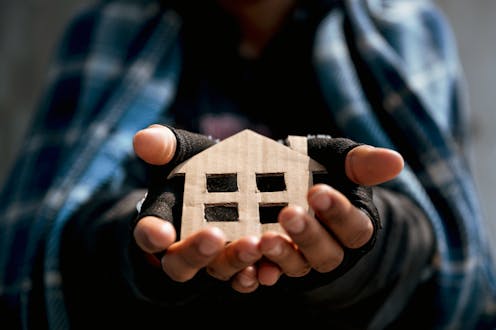
But there is another election bellwether we never hear about: people experiencing homelessness. Taken as a group, those who experience homelessness are representative of multiple forms of disadvantage and marginalisation.
Yet this is a very diverse group of people. While rough sleepers are the most recognisable, homelessness encompasses living in overcrowded accommodation, couch surfing, and being forced to sleep in cars, caravans or tents.
Read more: What’s in the name 'homeless'? How people see themselves and the labels we apply matter
Homelessness in Australia
On any given night, an estimated 116,000 people experience homelessness in Australia. It would be natural to assume that for those affected, finding a home is far more important than voting in an election. Yet the assumption that the need for housing supersedes the need to belong to a political community is not always true. Material needs and the need to belong co-exist and are interdependent.
Beyond the older, single, white male who typifies representations of homelessness, there are disproportionate numbers within this group of unhoused Aboriginal and Torres Strait Islanders, young people, older women, war veterans, ex-prisoners, people who were in out-of-home care as children, people with disabilities, and LGBTIQ+ communities.
People experiencing homelessness commonly also present with trauma, experience of family and domestic violence, and mental health concerns. Compounding this is the current housing crisis, where entirely new groups are entering homelessness service systems.
What our research showed
Working with the Australian Electoral Commission (AEC) and three specialist homelessness service providers in Adelaide over the 2019 federal election, we undertook one of the largest studies of homelessness and voting habits.
With 164 participants, our research demonstrated that while people experiencing homelessness have much lower enrolment and turnout rates than the general population, this is not due to lower levels of political interest.
In fact, we found political interest among this group was higher in some respects than the general population. As one of the participants in our study said about the act of voting:
That was one of the main things for me, the politicians knowing that okay, we are constituents, members of society, the homeless are actually coming out to vote, that my vote matters.
With a turnout rate in excess of 90% of enrolled voters, Australia has one of the most equitable electoral systems in the world. However, estimating the turnout rate for people experiencing homelessness is considerably more difficult. Data from small sample interactions - unhelpfully - places turnout at between 10 and 67%.
Disillusionment, not apathy
Our study did not attempt to definitively measure the turnout rates of people experiencing homelessness, though about a fifth of our participants reported voting regularly.
Despite the many barriers and disincentives to voting for this group, we found that disillusionment was the real problem. Most participants cared about voting and were interested in elections, but did not vote because they thought it was pointless. As one participant told us:
Why should we vote for someone who doesn’t want us? Who doesn’t want to look after us? […] All of us felt left out, we felt like we’re nothing. And we’re human beings, not animals to walk on just because we’re poor.
Those exit-polled at AEC pop-up booths at specialist homeless services expressed similar sentiments:
I felt sad […] I looked at those pieces of paper and I folded them up and I put them in the box and I walked away in disgust.
Over 80% of our participants said that voting was important yet most of them did not vote, and those who did reported mixed feelings about their electoral participation.
This reflects broader and deeper issues with political representation, especially of people experiencing disadvantage. Voting is how citizens assert their equality with other citizens, make their voices heard, and protect themselves from government neglect. As political scientist Walter Dean Burnham once said: “if you don’t vote, you don’t count”.
Increasing participation
Our study identified numerous ways electoral commissions can improve turnout for those experiencing homelessness. This includes permitting specialist homelessness service providers to be listed as residential addresses. This would allow homelessness service users to enrol and vote in the communities where they have meaningful connections.
We also recommended that any legislative, procedural, or operational changes, such as changes to voter identification requirements or enrolment processes, consider the potential impact on people experiencing homelessness.
However, the disillusionment with the political system felt by many experiencing homelessness is more serious and harder to tackle because it is informal and cultural.
The irony, of course, is that higher levels of electoral participation would make it harder for mainstream parties to ignore the needs, concerns and priorities of the most marginalised.
Being counted matters. We should do everything we can to ensure access to voting, the basic democratic right that protects and enhances all other rights.


