

Why a temporary flood levy on higher earners would be the fairest way to help pay for Cyclone Gabrielle
- Written by The Conversation
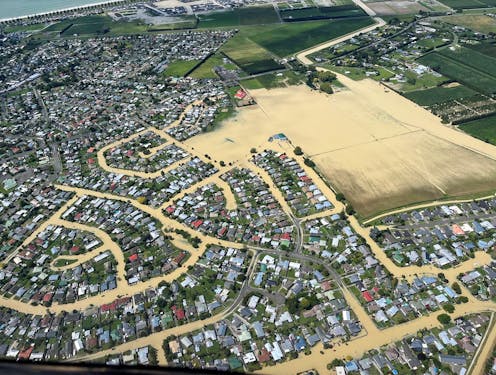
Cyclone Gabrielle’s trail of misery and destruction presents a major fiscal and political dilemma for the government: how should the country pay for the recovery? Does it borrow now and spread repayment over generations, or raise taxes in an election year?
Either way, the cost is significant. Finance Minister Grant Robertson has estimated the bill for fixing damaged or destroyed infrastructure at NZ$13 billion – equivalent to 11.5% of tax revenue collected in the year to June 2022.
According to Waka Kotahi, just repairing roads in the affected areas will cost an estimated $1 billion – more than a fifth of the agency’s usual annual expenditure.
On top of all this, New Zealand is still grappling with inflation and a cost-of-living crisis. The likley stimulus effect of significant government spending has to be part of the government’s calculations.
Between a rock and a hard place
Reserve Bank governor Adrian Orr has already suggested those in power will need to choose carefully between borrowing and raising taxes. The first option is predicted to stoke inflation. The second is politically challenging in an election year when the opposition is offering tax cuts.
Borrowing is undoubtedly the more politically attractive option for the government. The burden of repaying capital and interest could be spread over several years, perhaps over generations. (There are precedents for extreme debt spreading – some British government debt incurred in the 1750s was only repaid in 2015.)
Borrowing money then spreading capital and interest costs over generations is a reasonable option for infrastructure projects, such as a dam that might be expected to last 100 years.
But the problem with borrowing to fix the damage caused by Cyclone Gabrielle is that we don’t know if, or when, another catastrophic weather event will occur. In fact, we seem to be experiencing so-called hundred-year storms with increasing frequency.
The burden of borrowing
Adrian Orr has also cautioned that borrowing is likely to increase inflationary pressures. If that happens, we can expect the Reserve Bank to move the official cash rate higher sooner, prompting retail banks to raise interest rates.
This will cause further pain for owners of mortgaged properties and businesses with high levels of borrowing. The economy could move into a deep recession as a result. There is a risk, too, of the economic nightmare of stagflation (recession and inflation, last seen in the 1970s) reappearing.
The government also needs to consider whether it’s fair to borrow to fix current problems. Younger generations already face the prospect of a bearing a disproportionate tax burden of funding the superannuation and health costs of older people.
And shifting an unpredictable climate-related debt burden between generations appears unfair. Even if global warming is restricted to 1.5℃ from pre-industrial levels, it’s impossible to predict whether Gabrielle-type events will become the new normal, or what other climate change remediation future generations will have to fund.
The trouble with tax
While increasing taxes would not create the same financial problems as borrowing, it’s clearly less politically attractive in an election year. But if we were to assume the government might take this option, which taxes might be increased or introduced?
In the medium to long term, a shift to carbon taxation is needed, but that won’t solve the current fiscal problems. The rates base in cyclone-affected areas has been decimated, and there is no precedent for cross-subsidisation between local government authorities.
An increase on the goods and services tax (GST) might be anti-inflationary, but it would disproportionately affect lower-income groups. And a steep increase in fuel levies, while theoretically attractive, is politically implausible in an inflationary environment.
A punitive tax on forestry companies – a type of reverse windfall tax – might have some populist appeal, given the role of slash in cyclone damage. But this could lead to job losses in some of the poorest parts of the country. Besides, reform will be best achieved through fundamental changes to forestry practices rather than an ad hoc tax.
The introduction of entirely new taxes – such as a land tax, a comprehensive capital gains tax, or some form of wealth tax – would takes years to craft and implement. That leaves an income tax increase as the only plausible option.
A fairer flood levy
Income tax surcharges are common during wartime. Countries like Germany and South Africa introduced temporary “solidarity” surcharges to fund national reconstruction or reunification (although the German Solidaritätszuschlag has still not been fully abolished).
But the most relevant precedent for New Zealand is the flood levy raised by the Australian government in 2011 to help pay for the devastating Queensland floods.
Read more: Flooded Home Buyback scheme helps wash away the pain for Queenslanders
For one year only, taxpayers with an annual income between A$50,000 and $100,000 paid an extra 0.5% levy, while those earning over $100,000 paid an additional 1%. Taxpayers living in the affected areas were exempt from the levy, which was designed to raise A$1.8 billion.
In my view, the Queensland levy provides an appropriate template for partly funding infrastructure remediation after the catastrophe of Cyclone Gabrielle. A flood levy on higher earners would make a significant contribution to recovery funds and would send a message of solidarity: we are all in this together.
Regardless of what the government decides, in the years ahead we need to debate how taxes may alleviate the harm suffered by people and businesses after natural disasters, fund remediation and – maybe most importantly – reduce carbon emissions.


