

Are Western sanctions on Iran making a difference?
- Written by The Conversation
The Iranian Islamic regime has been seriously challenged since the start of public protests last September. The government has sought to contain and suppress the protesters – even resorting to executions – but has been unable to stop them.
There are continuing reports of mass demonstrations in various parts of the country, including in the capital Tehran and other major cities in recent weeks.
The European Union last week placed new sanctions on Iranian individuals and entities, but stopped short of labelling the Revolutionary Guards a terrorist group. Australia has also imposed new sanctions on Iranian officials, but critics have said it is not sufficient.
Read more: Iran executions: the role of the 'revolutionary courts' in breaching human rights
Regime endures despite decades of protests
This is not the first time the Islamic regime has been besieged by protests. It has faced many domestic and foreign policy challenges over the past 40 years, including severe Western sanctions and international isolation.
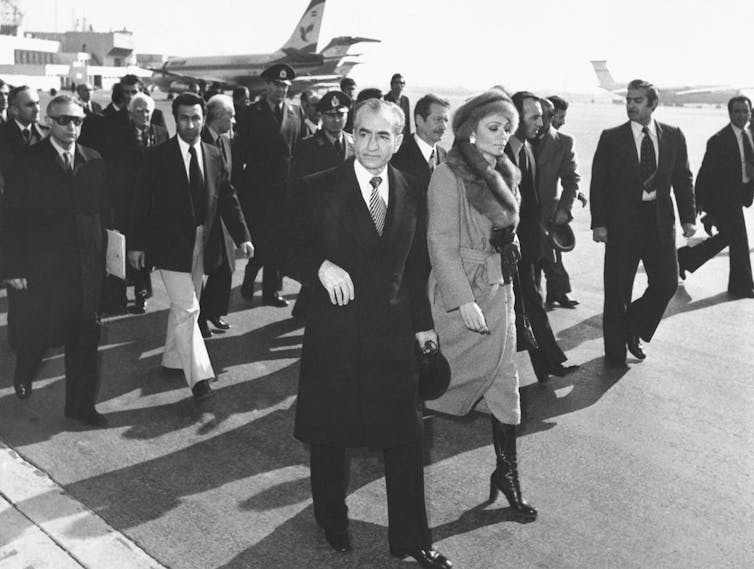
The regime came to power in the wake of the momentous revolution of 1978-79 that toppled the pro-Western monarchy of Mohammad Reza Shah. This propelled his key religious and political opponent, Ayatollah Ruhollah Khomeini, to transform Iran into a radical, predominantly Shia Islamic republic, with an anti-US posture.
Since then, Iran has been marked by growing domestic discontent over the regime’s conservative religious laws, political oppression, corruption and economic woes. The US has also frequently criticised the regime for human rights violations, its alleged frequent meddling in its neighbours’ affairs, and its controversial nuclear program.
Yet, the regime has managed to stay in power with a mix of force to contain internal opposition and ideological and pragmatic resilience to rebuff outside pressure.
In the process, the state has endured, but the society has suffered from religious restrictions, poor governance, economic decline, social and cultural stagnation and endemic corruption, despite Iran being an oil- and gas-rich country.
A new crisis for the regime
The current wave of protests – the largest and longest in the Islamic Republic’s history – was sparked by the death of a young Kurdish woman Mahsa Amini while in the custody of the regime’s notorious morality police. She had been arrested for for not wearing her hijab properly last September.
This tragic episode drove large masses of Iranian women, most from the post-revolutionary generation, to take to the streets for the first time. Their slogan became ubiquitous: “women, life, freedom”.
Given the widespread public grievances over other issues, the ranks of the protesters rapidly snowballed, signalling a revolutionary direction.
Shocked by the scale of the protests, the regime has used brute force to suppress them. So far, more than 500 demonstrators have been killed, many more injured and tens of thousands detained. At least four protesters have been hanged on charges of “war against God” or “corruption on earth”.
Do sanctions matter?
Most of the authoritarian governments in the region, plus Russia and China, have remained mute on the regime’s crackdown. But the West and human rights organisations have been outraged.
The US, UK and EU have condemned the regime’s repressive actions at home and supply of arms to Russia in support of its aggression in Ukraine. They have imposed multiple rounds of sanctions on the regime, including last week.
Members of the Iranian diaspora, including those in Australia, have also urged democracies around the world to put greater pressure on the regime.
In line with the US and its other allies, the Australian government also announced new Magnitsky-style sanctions on the regime in early February, targeting 16 law enforcement, political and military officials, including those with the powerful Islamic Revolutionary Guard Corps.
This came after criticism the government has been too slow and “risk-averse” to act.
An Australian Senate inquiry has also recommended designating the Revolutionary Guards a terrorist organisation – a move taken by the US and Canada.
But the Australian government has not so far acted on the Senate inquiry’s recommendation, probably because it wants to keep lines of diplomatic communication open. The UK has also resisted for similar reasons.
The reality, though, is that sanctions are unlikely to have any more impact on the regime than what it has experienced during most of its existence. No outside measure is likely to deter the governing clerical elite from ensuring its survival.
The Basij paramilitary forces and other individuals targeted by Canberra hardly have any assets in Australia. Furthermore, the volume of trade between the two countries has dwindled over the years, amounting to just A$205 million in 2020-21.
However, sanctions do have symbolic value. Canberra could also go a step further by severing diplomatic ties, though this will not be in the interest of keeping the lines of communications open.
What could come next?
As of late, Supreme Leader Ayatollah Ali Khamenei has reportedly pardoned many of the detained protesters. This amnesty, however, doesn’t apply to everyone and comes with conditions.
But this may not mark the end of the story. The regime is well-entrenched and possesses all the necessary means to get even tougher. Many of those who created it still run it. Their fortunes are intimately tied to the survival of the theocratic order.
The protesters have also shown a remarkable determination to continue their actions in one way or another. The scene is set for more troubled times ahead.
Read more: How female Iranian activists use powerful images to protest oppressive policies
Read more https://theconversation.com/are-western-sanctions-on-iran-making-a-difference-199302


