

Electricity flow in the human brain can be predicted using the simple maths of networks, new study reveals
- Written by The Conversation
Through a vast network of nerve fibres, electrical signals are constantly travelling across the brain. This complicated activity is what ultimately gives rise to our thoughts, emotions and behaviours – but also possibly to mental health and neurological problems when things go wrong.
Brain stimulation is an emerging treatment for such disorders. Stimulating a region of your brain with electrical or magnetic pulses will trigger a cascade of signals through your network of nerve connections.
Read more: What is repetitive transcranial magnetic stimulation and how does it actually work?
However, at the moment, scientists are not quite sure how these cascades travel to impact the activity of your brain as a whole – an important missing piece that limits the benefits of brain stimulation therapies.
In our latest research, published in Neuron today, we discovered the spread of brain stimulation can be predicted using the mathematics of networks.
Tracking electrical signals in the brain
Studying communication in the human brain is hard. This is because electrical signals move very fast, at the scale of thousandths of a second, between one part of the brain and another.
To make matters more complicated, signals are communicated via an incredibly complex network of nerve fibres that interlinks all brain regions. These issues make it difficult for scientists to even observe signals travelling through the brain.
Read more: Like sightseeing in Paris – a new model for brain communication
However, under very special and controlled circumstances, we can use invasive electrodes to precisely track the propagation of brain signals. Invasive electrodes are instruments that are surgically inserted into the brains of consenting patients.
It is important to stress this type of invasive procedure can only be done in very special circumstances, when the primary goal is to help patients. In our case, patients were people with severe epilepsy. When epilepsy patients do not respond to medication, they can opt to use electrodes to help doctors find out more about what might be happening in their brains.
Our study was based on a large group of 550 epilepsy patient volunteers in more than 20 hospitals across North America, Asia and Europe.
The electrodes provide a way to gently stimulate a brain area with an electrical pulse, and, at the same time, record the patient’s brain activity. We used data from electrodes placed in different positions of the brain to track the communication of electrical pulses from one region to another.
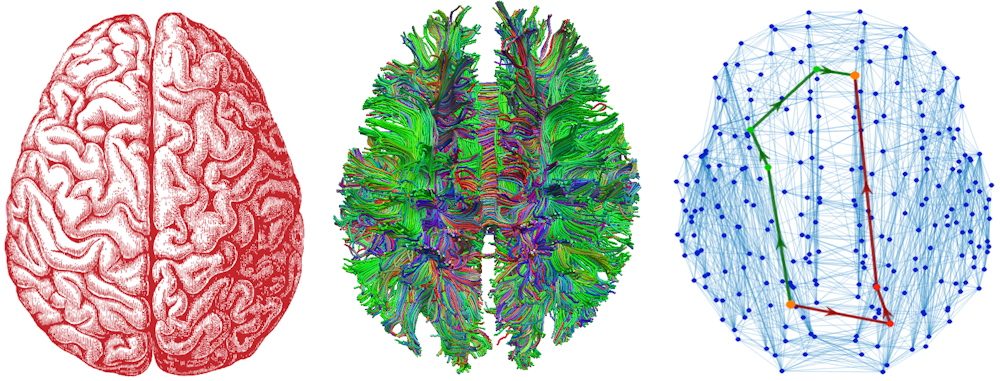
As a last ingredient for our study, we used MRI scans to reconstruct the network of nerve fibres of the human brain, known as the connectome. This gave us a model of the physical wiring through which electrical signals are communicated in the brain.
The mathematics of network communication
So, how are signals communicated via the complex wiring of the connectome?
A simple possibility is signals travel via the most direct paths in the connectome. In network terms, this would mean that an electrical pulse goes from one region to another via the shortest path of intermediate regions between them.
Another idea is that signals spread via network diffusion. To understand this, think about how water would flow down a network of pipes.
Each time the water reaches a junction in the network, the flow is split along diverging paths. More junctions along the water’s journey means more splits, and the flow along any given path becomes weaker. However, if some of the diverging paths meet again downstream, the strength of the flow increases again. In this analogy, all connections (pipes) in the network contribute to shaping signal (water) flow, not only the ones along the most direct path.
What we found
These two types of network communication – shortest paths versus diffusive flow – are two competing hypotheses to explain how electrical signals cascade through the wiring of the connectome after brain stimulation. Today, scientists are not sure which hypothesis best matches what happens in the brain.
Our study is one of the first to try to settle this debate. To do this, we asked whether shortest paths or diffusion best predict electrical signal propagation, as measured by the electrodes in the brains of the patients.
After analysing the data, we found evidence supporting the diffusive flow hypothesis. This means that many more nerve connections – compared to just the ones travelling along shortest paths – shape how brain stimulation cascades down the connectome.
This is important information for scientists, as it helps us understand how the physical wiring of nerve connections contributes to brain activity and function.
Read more: Your brain has 'landmarks' that drive neural traffic and help you make hard decisions
What’s next?
Our study is one of the first of its kind and more work is necessary to confirm what we found. We hope that progress in our understanding of brain communication will also help clinical scientists to design better brain stimulation treatments for mental health problems.
Brain stimulation can help to “restore” the malfunctioning communication between brain regions. For example, non-invasive stimulation (done outside the skull and without the need for surgery) is a treatment for major depressive disorder available in Australia.
In our future research, we will investigate if the discoveries reported here can be used to improve the therapeutic benefit of such brain stimulation treatments.


