

Extinct but not gone – the thylacine continues to fascinate us
- Written by The Conversation
Human life on Earth is utterly dependent on biodiversity but our activities are driving an increase in extinctions. Yet some extinct species continue to hold our fascination. New methods in genetics and reproductive biology hold the promise that de-extinction – resurrecting extinct species – could soon be possible.
But bringing back extinct species is costly. Shouldn’t our focus be on preventing further extinctions?
Almost 20 years ago, for instance, it was looking like impending doom for the Tasmanian devil. It’s the world’s largest surviving marsupial carnivore after the loss of the thylacine. In the words of Oscar Wilde, “to lose both looks like carelessness”.
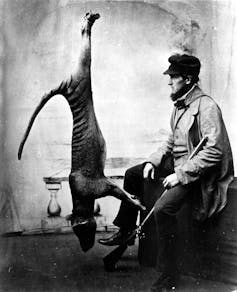
The enigmatic thylacine, also known as the Tasmanian tiger, continues to capture people’s attention. The size of a wolf, it was officially declared extinct in its last stronghold in Tasmania. Lost before it was ever appreciated or studied, the thylacine is known only from anecdotes.

An iconic symbol of extinction for many but also a symbol of hope, the thylacine has high cultural significance. This iconic animal might still be here if the European colonisers of Tasmania had appreciated a few decades earlier just how unique the thylacine was, as the last member of the marsupial carnivore family Thylacinidae, and stopped persecuting it.
A new book, Thylacine: The History, Ecology and Loss of the Tasmanian Tiger, presents new evidence-based knowledge about the thylacine in 78 contributions (I wrote the introduction). New scientific and historical methods and large databases mean we can learn much about the ecology and history of this animal from remains it left behind – bones, DNA in skin and bones, rock art, oral histories and historical records.
Read more: Can we resurrect the thylacine? Maybe, but it won't help the global extinction crisis
We can learn from extinctions to prevent more
To stem the rate of extinctions we need to better understand the processes of extinction and the species we have lost. To restore species and ecosystems, we need to know the context of how loss of species and their ecological functions has already changed the natural world.
Preventing further extinctions and recovering threatened species need to be the priority. Even common species can slip away rapidly before we notice.
The Tasmanian devil was widespread and abundant before a unique transmissible cancer emerged, cause unknown. Within 30 years of its appearance in the mid-1990s, it spread across the devil’s island range. The population was reduced by 80%.
 European colonists’ hunting of the thylacine was not the sole cause of its extinction.
AAP/Supplied image
European colonists’ hunting of the thylacine was not the sole cause of its extinction.
AAP/Supplied image
The final demise of the thylacine in the early 1900s appeared rapid and is not easily explained by persecution for alleged sheep killing or disease.
Many of us still hold out hope the thylacine will be found again. We rarely know the exact date and time of a species extinction. And more than half of Tasmania is remote and unchanged – rugged country that would have supported low numbers of thylacines.
The thylacine’s former strongholds in productive parts of Tasmania are now farmed and humans have dramatically altered the landscape in other ways. People still report seeing thylacines, but sightings are subject to psychological biases. In other words, we need a verifiable record of an actual live thylacine to confirm its existence.
Still, despite the compounding odds against its rediscovery, the thylacine offers hope.
Read more: Tasmanian tigers were going extinct before we pushed them over the edge
To restore ecosystems, we need to understand what’s lost
To conserve species and restore ecosystems effectively we have to understand historical context.
The thylacine was an apex predator, at the top of the food chain, albeit one that hunted smaller prey relative to its size. This meant it competed for prey with smaller carnivores. Thylacines may have shaped the behaviour and reduced the abundance of devils and quolls and their prey, wallabies and pademelons. This competition thus affected how the devil and quolls evolved in terms of prey size and the size of their canine teeth.
Wedge-tailed eagles are probably the closest analogue now to the thylacine.
Losing one species can have cascading effects on the loss of others. The significance of the co-extinction of the single known host-specific parasite of the thylacine is unknown. However, the important role of parasites in ecosystems is generally under-appreciated.
The thylacine lives on in culture
Thylacines were part of the place-based cosmologies of Aboriginal peoples. Aboriginal peoples hold long intergenerational knowledge of thylacines, even 3,000 years after their extinction on mainland Australia.
In some places, this knowledge is associated with rock art depictions, which may be regarded as being made by ancestral beings. Oral or written stories are important in maintaining a connection to the animal and for reimagining the future. They nourish the hope of seeing the animal again and imagining a connection to its legacy.
In Tasmania, there are constant reminders of the thylacine, which features on logos and the Tasmanian coat of arms.
Read more: Should we bring back the thylacine? We asked 5 experts
We still dare to hope for its return
The thylacine might be gone but, in our enthusiasm for seeking knowledge of its ecology, there is still hope it will turn up once again.
The thylacine played an important role in Tasmanian ecosystems and on the Australian mainland. Understanding this role and the factors leading to its extinction provides important context for saving other species and for restoring ecosystems.
Read more https://theconversation.com/extinct-but-not-gone-the-thylacine-continues-to-fascinate-us-201865


