News Daily


Men's Weekly

Australia

  • Written by The Conversation
How butterflies conquered the world: a new 'family tree' traces their 100-million-year journey across the globe

How old are butterflies, and where did they evolve? And perhaps more importantly, how and when did they reach the isolated continent of Australia?

Answers to these simple questions have baffled scientists for decades. Until recently we had very little idea when butterflies evolved, and hypotheses concerning their place of origin were largely educated guesses.

In recent years, however, several studies have indicated butterflies most likely arose sometime during the Cretaceous period, when dinosaurs dominated the Earth. Now, an international collaboration (of which I am a member) has placed the time of origin much more precisely: 101.4 million years ago, give or take 1.2 million years.

These early butterflies were different from nocturnal moths, their ancestors. They flew during the day, rather than at night, and were attracted to brightly coloured flowers for their rich nectar.

A 100-million-year history

To reach this conclusion, researchers from dozens of countries needed to construct the world’s largest “family tree” of butterfly species. This tree of life was assembled with DNA from 2,244 species representing all butterfly families and 92% of genera.
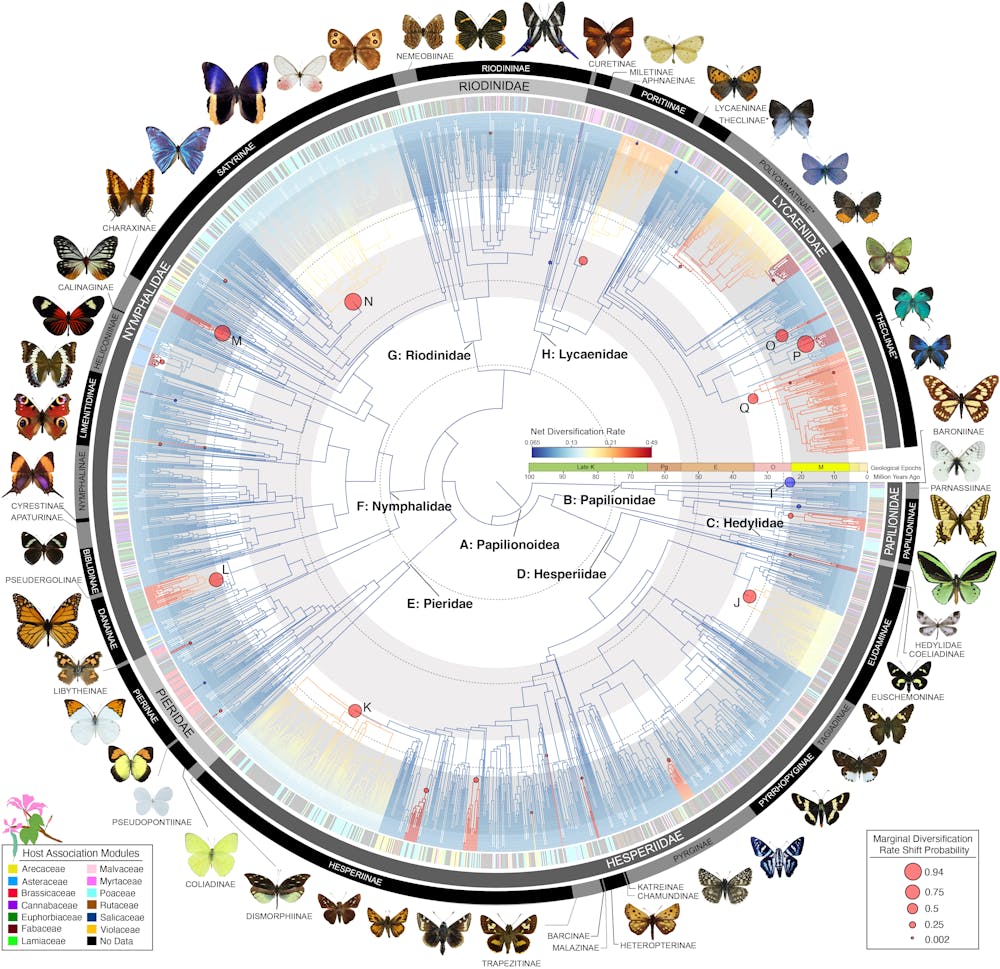
The ‘family tree’ of butterfly species was pieced together using DNA from 2,244 species. Kawahara et al. / Nature Ecology & Evolution, CC BY

There are roughly 19,000 butterfly species in the world, and piecing together the 100-million-year history of the group required assembling the world’s largest dataset of butterfly DNA sequences, geographical distributions and larval host plants.

Underlying the analysis were 11 rare butterfly fossils, without which the analysis would have been impossible. Butterflies are rarely preserved in the fossil record, and those that are preserved are frequently difficult to identify.

These fossils served as calibration points on the evolutionary tree. Once the tree was calibrated researchers could then estimate the timing of key events in butterfly evolution, starting with their origin.

North American origins

Not only did this latest study determine the age of butterflies, it also discovered where the butterflies first originated. By assembling a database of the distributions of all modern species and the plants on which they lay their eggs, the scientists were able to trace the movements of butterflies through time and space.

The study tells a dynamic story – one rife with rapid diversifications, faltering advances, and improbable dispersals. Some groups travelled over what seem impossibly vast distances, and others seem to have stayed in one place while continents, mountains and rivers moved around them.
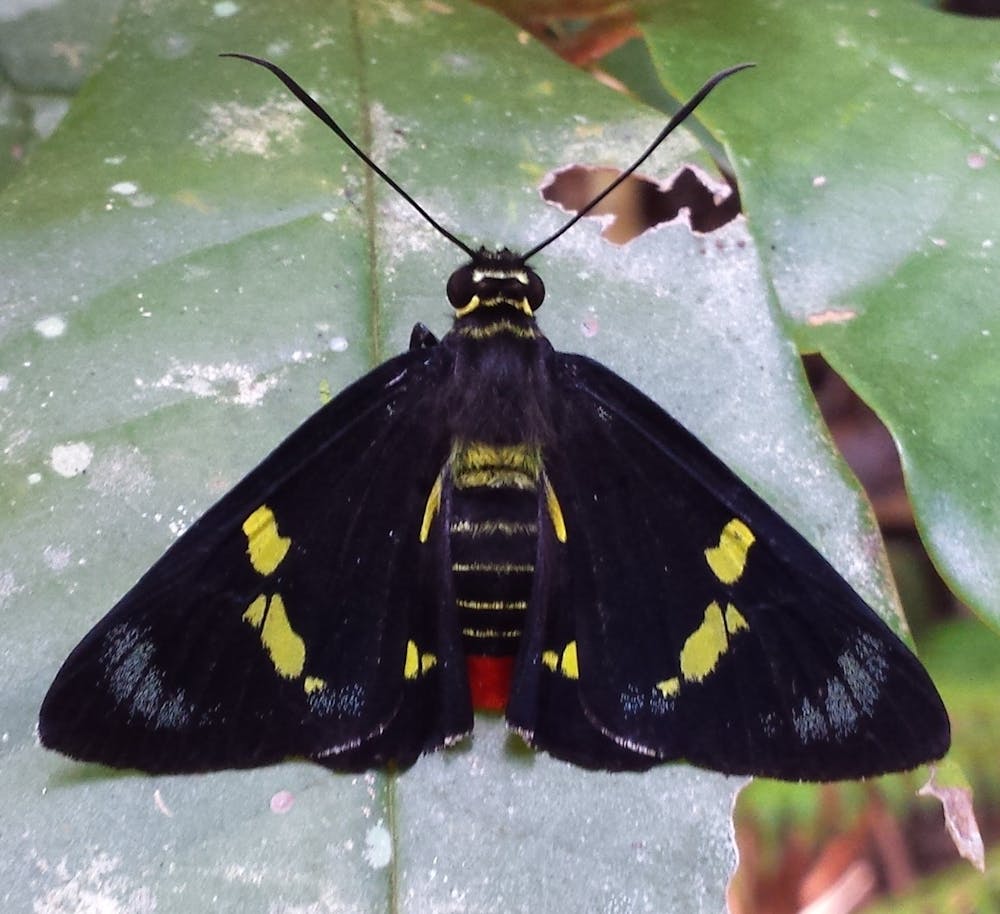
A photo of a black butterfly with yellow markings sitting on a green leaf. The Regent Skipper butterfly (Euschemon rafflesia), found only in the rainforests of Australia’s east coast, is the last remaining species of the Euschemoniinae subfamily. MF Braby, Author provided

According to this latest research, butterflies first appeared somewhere in Central and western North America.

At that time in the mid-Cretaceous, the continent of North America was part of eastern Laurasia, and it was bisected by an expansive seaway that split the continent in two. Present-day Mexico was joined in a long arc with what is now the United States, Canada and Russia.

North and South America had not yet joined via the isthmus of Panama, but butterflies seem to have had little difficulty crossing the water gap into the Southern Hemisphere. Once they reached South America, the early butterflies diversified to an astonishing degree.

From there, many groups not only moved back into North America, but they also dispersed to Australia via Antarctica. At the time, the three continents were still connected to form Southern Gondwana, a remnant of the supercontinent Gondwana. The path to Australia – and the rest of the world Two of the earliest butterfly lineages to reach Australia via Antarctica were the subfamilies Coeliadinae (awl skipper butterflies) (around 72 million years ago) and Euschemoniinae (around 65 million years ago). The Euschemoniinae are a group of butterflies found only in Australia, containing just a single remaining species – the spectacular regent skipper (Euschemon rafflesia) – restricted to the rainforests along the east coast. To reach Australia, butterflies must have once lived in Antarctica in the Late Cretaceous and Early Paleogene periods when global temperatures were considerably warmer than today. They would have made their way across the continent to Australia before the two landmasses separated some 34 million years ago. A photo of a butterfly with black wings and iridescent blue-green markings. The greater peacock awl butterfly (Allora major) is descended from the first butterflies to reach Australia some 72 million years ago. CSIRO Publishing, Author provided Other groups of butterflies entered Australia much later via the islands of South-East Asia. They had earlier reached Asia from North America across the Bering land bridge. From there, they quickly covered ground, spreading and diversifying across Southeast Asia, the Middle East and the Horn of Africa. They even made their way to India, which was then an isolated island, separated by kilometres of open sea on all sides. Once butterflies had become established in Central and North America approximately 101 million years ago, they quickly diversified alongside their plant hosts over the next 25 million years, with the last two families (Riodinidae and Lycaenidae) evolving around 76 million years ago. By the time dinosaurs were wiped out 66 million years ago, all six modern butterfly families had arrived on the scene.

Read more https://theconversation.com/how-butterflies-conquered-the-world-a-new-family-tree-traces-their-100-million-year-journey-across-the-globe-205487

Why Choosing the Right Dental Clinic Matters for Long Term Oral Health

Maintaining good oral health requires regular checkups, preventive care, and professional treatment when needed. Visiting a trusted Dental Clinic plays a vital role in keeping teeth and gums healthy while preventing more serious dental problems in the future. Many people only... Read more

Is Deep Plane Facelift Safe in Thailand?

When you ask whether a deep plane facelift is safe in Thailand, you’re really asking: “Can I get high-quality surgical care with strong safety standards and reliable follow-up while I’m traveling?” That’s a smart question. But the country name alone... Read more

Why Cloud Services Are Now Essential for Business Growth and Security

In today’s fast-moving digital environment, understanding how cloud services support long-term stability has become a priority for businesses across Australia. As expectations shift and workplaces adopt more flexible models, organisations are turning to cloud services to keep systems running smoothly... Read more

Steel Cutting Services: Precision That Shapes Modern Construction

In today’s construction, manufacturing, and fabrication environments, steel cutting services play a vital role in turning raw steel into practical, usable components. From large-scale infrastructure projects to bespoke architectural features, the accuracy and quality of steel cutting directly influence the... Read more

Lighting Stores Perth: Expert Guidance for Inspired and Functional Spaces

Choosing the right lighting can completely change how a space feels, functions, and flows. Trusted lighting stores Perth play a crucial role in helping homeowners and businesses make confident lighting decisions that go beyond appearance alone. Lighting influences mood, productivity, comfort... Read more

Why Retail Cleaning Plays a Key Role in Customer Experience

In retail environments, cleanliness directly shapes how customers perceive a brand. Retail cleaning is not just about appearance but about creating a space where shoppers feel comfortable, confident, and welcome. From small boutiques to large shopping centres, a clean retail environment... Read more