

A dramatic volcano eruption changed lives in Fiji 2,500 years ago. 100 generations have kept the story alive
- Written by The Conversation

Can you imagine a scientist who could neither read nor write, who spoke their wisdom in riddles, in tales of fantastic beings flying through the sky, fighting each another furiously and noisily, drinking the ocean dry, and throwing giant spears with force enough to leave massive holes in rocky headlands?
Our newly published research in the journal Oral Tradition shows memories of a volcanic eruption in Fiji some 2,500 years ago were encoded in oral traditions in precisely these ways.
They were never intended as fanciful stories, but rather as the pragmatic foundations of a system of local risk management.
Life-changing events
Around 2,500 years ago, at the western end of the island of Kadavu in the southern part of Fiji, the ground shook, the ocean became agitated, and clouds of billowing smoke and ash poured into the sky.
When the clouds cleared, the people saw a new mountain had formed, its shape resembling a mound of earth in which yams are grown. This gave the mountain its name – Nabukelevu, the giant yam mound. (It was renamed Mount Washington during Fiji’s colonial history.)
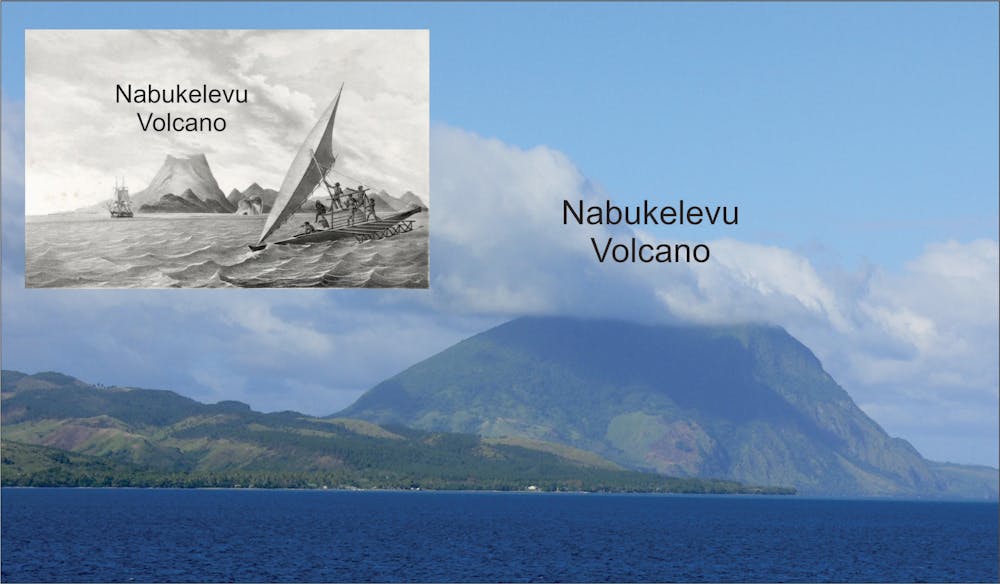
So dramatic, so life-changing were the events associated with this eruption, the people who witnessed it told stories about it. These stories have endured more than two millennia, faithfully passed on across roughly 100 generations to reach us today.
Scientists used to dismiss such stories as fictions, devalue them with labels like “myth” or “legend”. But the situation is changing.
Today, we are starting to recognise that many such “stories” are authentic memories of human pasts, encoded in oral traditions in ways that represent the worldviews of people from long ago.
In other words, these stories served the same purpose as scientific accounts, and the people who told them were trying to understand the natural world, much like scientists do today.
Battle of the vu
The most common story about the 2,500-year-old eruption of Nabukelevu is one involving a “god” (vu in Fijian) named Tanovo from the island of Ono, about 56km from the volcano.
Tanovo’s view of the sunset became blocked one day by this huge mountain. Our research identifies this as a volcanic dome that was created during the eruption, raising the height of the mountain several hundred feet.
Enraged, Tanovo flew to Nabukelevu and started to tear down the mountain, a process described by local residents as driva qele (stealing earth). This explains why even today the summit of Nabukelevu has a crater.
But Tanovo was interrupted by the “god” of Nabukelevu, named Tautaumolau. The pair started fighting. A chase ensued through the sky and, as the two twisted and turned, the earth being carried by Tanovo started falling to the ground, where it is said to have “created” islands.
We conclude that the sequence in which these islands are said to have been created is likely to represent the movement of the ash plume from the eruption, as shown on the map below.
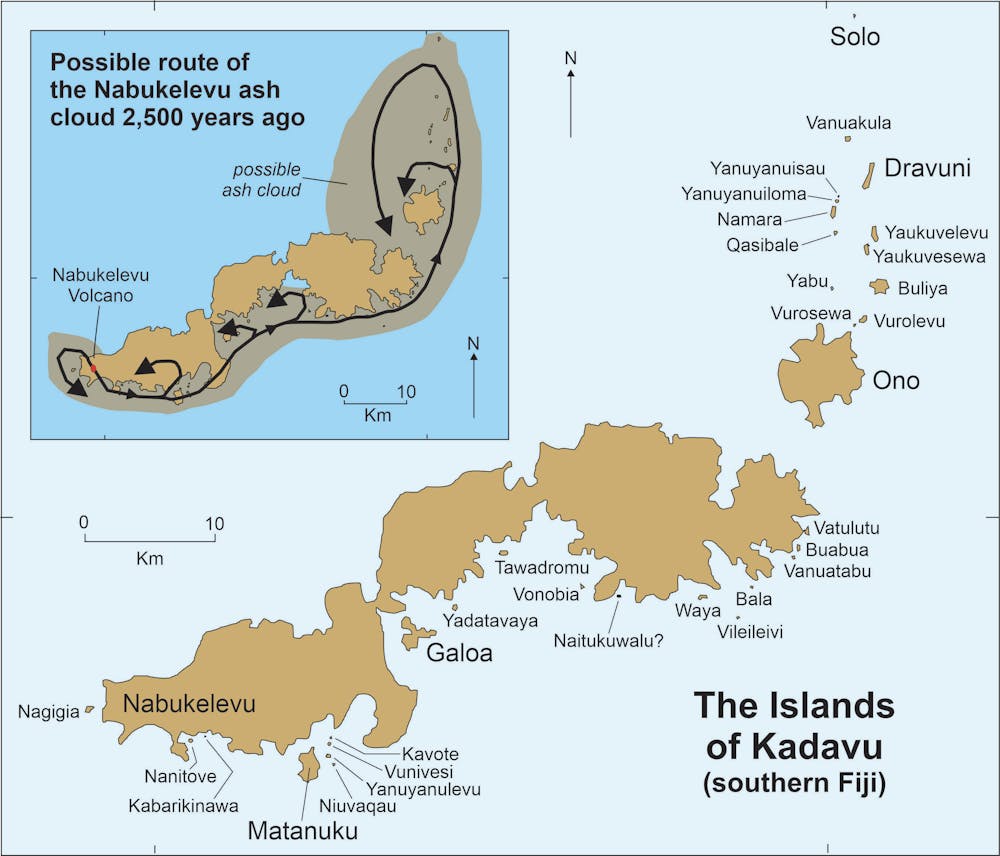 Smaller offshore islands named in seven versions of the Nabukelevu story as having formed following the Nabukelevu eruption. Inset shows the possible trace of the ash cloud based on the stories.
Author provided, CC BY-ND
Smaller offshore islands named in seven versions of the Nabukelevu story as having formed following the Nabukelevu eruption. Inset shows the possible trace of the ash cloud based on the stories.
Author provided, CC BY-ND
‘Myths’ based in fact
Geologists would today find it exceedingly difficult to deduce such details of an ancient eruption. But here, in the oral traditions of Kadavu people, this information is readily available.
Another detail we would never know if we did not have the oral traditions is about the tsunami the eruption caused.
In some versions of the story, one of the “gods” is so frightened, he hides beneath the sea. But his rival comes along and drinks up all the water at that place, a detail our research interprets as a memory of the ocean withdrawing prior to tsunami impact.
Other details in the oral traditions recall how one god threw a massive spear at his rival but missed, leaving behind a huge hole in a rock. This is a good example of how landforms likely predating the eruption can be retrofitted to a narrative.
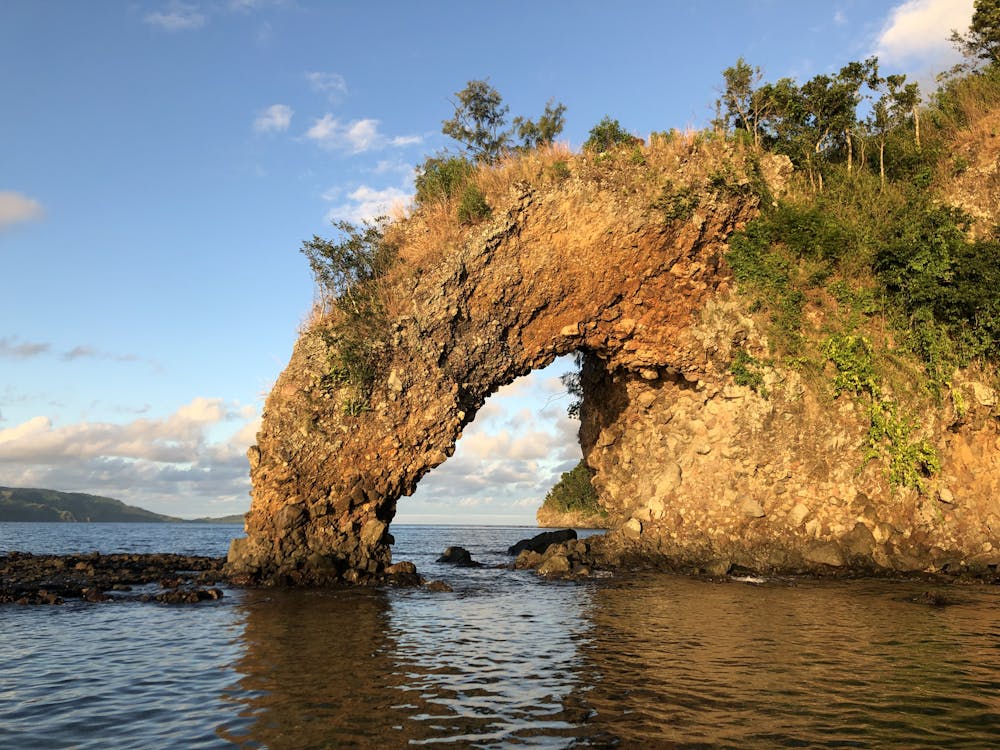 The hole made when a spear was thrown by one god at the other, on the north coast of eastern Kadavu.
Author provided, CC BY-ND
The hole made when a spear was thrown by one god at the other, on the north coast of eastern Kadavu.
Author provided, CC BY-ND
Our study adds to the growing body of scientific research into “myths” and “legends”, showing that many have a basis in fact, and the details they contain add depth and breadth to our understanding of human pasts.
The Kadavu volcano stories discussed here also show ancient societies were no less risk aware and risk averse than ours are today. The imperative was to survive, greatly aided by keeping alive memories of all the hazards that existed in a particular place.
Australian First Peoples’ cultures are replete with similar stories.
Literate people, those who read and write, tend to be impressed by the extraordinary time depth of oral traditions, like those about the 2,500-year old eruption of Nabukelevu. But not everyone is.
In early 2019, I was sitting and chatting to Ratu Petero Uluinaceva in Waisomo Village, after he had finished relating the Ono people’s story of the eruption. I told him this particular story recalled events which occurred more than two millennia ago – and thought he might be impressed. But he wasn’t.
“We know our stories are that old, that they recall our ancient history,” he told me with a grin. “But we are glad you have now learned this too!”
Acknowledgements: The original research was conducted in collaboration with Loredana Lancini and Rita Compatangelo-Soussignan (University of Le Mans), Meli Nanuku and Kaliopate Tavola (Fiji Museum), Taniela Bolea (University of the Sunshine Coast) and Paul Geraghty (University of the South Pacific).


