

‘Phantom decoys’ manipulate human shoppers – but bees may be immune to their charms
- Written by The Conversation
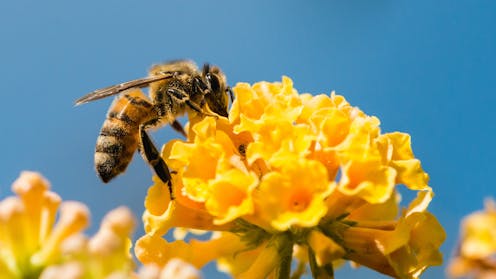
Have you ever waited in a long queue only to find the ice cream flavour you wanted is gone? What did you choose instead?
In the field of behavioural economics, researchers have shown that people make very predictable second choices if the item they want is sold out. So much so, that it is possible to use unavailable items to nudge people into buying certain products.
These unavailable items are referred to as phantom decoys, because even though they are not available, they still influence peoples’ choices.
So much for humans. What about bees? In new research published in Insectes Sociaux, we tested whether honeybees could be influenced by the phantom decoy effect – with surprising results.
Phantom decoys in the animal world
Research has found phantom decoys influence animals including cats, Asian honey bees and monkeys.
However, it’s not all straightforward. Phantom decoys can apparently make wallabies spend more time investigating all the available food options, but the decoys don’t nudge their choices.
Testing phantom decoy effects can help us understand why animals make particular choices. This can have benefits for agriculture, conservation and even pest control.
Read more: What bees don't know can help them: measuring insect indecision
Western honey bees (Apis mellifera) are important pollinators of agricultural crops around the world. In Australia, the honeybee industry is worth A$14 billion a year in honey production and pollination services.
Bees visit flowers to collect nectar and pollen, which provides them with carbohydrates and protein. In this process, they also pollinate plants, which is essential for the plants to reproduce.
However, not all flowers provide bees with nectar: some are, in effect, phantom decoys. Flowers that were rich in nectar at one time may have none at others, either because other insects have already collected it or because of variation in nectar production throughout the day. Some flowers never contain much nectar at all, but attract pollinators by resembling other plants that have more nectar.
Artificial flowers, real choices
In our latest research, we tested whether Western honey bees fall for phantom decoys. Instead of real flowers, we used artificial flowers made from a laminated piece of paper with a tube containing nectar in the centre.
To create different “values” of flowers, we adjusted the nectar quality of the flowers by increasing the nectar’s sugar content. We also adjusted the accessibility of the nectar by forcing bees to crawl down tubes to get to it. Short tubes were “easy access”; longer tubes made flowers “difficult to access”.
We then trained bees to fly into a box where they had a choice of three flowers: one flower was easy to access, but had low nectar quality; a second flower had high-quality nectar, but was difficult to access; and a third flower had easy access and much higher-quality nectar than the other two flowers.
Not surprisingly, bees quickly preferred flower number three. To see whether bees were influenced by the phantom decoy effect, we then gave them the same choice between three flowers, except the easy-access, high-quality flower was empty of nectar.
Bees won’t accept second best
Unlike humans, who would likely have picked whatever available option was most similiar to the empty flower, bees did not make choices in any predictable fashion after encountering the “sold out” empty flower. This suggests that, at least in this case, they were not susceptible to phantom decoys.
Instead, when bees encountered an empty phantom decoy flower, they left all three flowers alone. This is in contrast to humans, for whom unavailable items often create a sense of urgency, making them more likely to spend money on other items.
The bees’ behaviour is like discovering your favourite ice cream flavour is sold out and, instead of buying the next-best flavour, you leave the shop with no ice cream at all.
Bees also moved more between all three flowers in the presence of an empty flower, probably because the bees expected the empty flower would eventually refill.
The overall increase in movement between flowers, and eventual abandonment of patches due to phantom decoys, could have important ramifications for pollination in patches of flowers and related agricultural and conservation management practices.
Insect pollinated plants rely on insects to move pollen from flower to flower for reproduction, so empty flowers may benefit nearby flowers by increasing pollinator movement, which, in turn, increases the movement of pollen – but only if they hang around the flowers for long enough.
We would like to thank Anahi Castillo Angon and Cristian Gabriel Orlando for their contribution to this research and the writing of this article.


