

If we protect mangroves, we protect our fisheries, our towns and ourselves
- Written by The Conversation
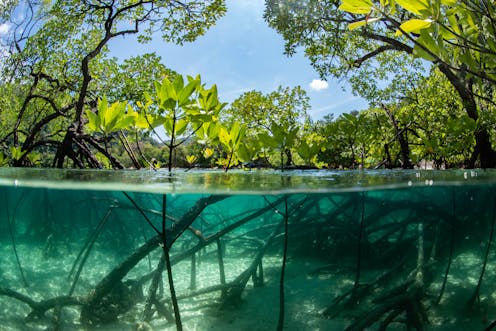
Mangroves might not look like much. Yes, they can have strange aerial roots. Yes, they’re surrounded by oozing mud.
But looks can be deceiving. These remarkable shrubs and trees are nurseries for many species of fish, shellfish and crabs. They protect our coastlines from erosion, storm surges, wind and floods. And that mud? It’s one of the best biological ways we know of to store carbon.
These ecosystem services are extremely valuable – but people often don’t notice what they offer until they’re lost to aquaculture, firewood or settlement.
Conserving mangroves by declaring parks and other protected areas seems like a logical solution. But often, nations can see protected areas as a cost, walling them off from human use, and ignoring their benefits to people.
What our new research shows is that you don’t have to choose between nature and humans. Protecting mangroves offers a win-win, given how valuable they are to coastal communities, fishers and the fight against climate change.
As nations aim to conserve 30% of their lands and waters by decade’s end, those lucky enough to have mangroves should look to their coasts.
Why are mangroves so important?
Mangroves thrive on the coast, poised between land and sea. They first evolved between 100 million and 65 million years ago. Each of the 65 species of mangrove is a shrub or tree which has, over time, evolved to live in salt or brackish water.
These trees are extremely resilient, surviving in brackish water and low-oxygen conditions, which would kill other trees. To survive, they’ve acquired adaptations such as aerial roots that can take in oxygen. These tangled roots make excellent hiding places for the creatures of land and sea, including mudskipper fish able to survive out of water.
Their complex roots are ideal nurseries for juvenile fish, crabs and prawns by providing shelter and places to feed. In turn, these nurseries keep populations healthy, sustaining commercial fisheries as well as direct sources of protein for coastal people.
Their robust tangles of roots protect them from the force of waves, storm surges and wind. In turn, this helps people, who can shelter behind this green wall, protecting our homes.
Mangroves also act as a natural way to tackle climate change. Their roots trap sediment, burying inorganic and organic carbon in the process. They also store carbon in their biomass. Overall, these sea forests store carbon at almost three times the rate of tropical rainforests, twice that of peat swamps, and almost seven times the rate of seagrasses.
Protecting mangroves needs a different approach
While mangroves give us a host of benefits, many of these only become apparent when these ecosystems are gone.
Unfortunately, mangroves are often cleared to make way for aquaculture, farming and human settlements, or for firewood. An estimated 20–35% of the world’s mangroves have been lost since 1980. In better news, losses have declined significantly. We now lose around 0.13% per year.
Protected areas work well as a way to cut mangrove losses. When a government sets out to create these areas, the aim is usually to protect biodiversity while minimising conflict with human use.
In our research, we found the world’s network of protected areas isn’t doing a great job in protecting either mangrove biodiversity or the ecosystem benefits mangroves give us. In fact, it’s no better than just picking areas at random.
That means high-priority mangrove forests important for both biodiversity and ecosystem services are not being properly conserved. Clever expansion of the current network could solve the problem. At present, parks and other protected areas cover about 13% of the world’s mangrove forests, which are clustered around the tropics.
Boosting this to 30% – in line with the biodiversity conservation target agreed to by 196 nations last year – would reap benefits. Our research suggests it would safeguard houses and infrastructure worth A$25.6 billion, protect six million people against coastal flooding, and store over one billion extra tonnes of carbon. Also, fishers would gain an extra 50 million days of successful fishing a year.
Even better – we found optimising conservation of both biodiversity and ecosystem services needed only 3–9% more area protected compared to mangrove protection areas based on saving species alone.
Read more: Protecting mangroves can prevent billions of dollars in global flooding damage every year
Protect mangroves in Asia and Oceania
Mangrove forests urgently needing protection are almost all in Asia (63% of the total) and Oceania (17%), where we find large biodiverse mangrove forests which support fishing industries and many coastal communities.
Indonesia is a particular hotspot, given its 17,000-odd islands are often ringed by mangroves. Mangroves in India, Vietnam and Papua New Guinea also need better protection.
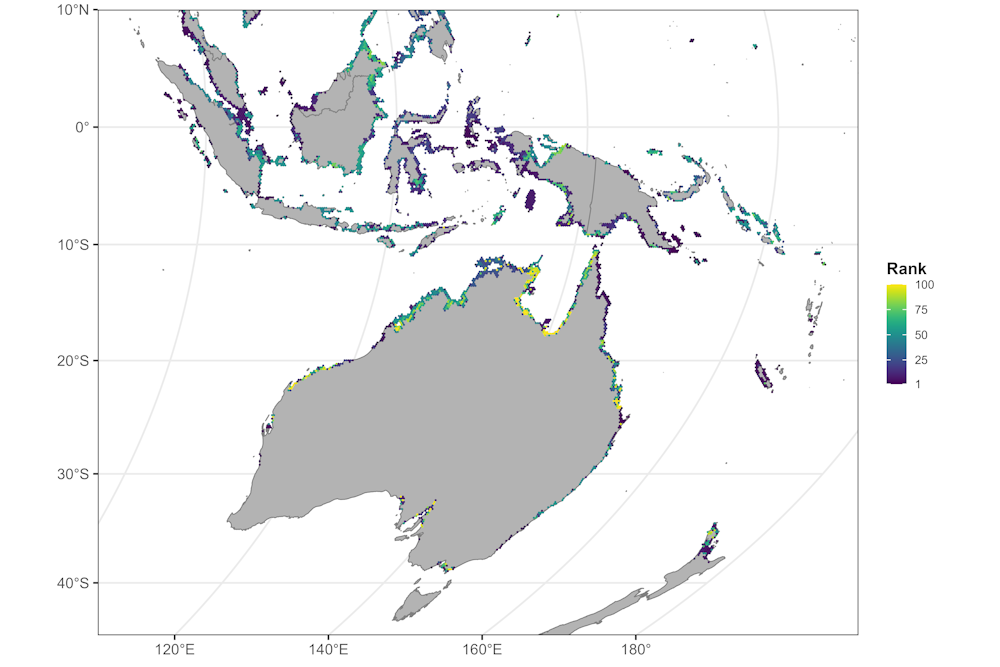
Australia does reasonably well. Around 18% of our mangroves are protected, above the global average of 13.5%. Over 20% of the areas we have flagged are high-priority for mangrove conservation are already protected. Even so, expanding the protected area network would be a good move, as Australian mangroves are some of the world’s most biodiverse and carbon-rich.
 Mangroves have undergone remarkable adaptation to be able to live where they do.
Author provided
Mangroves have undergone remarkable adaptation to be able to live where they do.
Author provided
Mangroves in parts of northern Queensland need better protection. Some mangroves are already protected by the Great Barrier Reef Marine Reserve, but there are still large unprotected tracts.
Mangroves around Darwin and Arnhem Land in the Northern Territory need expanded protected areas, as do those on the coast between the Pilbara and the Kimberley in Western Australia.
Too often, protecting nature is seen as a cost to society. What our modelling shows is that we can have a win-win. By protecting the most precious areas of mangrove, we can protect human communities and wider biodiversity at a stroke.
Read more: After decades of loss, the world's largest mangrove forests are set for a comeback


