

Queensland's fires are not easing at night. That's a bad sign for the summer ahead
- Written by The Conversation
This week, dozens of fires have burned across Queensland. More homes have burned in the state than during the 2019–2020 Black Summer – 57 so far this year, compared to 49.
The question many are asking is – are these fires normal? Our analysis shows these fires are weird in at least two ways.
First, many more than usual are burning through the night. This is anomalous, as nighttime usually brings lower temperatures and more moisture in the air, slowing or quelling fires. Queensland’s south-east and Western Downs regions are seeing more than five times more nighttime hotspots than average. And second, these fires are early in the season – especially the nighttime fires.
Why? Much of the east coast is now exceptionally dry. The plant regrowth from La Niña rains has dried out and is, in many places, set to burn. It’s still spring, with a long summer ahead. Where there has been rain, such as in eastern Victoria, it has sometimes coincided with intense bushfire. That gave rise to the extremely unusual situation in early October where residents grappled with fire one day and flood the next.
Put together, it suggests we may be facing a very bad fire season on the east coast and Tasmania. This is, of course, happening against the drumbeat of global warming, and the extra spike in heating this year caused by El Niño.
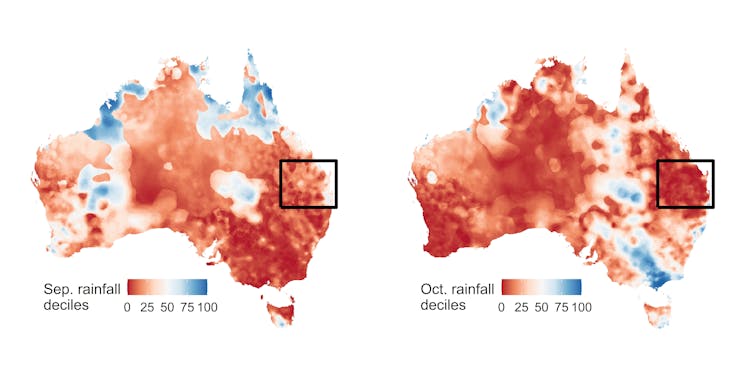
Rainfall across Australia this spring has been very low almost everywhere. Bureau of Meteorology, CC BY-NDWhat’s happening in Queensland?
This spring has been exceptionally dry across most of the Sunshine State. September and October rainfall in the state’s heavily populated south has been close to the lowest on record and certainly in the bottom 10% of years.
This, in turn, has made many areas ready to burn. While there are fires up and down Queensland, most house losses have been within a few hundred kilometres of Brisbane. The town of Tara and surrounding areas has been worst affected.

How do we know where the fires are? Four times a day, heat-sensing satellites pass over Australia and pinpoint hotspots, where temperatures suddenly jump compared to areas nearby, based on square kilometre tiles. These tell us where the fires are, almost in real time and let us track them as they grow.
To this region, October has brought the third highest number of daytime hotspots seen this century. But it’s the nighttime hotspots that are freakish. Five times more nighttime hotspots than average have been detected compared to previous Octobers.
Why is that so concerning? Think of it from the firefighters’ point of view. If you know that fires usually ease off at night, you can plan around this reprieve – or even get some rest. But this belief will have to change as the nighttime barrier to fire weakens around the world.
Climate change can speed up how fast droughts happen, in what’s been dubbed “flash drought”. It was not so long ago that Australia’s east coast was seemingly underwater, with record-breaking floods. Now drought is back with a vengeance.
Is south-east Queensland seeing more fire than usual? On the whole, yes. And it’s early – one of the earliest seasons since satellite records began in 2001.
So far, most of the serious fires in this area are burning not through grasslands, as is happening in Central Australia, but through open forest and woodlands.
Could we see rainforests in Queensland burn, as we did during the Black Summer? It’s possible, but less likely. But we could see some areas which burned during Black Summer along the east coast burn again, though probably not to the same severity.
There’s certainly enough fuel for some areas on the east coast burned by the 2019–20 bushfires to re-burn, such as New South Wales’ coast and the fringes of the Blue Mountains. That would have serious ecological consequences for areas still in recovery if fires returned before seedlings matured.
Read more: What is a flash drought? An earth scientist explains
Fire scientists are flying blind
For decades, we’ve known that parts of Australia – the world’s most fire prone continent – would be likely to see more intense and more damaging fires as climate change adds heat and takes away moisture in many regions.
One problem is that we and other professional fire scientists are forced to read the tea leaves from media reports to gauge what’s happening on the ground.
Data on fire progression, fuels and weather are often walled away in government agencies. Firefighters have access, but they are – rightly – focused on the immediate crisis at hand. And insurers have their own data sets on trends in property loss but they are commercially sensitive.
Because there’s no systematic and accessible way to publicise fire data, we end up with a lot of speculation in the media about whether this is a normal or abnormal fire season.

This could be easily fixed with more investment and coordination. Data from geostationary satellites have revolutionised fire spotting, shifting from six-hourly updates to every ten minutes.
These data and historic data, could and should be made easily available to non-specialists, ideally through either the Bureau of Meteorology or a new agency.
Researchers have a role to play in developing tools to help put this flood of data to use.
If we have better public data sets, we can also more quickly shut down talking points from climate deniers, who might claim “there’s nothing new – Queensland has always burned” or use selective statistics to claim the number of dangerous forest fires on Earth is declining. We can’t adapt as a society if we’re arguing whether the fires really are happening or really are this bad.
If we don’t start to adapt to new fire regimes – and fast – we will face a very real crisis. We could soon see insurers stop offering insurance, as some have in California.


