

Australia's media classification system is no help to parents and carers. It needs a grounding in evidence
- Written by The Conversation
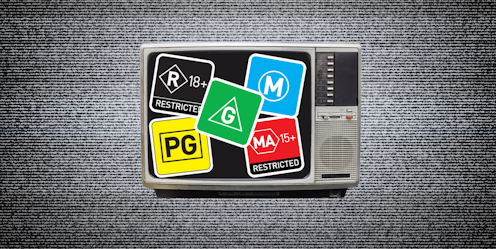
In the era of proliferating streaming platforms, choosing what to watch on family movie night can be hard.
Parents have a greater need than ever for good advice to help them narrow down the options, and they should be able to turn to the government’s classification system.
When they do, they will usually trust that if something is rated G or PG, it’s suitable for young children.
You might be surprised to learn, then, the current media classification system has no basis in evidence about children’s developmental needs.
Read more: Episode – Choose Your Story: the inappropriate game your kids have probably played
Where did classifications come from?
Australia’s National Classification Scheme for films, games and publications was established in 1995. The Commonwealth and the states and territories agreed to replace what was then known as the “censorship” system.
The scheme classifies media content based on the perceived impact (very mild, mild, moderate, and so on) of elements such as violence, sex, and themes related to social issues including crime, racism and suicide.
The ratings aim to give effect to four principles listed in the National Classification Code. One of those is that “minors should be protected from material likely to harm or disturb them”.
This film ratings promo was on many VHS and DVDs in Australia in the 2000s.Initially there was no R18+ classification for games.
After intense debate in the late 2000s, the adults-only classification was introduced in 2013.
Flawed attempts at reform
The Commonwealth referred classification law to the Australian Law Reform Commission for review in 2011.
The 2012 report revealed little about the efficacy of the scheme for families.
The review led to very few changes. None were of any real significance for consumers.
Recommendations from the latest review of the scheme were submitted to the Morrison government in 2020.
Read more: There are no age restrictions for gambling in video games, despite potential risks to children
There was no action on those until the Albanese government, in April 2023, announced a couple of fairly significant changes, such as mandatory minimum classifications for gambling-related content.
Unfortunately, however, useful information for families is still hard to come by.
Vague terms not based in fact
The current system is based entirely on “impact”, which is undefined.
The efficacy of the system in protecting children from harm or disturbance is diminished because it’s not based on evidence of children’s developmental needs.
For example, there is strong evidence that scary content poses risks for children’s mental wellbeing.
But unless it’s actually violent (which it isn’t always), you have to hope it will be picked up under the “themes”.
If we had an evidence-based system, scariness would be established as a separate criterion during the classification process.
Regarding violent content, there is evidence as to which kinds pose greater risks than others.
But a study of the Classification Review Board’s thought processes around violence shows these are often at odds with the evidence.
For example, they tend to downplay “superhero violence”.
However, research shows appealing perpetrators whose violence is justified are more likely to foster an attitude in viewers that violence is an appropriate way to resolve conflict.
The most recent review of the scheme recognised the need for an evidence-based system, but stopped short of recommending it.
Overhaul needed to better guide parents
Parents need reliable information to judge the suitability of content for children of different ages.
The G and PG ratings, for example, effectively lump everyone under 15 into a single age group. This means they don’t provide any guidance about whether or not content is suitable for any particular age group under that threshold.
The 2020 review suggested an additional category (PG13) could be appropriate.
This may help address the vast range of content lumped in the current PG category, but only if it was based on evidence about the developmental needs of children under 13.
 Parents should have more of a say to make the Australian classification system more user-friendly.
Shutterstock
Parents should have more of a say to make the Australian classification system more user-friendly.
Shutterstock
And even if PG13 was introduced, the system would still fail to address the differing developmental stages of children aged 1 to 12 years.
An overhaul of the system is needed, including a move away from “impact” to a test based on children’s developmental needs.
This could help support parents to make well-informed decisions for their children. The Commonwealth is obliged to do this under article 18 of the UN’s Convention on the Rights of the Child.
Policy-makers should also be seeking the thoughts of parents, who ultimately interact with the system most.
Previous government research hasn’t focused on parents enough.
A 2022 report found 74% broad agreement with the statement “classification categories do not need to change”. But participants, only 30% of whom were parents or carers, were not given an alternative model for comparison.
We cannot know what participants would have said if they had been asked to consider other options, such as an age-based set of categories.
Research we are currently undertaking fills this gap.
Our survey informs parents and carers about the current Australian system and asks them to rate content using an evidence-informed framework.
It will provide important information about the usability of the scheme. Then, we can propose a model of classification that better reflects the needs of its primary users – one that is actually based on evidence.


