

Napoleon director Ridley Scott is calling on us historians to ‘get a life’ – and he has a point. Art is about more than historical facts
- Written by The Conversation
The release of Napoleon unleashed a torrent of objections to historical errors in the movie.
Social media platforms were inundated with outrage – particularly from military historians – objecting from everything from details on uniforms to military formations.
These heated responses highlighted a more fundamental question: how should historians respond to creative works about history? Do historians have a public responsibility to apply their specialist knowledge to contest spurious claims about the past? Or should they simply respect creative licence, and let moviegoers have their fun?
Historical accuracy matters. But more important for historians should be whether creative works pass the test of authenticity: whether a creative work “rings true” to the historical context as a whole.
Historical inaccuracies
Whatever the cinematic opulence of Ridley Scott’s battle scenes and of the coronation of Napoleon and Josephine in 1804, historians have railed against a plethora of shortcomings and silences.
Careful makeup could not disguise 49-year-old Joaquin Phoenix as the 24-year-old lieutenant who first came to notice at the battle of Toulon in 1793. The portly, middle-aged Robespierre (Sam Troughton) bears no resemblance to the young revolutionary in appearance or style. Napoleon was not at the execution of Marie-Antoinette, nor did he order his troops to open fire on the Pyramids when in Egypt.
There are many more serious objections one could make – notably of silences about Napoleon’s failure to suppress guerilla resistance in Spain and his disastrous attempt to reimpose slavery in French colonies in the Caribbean after its abolition in 1794.
But historical inaccuracies are nothing new. Similar, if less strident, objections may be made about all historical recreations on film or in theatre.
In the celebrated Australian movie The Dish (2000), Rob Sitch and his team located the first reception of news of the Apollo 11 moon landing and Neil Armstrong’s famous words about his “one small step” at the iconic Parkes Observatory rather than, as in reality, at the NASA stations at Honeysuckle Creek near Canberra and in California. Cinematic attraction trumped accuracy.
The 1982 film Breaker Morant is still receiving criticism for its lionising of Morant. The pivotal Battle of Stirling Bridge scene in Braveheart didn’t include a bridge in the film. Hospitals weren’t a target during the attack on Pearl Harbor.
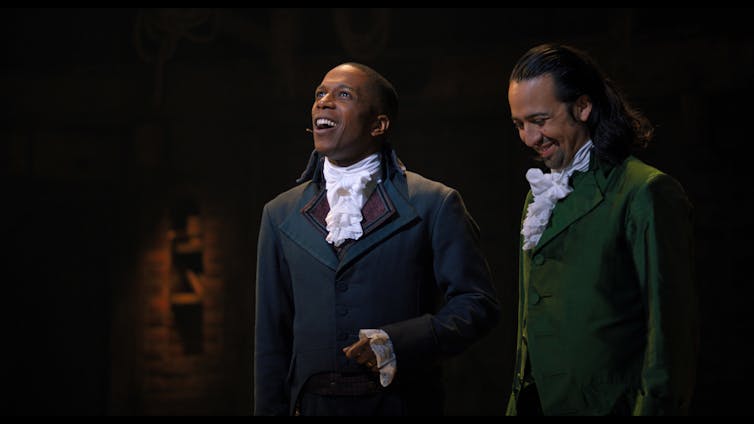
Far more controversial was the scintillating musical Hamilton (2015) created by Lin-Manuel Miranda, based on the prize-winning 2004 biography of Alexander Hamilton by Ron Chernow.

Miranda explicitly recognised the musical was his interpretation of the founding of the United States from today’s perspective, deliberately cast non-white actors as the Founding Fathers and drew on musical styles ranging from R&B to soul and hip hop.
Despite his candour, historians rushed to point out errors, exaggerations and elisions. Hamilton’s contributions to the battlefield during the American War of Independence are exaggerated for effect. The Schuyler sisters articulate feminist ideas far from those they would have had at the time. While Miranda makes much of Hamilton’s opposition to slavery, Hamilton was personally involved in purchasing slaves and his wife came from a wealthy slave-owning family.
But artists create works within different genres to that of professional history. They are not creating documentaries that can be evaluated according to the historical conventions of the careful use of available evidence, and respect for ambiguity and uncertainty. These need to be considered, first and foremost, as creative works.
Read more: What Alexander Hamilton's deep connections to slavery reveal about the need for reparations today
A place for historians
As Scott snapped, the fact-checkers should “get a life!” and join the crowds enjoying his interpretation.
Instead of nitpicking the historical details of entertainment, perhaps historians should celebrate the fact that a long historical drama has been an immediate box office success, including in France – home to some of the film’s most vocal critics.
People who attend Napoleon, or any historically-based work of art, are more likely to be curious to know more rather than be gullible about its historical accuracy.
 Jacques-Louis David’s 1810 portrait highlighted the Napoleonic law code on his desk.
National Gallery of Art
Jacques-Louis David’s 1810 portrait highlighted the Napoleonic law code on his desk.
National Gallery of Art
Of course, historians should not fall silent on failings of historical accuracy, but the central issue for historians should be authenticity. That is, a creative work should be evaluated by historians not so much on whether specific details are accurate but on whether the producer’s imagination captures the essence of the historical moment.
“Poetic licence” permits selectivity and exaggeration in the interests of evoking a deeper meaning. (Of course, that cannot excuse deliberate distortion unless, as in Miranda’s case, it is openly acknowledged.)
The real weakness of Napoleon is Scott’s failure to ground the Emperor’s motivations in the principles underpinning his 1804 legal code – which he saw as his greatest legacy. Scott’s focus on Napoleon’s brutality and megalomania means the explanation for his behaviour boils down to a mixture of murderous territorial greed and a pathetic need to impress Josephine, instead of a more complex impulse to also impose revolutionary reforms.
In their public comments, historians might focus more on the level of contextual veracity in creative works and leave their long lists of errors of detail to professional journals. The problem with the Napoleon movie is not so much its errors of detail as its lack of authenticity about what we know of the man and his world view.
Read more: Napoleon Bonaparte features in 60,000 books and more than 100 films – does Ridley Scott's stand up?


