

100-million-year-old fossil find reveals huge flying reptile that patrolled Australia’s inland sea
- Written by The Conversation
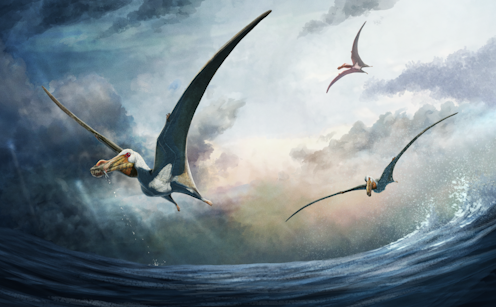
One hundred million years ago, during the Cretaceous period, much of northeastern Australia was underwater. The inland Eromanga Sea was home to a myriad of marine creatures, from turtles and dolphin-like ichthyosaurs to the bus-sized predator Kronosaurus queenslandicus and other plesiosaurs.
The forested outskirts of the sea were home to dinosaurs and the skies above were filled with birds. But all of them would have been shaded by the largest flying creatures of the age – the pterosaurs.
In November 2021, an avocado farmer turned museum curator named Kevin Petersen discovered a fossilised skeleton near Richmond in Queensland. The previously unknown species turned out to be the most complete pterosaur fossil found in Australia. It comprises around 22% of the skeleton of an animal with a wingspan of some 4.6 metres.
My colleagues and I have now described the fossil in the journal Scientific Reports. It represents a new species of pterosaur, and we’ve named it Haliskia peterseni, meaning Petersen’s sea phantom.
Pterosaur fossils are rare
Pterosaur fossils have been found on every continent. However, they are far less common than fossils of dinosaurs or ancient marine reptiles.
Pterosaurs had hollow, thin-walled bones. This was a great evolutionary adaptation for life in the air, but the lightweight skeletons are not easily fossilised.
Few complete pterosaur skeletons are known worldwide, and most come from a handful of sites with unusually excellent conditions for fossil preservation. When pterosaur bones have been found at other sites, they are often crushed and distorted.
As a result, many pterosaur fossils are the only one of their kind. This includes the oldest flying reptile fossils ever found in Australia.
What the skeleton tells us about how Haliskia lived
The newly described fossil is only the second partial pterosaur skeleton ever found in Australia. It preserves twice as many bones as Ferrodraco lentoni.
Haliskia preserves a complete lower jaw, the tip of the upper jaw, 43 teeth, vertebrae, ribs, bones from both wings, and a partial leg. Also preserved are delicate, spaghetti-thin hyoid bones which would have helped support a strong muscular tongue.

We can tell Haliskia was fully grown when it died because its shoulder bones, and others in the skeleton, have fused.
Almost all pterosaur fossils described from Australia (including Haliskia’s contemporaries Mythunga camara, Aussiedraco molnari and Thapunngaka shawi) have been placed in the same family. These species, collectively known as Anhangueria, have long been viewed as fish-eaters.
Although fish fossils are often found in rocks laid down in the Eromanga Sea, squid-like cephalopods called belemnites are even more common. Based on Haliskia‘s long hyoid bones and conical, interlocking teeth, it would have eaten a diet of fish and squid.
A labour of love
The Haliskia specimen was prepared by fossil enthusiast Kevin Petersen using a combination of pneumatic tools, the paleontological equivalent to a dentist’s drill, and a hand-wielded metal pin. The pterosaur bones are flattened, and although one surface has been exposed, they remain encased in rock to provide stability and support to the fossil.
Kevin spent many hours preparing the pterosaur fossil. However, when we asked if he would like to join the team of researchers studying this specimen, he politely declined, stating he was happy to simply be acknowledged for his efforts.
 Haliskia peterseni finder Kevin Petersen digging for fossils.
Krokosaurus Korner
Haliskia peterseni finder Kevin Petersen digging for fossils.
Krokosaurus Korner
Without Kevin, this specimen wouldn’t be on public display or known to science. It seemed only fitting that this new species Haliskia peterseni be named in honour of its discoverer.
More fossils to be found
This was not the first pterosaur fossil Kevin had found. He uncovered his first flying reptile fossil a few years earlier, when he visited Richmond in Queensland as a tourist.
Since the discovery of the Haliskia specimen in 2021, even more pterosaur fossils have been found at the public dig pits outside Richmond.
Kevin is proof you do not need a degree to make significant contributions to science and the field of palaeontology. It takes dedication and determination – and it helps to be in the right spot at the right time.
It requires some imagination to visualise pterosaurs at sea, hunting fish and squid-like creatures alongside massive marine reptiles millions of years ago, in what is now the dry Australian outback. But the process is made easier with the fossils in front of you.
Haliskia provides a tantalising glimpse into an ancient ecosystem, and provides hope we might find more complete skeletons of these winged reptiles.


