

Ukraine's Eurovision win shows us that despite arguments to the contrary, the contest has always been political
- Written by The Conversation
The 66th edition of the Eurovision Song Contest was held in Turin, Italy on Saturday night. The extravaganza didn’t disappoint in delivering our annual dose of ballads, bops and politics.
The answer to the question of whether Eurovision is political is always yes, but with various qualifications. After all, can a contest of nations ever be truly apolitical?
Can culture and politics ever be extracted from each other? Isn’t all art political?
Russia’s invasion of Ukraine provides an inevitable backdrop to understanding this year’s Eurovision competition. This context infuses a more specific meaning into the standard platitudes of peace and unity that are often included as part of the show.
Host country Italy’s decision to begin the grand final with a rendition of Lennon’s Give Peace a Chance set the tone for the 2022 contest.
State politics and values politics
Eurovision claims to be apolitical. Its famous politics rule states: “the Eurovision Song Contest shall in no case be politicised and/or instrumentalised and/or otherwise brought into disrepute in any way.” In practice, it focuses mainly on direct expressions of state-based politics.
For example, Belarus was excluded last year for lyrics perceived to be mocking protesters of the Lukashenko government. (They were ultimately ejected entirely from the European Broadcasting Union – Eurovision’s organising body – for suppressing journalists’ freedom of speech.) Georgia withdrew in 2009 when the EBU rejected its entry for being a barely-concealed dig at Putin.
By contrast, performances that express values-based politics – love, peace, tolerance, acceptance, and unity – are the bread-and-butter of the contest. But this has not always been consistently applied.
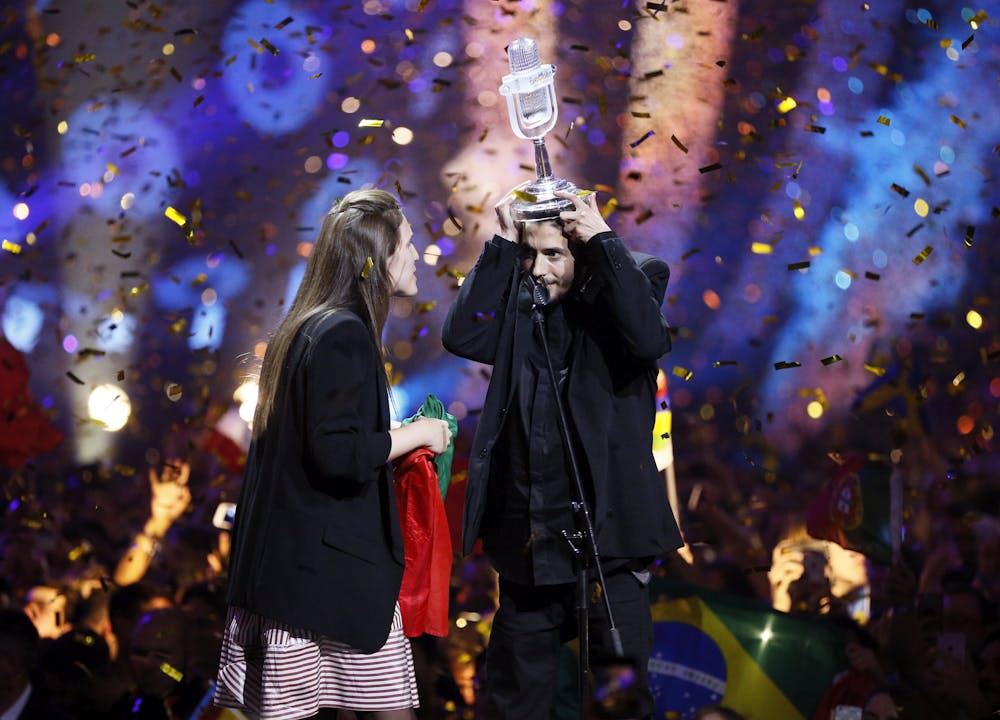
In 2017 (in Kyiv, no less), the EBU censured Portuguese artist (and eventual winner) Salvador Sobral for wearing a sweatshirt reading SOS Refugees to his press conferences. Sobral emphasised that it was “not a political message – it is a humanitarian and essentially human message”.
Sympathy and solidarity
There were more overt political statements made throughout the evening. Many voting spokespersons – usually those about to deliver 12 points to Ukraine – wore yellow and blue ribbons or even spoke directly about the conflict. Several performers, such as Iceland’s Systur and Germany’s Malik Harris, stuck Ukrainian flags on their instruments.
The Icelandic delegation are no strangers to flag-based political statements. In 2019, the EBU fined Iceland when artists Hatari held up scarves in support of Palestine during their televote results. The difference between 2019 and 2022 in the accepted interpretation of the rules is that Ukraine is not a “contested territory”. A similar controversy ensued when Armenian artist Iveta Mukuchyan held up a flag for Nagorno-Karabakh, a territory contested with Azerbaijan.
Ukraine’s victory has been framed by many as a sympathy vote, but this doesn’t give a full picture of their success. While political sympathy undoubtedly contributed to their ultimate success over other favourites – the United Kingdom, Sweden and Spain – it is important to acknowledge that the folk-contemporary fusion featured in winning song Stefania has already proven popular with Eurovision audiences in recent years. In 2021, the Ukrainian entry Go_A came fifth with their folk-EDM hit, Shum (and were unplaced but popular in the cancelled 2020 cohort of songs). Ukraine are also considered a strong Eurovision nation – they are the only country with an unblemished record of qualifying for the grand final.
Eurovision is often spoken of as a form of cultural diplomacy and a platform for countries to display and gain soft power. Another term used in popular culture studies, participatory culture, refers to how the public don’t simply consume popular culture but actively participate in its production, creation and meaning-making.
Eurovision and Ukraine’s landslide success in the popular vote demonstrates what we can think of as participatory diplomacy – when an audience actively participates in the cultural platform to shape their own political message in response to what is communicated to them.
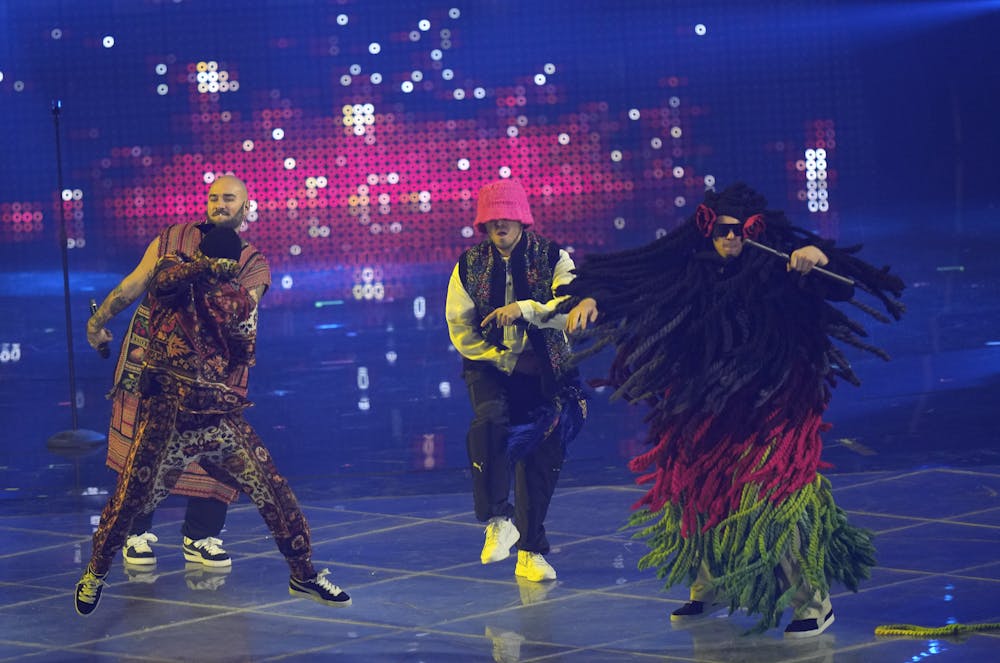 Kalush Orchestra from Ukraine perform during the Grand Final of the Eurovision Song Contest at Palaolimpico arena, in Turin, Italy.
Luca Bruno/ AP
Kalush Orchestra from Ukraine perform during the Grand Final of the Eurovision Song Contest at Palaolimpico arena, in Turin, Italy.
Luca Bruno/ AP
A return to language diversity
This year, we saw a return to language diversity, with 11 out of the 25 grand final entries featuring languages other than English. Notably, it was the first time since 2011 that a song in French did not feature. The French entry was sung in Breton, the local dialect of France’s westernmost region, Brittany.
It was also the first time since 1994 that Lithuania entered a song completely in Lithuanian (their 2001 entry featured two Lithuanian verses in an otherwise English-language song). And, of course, the winning entry was in a language other than English for the second year running.
We can hope that this signals an era of greater optimism about the appeal of non-English songs at the contest and the power of song to transcend language barriers.
The future of the contest
Traditionally, the winning country hosts the next Eurovision. The EBU acknowledge that there will be “unique challenges” in hosting the 2023 contest. Currently, it is difficult to predict whether it will be possible to host in Ukraine itself. Should Ukraine be unable to host, it won’t be the first time that another country has stepped in to assist.
The events of this year also highlight that it might be time for the EBU to revisit its politics rule to ensure that it is applied consistently to the various conflicts its member states are involved in.
And those member states might look to Eurovision with a renewed appreciation for its diplomatic value.


