

Is Australia’s trade war with China now over? The answer might be out of our hands
- Written by The Conversation
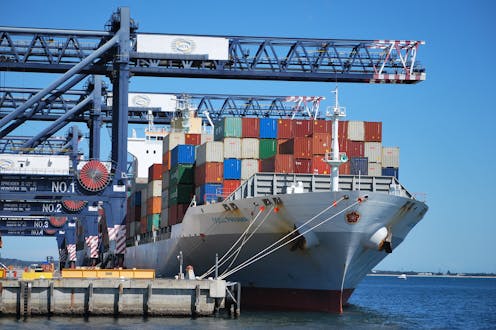
Finally, Australia’s rock lobster industry will be able to export to China again, following a deal struck on the sidelines of the ASEAN summit in Laos last week.
It will take some weeks to finalise the paperwork, but Chinese diners can expect to eat our high-quality crustaceans as we devour our Christmas roast turkeys.
The breakthrough brings a particularly nasty chapter in Australia-China trade relations to a close. Tariffs on rock lobsters were the only remaining major restriction of a raft of trade barriers imposed by China in 2020.
It might be tempting to celebrate, but we should tread carefully. Our situation remains hostage to Beijing’s relationship with Washington. Whether Australia’s trade woes with China are actually over may ultimately be out of our hands.
Read more: China removes block on Australian lobster, in last big bilateral trade breakthrough
Australia’s reversal of fortunes
The past couple of years have been a whirlwind.
The Albanese government has seen China systematically undo the export restrictions it had imposed on Australia in 2020 – including on barley, wine, beef, and now lobster – without giving away much of substance in return.
Yes, Australia suspended two cases it had brought against China at the World Trade Organization, concerning barley and wine duties China had imposed. But those cases can be resumed if the Chinese government backslides.
And true, the Albanese government did not oppose China’s bid to join the Comprehensive and Progressive Agreement for Trans-Pacific Partnership – an important regional free trade agreement of which Australia is a founding member. But neither did it endorse China’s bid.
It seems we’ve come a long way since 2020, when China tabled its infamous “14 grievances” against Australia. This deliberately leaked document publicly criticised Australia on a whole range of fronts, including foreign investment decisions, alleged interference in China’s affairs, research funding and media coverage.
A more sobering picture elsewhere
This reopening of trade might make it seem like things are looking up for Australia. In some cases, our business community has bounced back with gusto, notably wine exports to China.
Zooming out, however, paints a more sobering picture of global trade relations. In the near term, the decisions of our key allies – namely the United States – may come to matter more than our own.
The Biden administration has long hoped to place a “floor” under America’s geopolitical competition with China. Neither side wants things to get ugly.
But in Washington, strong bipartisan consensus remains that China must be confronted. The US has continued to take coercive actions against Chinese exports and investment.
For example, the US recently imposed a 100% import duty on electric vehicles produced by Chinese-owned companies. Similarly, it imposed a 25% import duty on imports of Chinese container cranes. Strategic distrust will escalate no matter who wins the White House on November 5.
This animosity is mirrored in Beijing. China’s security state is expanding ever more into business, while its private sector retreats. China’s own coercive activities are also escalating in regional disputes over the South and East China seas, as well as in its trade retaliations against Western markets.
Widening tensions
These tensions are also playing out in Europe and the Middle East. International relations scholars worry that the West must now confront an authoritarian axis comprising Russia, Iran, North Korea and China.
China’s “no limits” partnership with Russia has spooked most European elites. Western sanctions on Russia, meant to erode the Kremlin’s war machine, are likely being circumvented by China’s unmatched industrial capacities.
Iran’s military support for Russia supplements the Kremlin’s war-fighting capacities at Ukraine’s expense.
Unsurprisingly, economic security concerns are rapidly eclipsing free trade considerations for the US.
When US National Security Advisor Jake Sullivan introduced the 2022 National Security Strategy, he adopted a selectively restrictive approach he called “small yard, high fence”.
He was talking about export controls and inward restrictions on investment, applied to high-technology products.
Since then, the “yard” has grown wider, and the “fence” has expanded. More sectors and products are being thrown into the mix, from energy security, through critical minerals, to food production.
The challenge with digital technologies, able to be used for both military and civilian purposes, is that the yard can be very large indeed.
Middle power problems
The US has the economic and military weight to confront China. As the European Union is learning, having the economic weight is necessary. But being politically united is essential, and they remain far from that.
Australia is a middle power, without the necessary economic weight or military heft to confront China. That means we must support the rules-based multilateral trading system – preserving the authority of institutions like the World Trade Organisation (WTO) – to constrain the actions of the great powers and preserve as much of our open trade posture as possible.
Washington, however, increasingly expects its allies to fall into line. How else can one explain Canada’s decision to follow the US and impose 100% import duties on electric vehicles produced by Chinese owned companies?
Like Australia, Canada is also a middle power. It is also a strong supporter of the rules-based multilateral trading system. But Canada’s action violates WTO rules.
The fact that Washington’s actions also violate these rules is taken for granted these days.
Australia must pay attention
Global trade cooperation is deteriorating, and the world is fracturing into two “values-based” trading blocs. While there could be positive upswings in our bilateral trade relations with China, the medium term trend is down.
As Napoleon Bonaparte is reputed to have said:
China is a sleeping giant; let him sleep, for if he wakes he will shake the world.
China has changed, and the world with it.
Australian business needs to pay attention. Our East Asian partners, notably Japan and South Korea, have long spoken of the need for a “China plus one” (or more) business strategy – making sure trade and investment is diversified into other countries, as well.
Such diversification will be increasingly important in the years to come.


