

Authoritarian fossil fuel states keep hosting climate conferences – how do these regimes operate and what do they want?
- Written by The Conversation
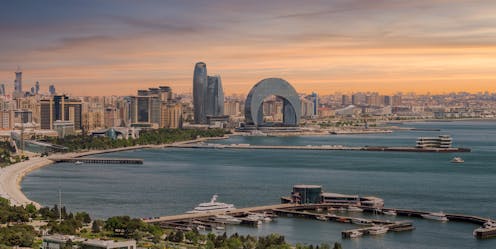
For the third year in a row, the United Nations Climate Change Conference will be hosted by an authoritarian state that sells fossil fuels. This week the 29th “conference of the parties”, COP29, is being held in Baku, Azerbaijan. It follows COP28 in Dubai, the United Arab Emirates last year and COP27 in Sharm El-Sheikh, Egypt the year before that.
It’s concerning that a succession of authoritarian and fossil fuel-rich states have been selected to host international climate negotiations. It means we must pay extra attention to political influences on the talks and beware of greenwashing by the hosts.
The domestic politics of these states also shapes global supply chains of fossil fuels and critical minerals. This in turn directly affects Australia’s trade, economy and foreign policies.
There are now more authoritarian and hybrid regimes globally than there are democracies. So some basic understanding of how authoritarian states respond to climate change matters, for Australia and the rest of the world.
What is an authoritarian state and why should we care?
Power in authoritarian states is concentrated in the hands of a single ruler or group of elites. People under authoritarian rule lack many basic human rights, and risk punishment for speaking out against the political regime. Rule of law and political institutions are weak, so abuse of power can go unchecked.
Not all authoritarian states are fossil fuel producers, although many are. Some also supply critical minerals for electric vehicles and renewable energy.
China dominates global critical minerals supply chains and electric vehicle manufacturing.
Russia remains one of the largest fossil fuels producers and exporters, despite sanctions since 2022. It is also using revenues from these exports to continue its war in Ukraine.
Most of the major oil, coal and gas producers in the Middle East and Central and Southeast Asia are non-democracies or hybrid autocracies. UAE lifted oil production after hosting COP28.
Indonesia, considered “partly free”, is the world’s largest coal exporter. Despite having signed the Paris Agreement, the Indonesian government recently approved close to one billion tonnes of coal mining. Domestic coal consumption and export is expected to rise.
What is at stake at COP29?
At COP29, countries are expected to announce stronger national climate commitments. This is essential for limiting global temperature rise to 1.5°C and achieving net-zero emissions by mid-century.
It is hoped more concrete steps will also be taken towards providing financial support to developing countries struggling with the energy transition.
In previous years, authoritarian states have been able to block or undermine progress at international climate negotiations. Expect to see more of this at COP29.
China’s cautious approach to phasing out coal has affected COP negotiations in the past. Even after COP28, where a roadmap to transition away from fossil fuel was agreed, coal remains crucial to China’s economy.
At COP27 in Egypt, Russian energy lobbyists were permitted to attend even after the invasion of Ukraine. They met with heads of states and energy ministers from Africa, Asia and the rest of the world.
Russia will likely use COP29 to promote its own agenda, including its nuclear export industry. Since the war began, Russia has sought to frame Western-led cooperation on climate as a form of neo-colonialism designed to undermine its economy and others like it.
The mere fact COP29 is being held in Azerbaijan may be a consequence of Russian intervention. Russia reportedly opposed COP29 being held in Bulgaria after the European Union condemned the invasion of Ukraine and imposed sanctions.
Climate politics in autocracies
Finally, evidence suggests as climate change intensifies, authoritarianism could gain legitimacy over liberal democratic norms, for several reasons.
First, authoritarian states can provide effective short-term disaster response and relief. The central authorities in these states can mobilise considerable human and material resources without many institutional checks and balances.
Second, authoritarian states can introduce large-scale green energy technologies, such as solar, wind, hydro and nuclear, using substantial government funding. This has happened in China and many other states, including Laos, Vietnam, and Morocco. In doing so, authoritarian states can portray themselves as more capable than democracies.
Finally, following the demise of fossil fuel-related industries, functioning authoritarian states can manage massive job losses and suppress social resentment in ways democratic governments do not.

Challenges lie ahead
Long-standing democracies such as the United States and Australia have been bogged down in the complex politics around climate and energy transition. This has led to scientific evidence being questioned, crackdowns on environmental activism, and restrictions on media freedom. We need to make sure addressing climate change doesn’t undermine democratic principles.
What’s more, authoritarian and fossil fuel rich states have actively funded climate denial in democratic societies. For example, Russia was found to be promoting anti-climate misinformation on social media.
As far as China goes, the global superpower is extending its geopolitical influence by helping developing countries access cheap renewable energy technologies from non-Western sources. This challenges the leading role of the US and the West in the field of international cooperation on climate change.
As COP29 gets underway, the potential for authoritarian states to shape the outcomes remains strong. Understanding how these regimes work, and what they want, is vital as they affect global cooperation on climate change.


