

You will soon be able to power your house with your electric car. Here’s how
- Written by The Conversation
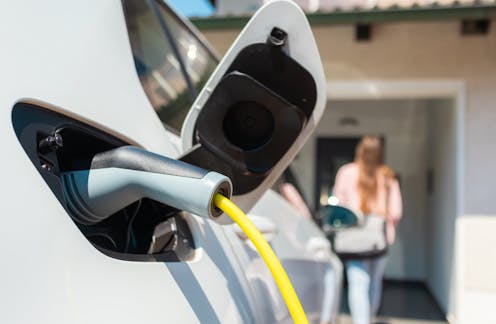
This year, dozens of new models of electric vehicles have hit the Australian market – and more are coming. New models of battery electric and plug-in hybrids come with bigger batteries. The average battery electric now has a range of over 400 kilometres.
But until now, there’s been a missing piece of the puzzle. The batteries in most new electric cars are huge – much larger than a typical home battery. A BYD Seal might have a battery capacity of 60 to 80 kilowatt hours (kWh), while the average home battery installed in Australia is 11 to 12 kWh.
So why can’t you plug your car in and power your house?
Soon, you will be able to. The suite of technologies already exists. They’re known as vehicle to grid (V2G, where you export power to the grid), vehicle to house (V2H, where you run your house off your car) and vehicle to load (V2L, where you run electric devices off your car).
There’s a cost – you need a bidirectional charger able to send power both to and from the car. But experts expect substantial benefits.
With V2G, you can sell power back to the grid at peak times, helping the grid stay stable. With V2H, you can weather power outages or even go off grid. V2L would be useful for campers and tradies.
One reason it’s not here already is that regulations and processes haven’t been in place. On Saturday, climate change minister Chris Bowen announced progress on this front. Vehicle to grid would be up and running by Christmas. That’s a very ambitious timeline, as there’s more to it than just regulations. But it is a jump forward.
“When you pick your next EV you won’t be buying just a car, you’ll be buying a household battery on wheels,” Bowen has said.

What changed?
Vehicle to grid isn’t totally new in Australia.
In late 2022, South Australia became the first state to greenlight bidirectional chargers in homes. But these chargers only work with two EV models, the electric Nissan Leaf and the plug-in hybrid Mitsubishi Outlander.
So what just changed? Crucial underpinning – the boring but important scaffolding which makes new technology robust and reliable. Specifically, Standards Australia has approved a new standard for bidirectional chargers.
Australian standards are technical standards outlining specifications and guidelines for new technologies. While voluntary, products are expected to meet the relevant standards. A V2G standard will level the playing field and give clarity for owners, grid operators and electric charger manufacturers.
A new standard is a leap forward. But to make V2G a reality will take more action. Car owners have to install bidirectional fast chargers, able to send power both ways. These aren’t cheap, at around A$3,500 a pop. Car companies have to ensure their chargers meet the new standard. And distribution networks have to approve charger models for use on the grid.
Trial projects such as the Realising Electric Vehicle-to-Grid Services in the Australian Capital Territory and the Amber/ARENA trial in New South Wales show we can meet some of the technical requirements. It will take time and money to integrate these changes nationwide.
 For vehicle to grid technology to become common, the grid has to be able to handle it.
yelantsevv/Shutterstock
For vehicle to grid technology to become common, the grid has to be able to handle it.
yelantsevv/Shutterstock
Why should we be excited about this?
As more car owners go electric, the size of the battery fleet on Australian roads and driveways is growing fast.
Without V2G, these batteries are just used for one thing – to make a car, truck or bus operate. But these batteries could do much more. Australia’s electric fleet is now over 180,000. If the average battery pack size was 50 kWh, that would represent a giant distributed battery of 9 gigawatt hours. The largest grid-scale battery under construction in Australia will have 2.4 gigawatt hours.
For energy authorities, this fleet of batteries presents a huge opportunity. At times of peak demand, they could offer financial incentives for EV owners to discharge to the grid. Used carefully, EV batteries could avert blackouts. A decentralised power source is more resilient to shocks. It could mean avoiding the need to fire up expensive gas plants at times of peak demand.
For EV owners, the financial incentives could be enough to let their cars be used to keep the grid stable. In testing, early V2G users have been able to turn large power bills into power payments. Annual earnings could be as high as $9-$12,000 per vehicle in New South Wales, according to one report.
Many carmakers are moving towards including V2G.
2025 could be the year
Overseas, vehicle to grid technology is gaining traction. California has mandated V2G capabilities in all light EVs sold from 2027 onward.
In Australia, regulatory change and incentives will be needed to encourage broader adoption.
It’s encouraging to see Australian standards for V2G arrive. But while Bowen is pitching V2G as about to happen, there is still some spadework left to do before it’s really here.


