

Curious Kids: what would happen if someone moved at twice the speed of light?
- Written by The Conversation
I’m curious about what will happen if, hypothetically, someone moves with speed (that is) twice the speed of light? – Devanshi, age 13, Mumbai

Hi Devanshi! Thanks for this great question.
As far as we know, it’s not possible for a person to move at twice the speed of light. In fact, it’s not possible for any object with the kind of mass you or I have to move faster than the speed of light.
However, for certain strange particles, travelling at twice the speed of light might be possible – and it might send those particles back in time.
A universal speed limit
One of our best physical theories at the moment is the theory of relativity, developed by Albert Einstein. According to this theory, the speed of light operates as a universal speed limit on anything with mass.
Specifically, relativity tells us that nothing with mass can accelerate past the speed of light.
To accelerate an object with mass, we have to add energy. The faster we want the object to go, the more energy we’ll need.
The equations of relativity tell us that anything with mass – regardless of how much mass it has – would require an infinite amount of energy to be accelerated to the speed of light.
But all of the sources of energy we know of are finite: they are limited in some respect.
Indeed, it’s plausible the Universe only contains a finite amount of energy. That would mean there isn’t enough energy in the Universe to accelerate something with mass up to the speed of light.
Since you and I have mass, don’t expect to be travelling at twice the speed of light anytime soon.
Tachyons
This universal speed limit applies to anything with what we might call “ordinary mass”.
There are, however, hypothetical particles called tachyons with a special kind of mass called “imaginary mass”.
There is no evidence tachyons exist. But according to relativity, their possible existence can’t be ruled out.
If they do exist, tachyons must always be travelling faster than the speed of light. Just as something with ordinary mass can’t be accelerated past the speed of light, tachyons can’t be slowed down to below the speed of light.
Some physicists believe that if tachyons exist, they would constantly be travelling backwards in time. This is why tachyons are associated with time travel in many science fiction books and movies.
There are ideas that we might someday harness tachyons to build a time machine. But for now this remains a distant dream, as we don’t have the ability to detect potential tachyons.
Read more: Curious Kids: is time travel possible for humans?
Shortcuts?
It’s disappointing we can’t travel faster than the speed of light. The nearest star to us, other than the Sun, is 4.35 light years away. So, travelling at the speed of light, it would take more than four years to get there.
The farthest star we’ve ever detected is 28 billion light years away. So you can pretty much give up on charting the entire Universe.
That said, relativity does allow for the existence of “wormholes”.
A wormhole is a shortcut between any two points in space. While a star might be 4.5 light years away in normal terms, it might only be a few hours away via a wormhole.
If there are any actual wormholes, they would let us travel great distances in a very short period of time – allowing us to get to the farthest reaches of the universe within a single lifetime.
Unfortunately, like tachyons, wormholes remain entirely hypothetical.
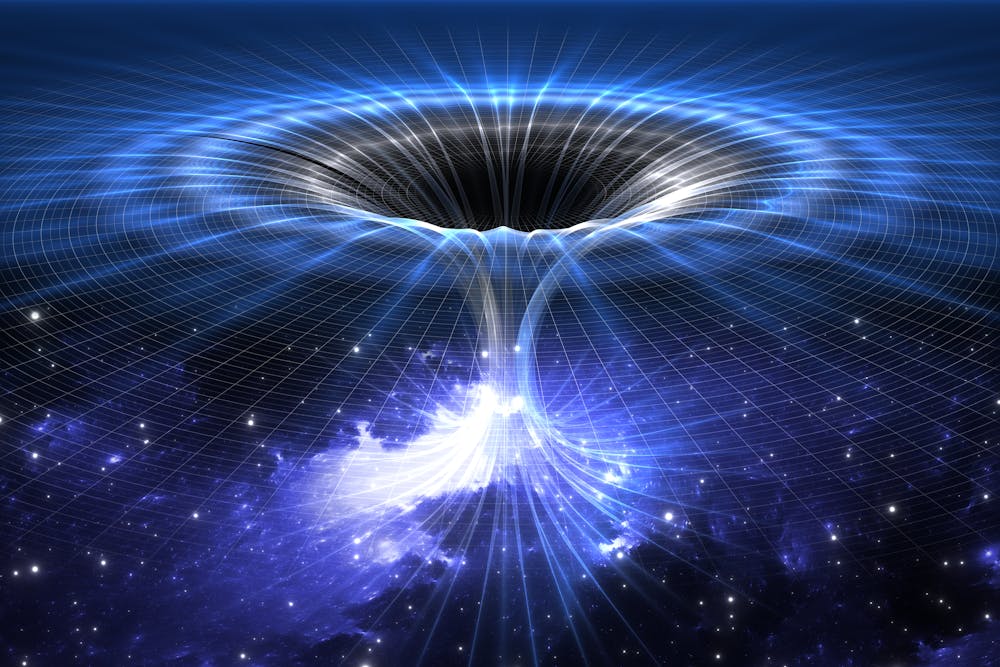 You can think of a wormhole as a tunnel with two ends opening up to different points in spacetime.
Shutterstock
You can think of a wormhole as a tunnel with two ends opening up to different points in spacetime.
Shutterstock
Strange possibilities
Despite the fact we can’t genuinely travel faster than light, we can still try to imagine what it would be like to do so.
By thinking in this way, we are engaging in “counterfactual thinking”. We are considering what things would, or might, be like if reality was different in some way.
There are many different possibilities we could consider, each with a different set of physical principles.
So we can’t say with any certainty what would happen if we were able to travel faster than light. At best, we can guess what might happen. Would we start to travel back in time, as some scientists think tachyons might do?
I’ll leave it to you and your imagination to come up with some ideas!


