

Scientists claim to have found evidence of alien life. But ‘biosignatures’ might hide more than they reveal
- Written by The Conversation
Whether or not we’re alone in the universe is one of the biggest questions in science.
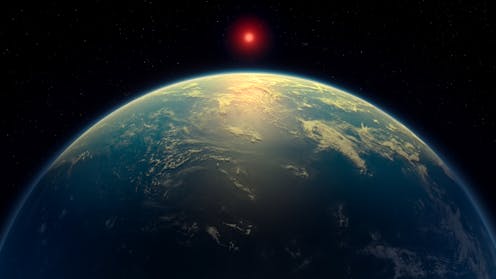
A recent study, led by astrophysicist Nikku Madhusudhan at the University of Cambridge, suggests the answer might be no. Based on observations from NASA’s James Webb Space Telescope, the study points to alien life on K2-18b, a distant exoplanet 124 light years from Earth.
The researchers found strong evidence of a chemical called dimethyl sulfide (DMS) in the planet’s atmosphere. On Earth, DMS is produced only by living organisms, so it appears to be a compelling sign of life, or “biosignature”.
While the new findings have made headlines, a look at the history of astrobiology shows similar discoveries have been inconclusive in the past. The issue is partly theoretical: scientists and philosophers still have no agreed-upon definition of exactly what life is.
A closer look
Unlike the older Hubble telescope, which orbited Earth, NASA’s James Webb Space Telescope is placed in orbit around the Sun. This gives it a better view of objects in deep space.
When distant exoplanets pass in front of their host star, astronomers can deduce what chemicals are in their atmospheres from the tell-tale wavelengths they leave in the detected light. Since the precision of these readings can vary, scientists estimate a margin of error for their results, to rule out random chance. The recent study of K2-18b found only a 0.3% probability that the readings were a fluke, leaving researchers confident in their detection of DMS.
On Earth, DMS is only produced by life, mostly aquatic phytoplankton. This makes it a persuasive biosignature.
The findings line up with what scientists already conjecture about K2-18b. Considered a “Hycean” world (a portmanteau of “hydrogen” and “ocean”), K2-18b is thought to feature a hydrogen-rich atmosphere and a surface covered with liquid water. These conditions are favourable to life.
So does this mean K2-18b’s oceans are crawling with extraterrestrial microbes?
Some experts are less certain. Speaking to the New York Times, planetary scientist Christopher Glein expressed doubt that the study represents a “smoking gun”. And past experiences teach us that in astrobiology, inconclusive findings are the norm.
Life as we don’t know it
Astrobiology has its origins in efforts to explain how life began on our own planet.
In the early 1950s, the Miller-Urey experiment showed that an electrical current could produce organic compounds from a best-guess reconstruction of the chemistry in Earth’s earliest oceans – sometimes called the “primordial soup”.
Although it gave no real indication of how life in fact first evolved, the experiment left astrobiology with a framework for investigating the chemistry of alien worlds.
In 1975, the first Mars landers – Viking 1 and 2 – conducted experiments with collected samples of Martian soil. In one experiment, nutrients added to soil samples appeared to produce carbon dioxide, suggesting microbes were digesting the nutrients.
Initial excitement quickly dissipated, as other tests failed to pick up organic compounds in the soil. And later studies identified plausible non-biological explanations for the carbon dioxide. One explanation points to a mineral abundant on Mars called perchlorate. Interactions between perchlorate and cosmic rays may have led to chemical reactions similar to those observed by the Viking tests.
Concerns the landers’ instruments had been contaminated on Earth also introduced uncertainty.
In 1996, a NASA team announced a Martian meteorite discovered in Antarctica bore signs of past alien life. Specimen ALH84001 showed evidence of organic hydrocarbons, as well as magnetite crystals arranged in a distinctive pattern only produced biologically on Earth.
More suggestive were the small, round structures in the rock resembling fossilised bacteria. Again, closer analysis led to disappointment. Non-biological explanations were found for the magnetite grains and hydrocarbons, while the fossil bacteria were deemed too small to plausibly support life.
The most recent comparable discovery – claims of phosphine gas on Venus in 2020 – is also still controversial. Phosphine is considered a biosignature, since on Earth it’s produced by bacterial life in low-oxygen environments, particularly in the digestive tracts of animals. Some astronomers claim the detected phosphine signal is too weak, or attributable to inorganically produced sulfur compounds.
Each time biosignatures are found, biologists confront the ambiguous distinction between life and non-life, and the difficulty of extrapolating characteristics of life on Earth to alien environments.
Carol Cleland, a leading philosopher of science, has called this the problem of finding “life as we don’t know it”.

Moving beyond chemistry
We still know very little about how life first emerged on Earth. This makes it hard to know what to expect from the primitive lifeforms that might exist on Mars or K2-18b.
It’s uncertain whether such lifeforms would resemble Earth life at all. Alien life might manifest in surprising and unrecognisable ways: while life on Earth is carbon-based, cellular, and reliant on self-replicating molecules such as DNA, an alien lifeform might fulfil the same functions with totally unfamiliar materials and structures.
Our knowledge of the environmental conditions on K2-18b is also limited, so it’s hard to imagine the adaptations a Hycean organism might need to survive there.
Chemical biosignatures derived from life on Earth, it seems, might be a misleading guide.
Philosophers of biology argue that a general definition of life will need to go beyond chemistry. According to one view, life is defined by its organisation, not the list of chemicals making it up: living things embody a kind of self-organisation able to autonomously produce its own parts, sustain a metabolism, and maintain a boundary or membrane separating inside from outside.
Some philosophers of science claim such a definition is too imprecise. In my own research, I’ve argued that this kind of generality is a strength: it helps keep our theories flexible, and applicable to new contexts.
K2-18b may be a promising candidate for identifying extraterrestrial life. But excitement about biosignatures such as DMS disguises deeper, theoretical problems that also need to be resolved.
Novel lifeforms in distant, unfamiliar environments might not be detectable in the ways we expect. Philosophers and scientists will have to work together on non-reductive descriptions of living processes, so that when we do stumble across alien life, we don’t miss it.


