

Could a river sue a corporation? Robert Macfarlane’s books change the world – now he’s advocating for the world’s waterways
- Written by The Conversation
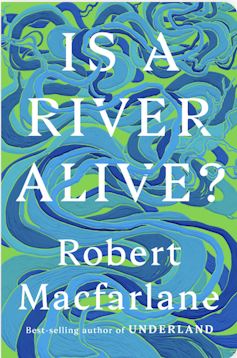
Robert Macfarlane is not easy to pin down – song writer, nature writer, children’s author, environmental activist, documentary film maker, mountain climber and restless adventurer, spoken word performer, literary historian, librettist, linguist and researcher. Likewise, his books are so various and yet so much themselves, it seems he has forged his own genre.
Review: Is a River Alive? – Robert Macfarlane (Penguin Random House)
He has won many kinds of prizes for his books, so many that he has been spoken of as a likely Nobel Prize winner several times over the past few years. Each of his books changes the world a little, possibly sometimes profoundly.
His latest takes as its title and starting point a question his young son once put to him, “Is a River Alive?” If we can talk of rivers dying (and we do), then isn’t there an assumption somewhere along that line of thought that a river does indeed constitute a life?
MacFarlane lives south of Cambridge, England, not far from a rare chalk stream spring that feeds the early reaches of the River Cam, which flows through the town. This is one of the four troubled rivers he explores across the pages of his book.
In England, climate change will put such springs at risk not too far into the future. He reports in his brief inter-chapters on the River Cam that the nationwide privatisation of riverways has put the health of England’s rivers at risk of dying as viable natural ecosystems.
His book takes us across the globe. To the Ecuadorian cloud-forest named Los Cedros, where the “river of the Cedars” is under threat from gold-mining.
Then to Chennai in south-east India, a city of three rivers and a surrounding marshland. All three rivers have been declared “dead” due to a total lack of dissolved oxygen in their waters as they pass through this city of three million people, taking up raw sewage and industrial waste in huge quantities.

The final journey is into Quebec’s wild Magpie River, named Muteshekau-Shipu by the Innu people who have lived for 8,000 years with this river. Its flow, he writes, is now threatened by a hydro scheme that would transform it into a series of chained reservoirs – an incursion into one of the largest intact ecosystems in the world. Already, power lines from a just-completed hydro scheme that has drowned a nearby river are crossing the Muteshekau.
We visit, alongside Macfarlane, each of these rivers, and encounter with him the characters entangled with them. Often these individuals are quixotically heroic, damaged by their tilting against governments and corporations, deeply insightful, determinedly optimistic, and always (in his appreciative hands) articulate.
Each river is at the forefront of the emergence of what Macfarlane calls a new-old idea. This idea has been newly pioneered in recent years by the ecologist, historian and theologian-turned-geologian Thomas Berry, one of the philosophical fathers of the Rights of Nature Movement.
Berry has coined the phrase “Earth Jurisprudence” to recognise and uphold the idea of earth as “a communion of subjects, not a collection of objects”. Under this juridical philosophy, “trees have tree rights, insects have insect rights, rivers have river rights, and mountains have mountain rights”.
Towards the end of Macfarlane’s book, the Innu poet, artist, therapist, river guide and mystic Lydia Mestokosho-Paradis declares,
It seems crazy that we give a corporation that’s ten years old rights, but we won’t give rights to a ten-thousand-year-old river.
How to bring such an imagined and imaginative, partly spiritual idea into the realm of law? It has begun to happen, perhaps most strikingly in 2008 when Ecuador under the guidance of the socialist government of Rafael Correa passed into existence a new constitution that recognised the Rights of Nature alongside those of humanity and its corporations.
The major article of the new constitution stated,
Nature, or Pacha Mama, where life is reproduced and occurs, has the right to integral respect for its existence and the maintenance and regeneration of its life cycles, structure, functions and evolutionary processes.
It is possible this declaration in their constitution will in time close the gold mines in the cloud-forest of Los Cedros.
In 2017, extraordinarily, New Zealand passed legislation called the Te Awa Tupua Act, which recognises the Whanganui River in the North Island is alive, is an ancestor to the Whanganui iwi (tribe), and is itself a spiritual and physical entity, “an indivisible and living whole”.
This legislation has encouraged individuals and groups around the world to agitate for their rivers’ lives to be recognised and respected in law.
“There are few things as powerful as an idea whose time has come,” Macfarlane writes, certainly more in hope than hubris at this tipping point for the world’s climate and its climate politics.


