

Humans keep building robots that are shaped like us – what’s the point?
- Written by The Conversation
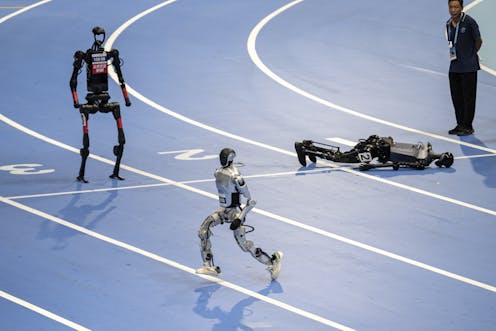
Robots come in a vast array of shapes and sizes. By definition, they’re machines that perform automatic tasks and can be operated by humans, but sometimes work autonomously – without human help.
Most of these machines are built for a specific purpose: think of the puck-shaped robot vacuum or a robotic assembly arm in a factory. But recently, human-shaped or humanoid robots have increasingly entered the spotlight.
Humanoid robots are exactly what they sound like – machines with arms, legs, a torso and a head, typically walking upright on two legs. Investment in humanoid robot development has been skyrocketing recently. If you have several thousand dollars, some are already available for purchase.
But why is there so much interest in human-shaped robots? What are they good for, apart from showcases such as Beijing’s World Humanoid Robot Games or funky dance routine videos?
A machine just like us
A robot vacuum is a single-purpose machine. The promise of humanoid robots is they might work as general-purpose platforms, doing multiple tasks in various environments.
That’s because robots similar in shape to humans can potentially better fit into human environments – ones already designed for bodies and physical capabilities such as ours.
A robot vacuum – or any other machine with wheels – can’t climb the stairs. In principle, humanoids would be much more mobile in busy human environments, able to climb stairs, use doors, navigate and reach diverse spaces not just at home, but our workplaces, streets and the outdoors.

Humanoid robots existed in entertainment long before humans actually built one. From Maschinenmensch in Fritz Lang’s 1927 film Metropolis to C-3PO in Star Wars, they’ve influenced our imagination. Of course, these were costumed actors – real humanoid robots didn’t start walking until WABOT-1 in 1972, built in Japan.
A lucrative industry?
Developers, manufacturers and investors have been betting big on humanoid robots and believe they will have an enormous impact on society.
Last year, a Goldman Sachs report estimated the global market for humanoid robots would be US$38 billion by 2035 (A$58 billion), with between 3 million and 27 million humanoid robots installed worldwide. They could be “particularly appealing” for dangerous tasks, potentially saving the lives of human workers who could delegate hazardous jobs to robots.
A 2025 Bank of America report estimates there will be 1 million humanoid robots sold annually by 2030, and a staggering 3 billion humanoid robots in service by 2060 – that’s almost one humanoid for every three humans.
Even conservative estimates of the future number of humanoid robots signal a significant shift across nearly all aspects of society.
However, to achieve this impact humanoids would truly need to be everywhere, including entertainment, care, home, services and hospitality.
In reality, the path to a multi-talented, general-purpose robot is still a fair way off.
Footage released by Chinese state video news agency CCTV shows humanoid robots join human dancers at the 2025 Spring Festival Gala.We’re not yet living in the future
Building a machine that can move like a human is notoriously difficult.
In recent years, humanoid robots have vastly improved thanks in large part to artificial intelligence (AI) learning algorithms that are augmenting and even replacing previous robot programming methods.
AI methods such as reinforcement learning are generating more robust walking, running and high-level skills that adjust better to uneven terrain and external challenges like being pushed or bumped.
But machines like those these robot kick-boxers are still under human control when deciding which moves to do, although they can autonomously keep balance even when doing complex kicks and punches.
General logic, situational and socially appropriate awareness are also still rather basic. Robots need help from humans to act appropriately. For example, humanoid robots don’t understand the physical, social and cultural differences in how to appropriately engage with a baby, a child, an adult or an older person.
The game-changer that could give us truly general-purpose humanoid robots would have to be an ability to draw on human knowledge and skills directly. For example, you could show a robot how to wash the dishes and it would then copy your behaviour.
To do so, however, robots also need to become more adaptable to different environments – not just the lab they were trained in.
Recently, AI learning techniques such as imitation learning or learning from demonstration and deep reinforcement learning that uses powerful algorithms have been showing great results in speeding up how robots pick up new, complex skills from examples.
Footage from ten years of Boston Dynamics (Hyundai) videos show how the walking robots have progressed in this time.The next smartphone?
Current predictions for when humanoids will be in your home vary widely. While some robots are already tested in home environments, others suggest consumer applications could be five to ten years away.
Companies such as Boston Dynamics (Hyundai), Tesla, Unitree, Figure AI, Agility, UBTech and many more are now vying for a place in a future market they think could be as big as the car industry and “as ubiquitous as smartphones”.
However, critics argue robot designs still need to improve to truly match human dexterity.
If humanoid robots really do enter our homes en masse, the future social impact could be enormous and is little understood. It will require concerted leadership from business, government, research and public to see that such a momentous change has a positive impact on people’s lives.
And while this future is not yet certain, it’s one we’ve been collectively imagining for at least 100 years.


