

Touch reveals what eyes can’t see – so museums should embrace interactivity
- Written by The Conversation
Walk into most art galleries with children, and you’ll hear the familiar refrain “look but don’t touch”. This instruction reveals something troubling about how cultural institutions understand learning. Museums have become temples to visual consumption, where knowledge is received through eyes rather than constructed through bodies.
This fundamentally misunderstands how humans learn – and what we deny young people when we privilege looking over all other forms of engagement.
At my exhibition The Whole is Greater Than the Sum of Her Parts, I have watched visitors consistently spend significantly longer with touchable elements compared to visual-only displays. Visitors engaging tactilely ask fundamentally different questions, too, moving from “what is this?” to “how was this made?” and “what if I tried…?”
So what happens when we design cultural spaces honouring the full range of human learning capacities?
Touch reveals what eyes miss
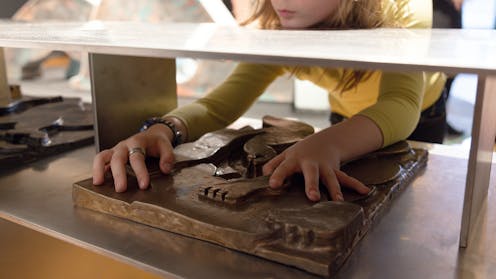
My exhibition includes bronze reliefs visitors can touch while viewing corresponding paintings. This simple addition reveals artistic knowledge that visual observation alone cannot provide.
Take a moment I witnessed with the work The Weight of Connection, where a child placed her hands on reliefs while looking at paintings.
These bronze sculptures translate semi-abstract paintings into three-dimensional form, but with a twist. What appears to recede in the painting might actually protrude in the bronze relief.

“This looks like the background, but it feels raised,” she said, as her fingers traced raised areas that appeared sunken in the painting. Suddenly she had to work harder to understand what was actually happening, comparing what her eyes told her with what her hands discovered.
This is spatial reasoning in action: understanding emerging not from a single sense, but from reconciling conflicting information.
The exhibition’s large playable sculpture, Ludic Folly, transforms semi-abstract figurative forms into an interactive adventure. Visitors climb, rest and navigate space. I repeatedly observe children and adults having “aha moments” as physical position fundamentally changes their understanding of sculptural forms.
My research has shown children naturally learn by building foam compositions on this interactive sculpture, stacking geometric shapes while balancing on curved surfaces.
I’ve watched them discover triangular forms won’t balance the same way rectangular ones do, and weight distribution changes everything. Their whole body becomes part of the learning process.
When children build these compositions together, they don’t just absorb information, they negotiate what works. I’ve seen two kids argue about whether a foam cube should go “on top or underneath”, then test both options, their hands and bodies providing immediate feedback about balance and stability.
When foam structures topple over in Ludic Folly, children don’t see catastrophe, they see information. “Oh, it needs more support here,” one child told me after her tower collapsed, immediately rebuilding with a wider base.
Embracing risk
My research explores a concerning pattern: students from highly supervised, risk-averse childhoods often struggle with creative risk-taking in young adulthood. Physical risks in early childhood build resilience, enabling later intellectual and creative risks.
Museums maintaining “look but don’t touch” policies aren’t just being conservative. They’re reinforcing educational approaches that produce passive, risk-averse learners precisely when society increasingly needs creative problem-solvers.
When children in Ludic Folly climb, balance and build structures that might fall, they’re developing both physical confidence and intellectual courage.

In the real world, we never rely on just our eyes. When you’re cooking, you’re listening to the sizzle, feeling the heat, smelling when something’s ready, tasting as you go. When you’re fixing something, your hands tell you as much as your eyes do.
Yet, somehow, we’ve convinced ourselves that in museums learning should happen only through looking.
A path forward
Cultural institutions can implement embodied learning approaches without major infrastructure changes. They can:
allow visitors to explore exhibitions with their hands, providing various textures, weights and temperatures for visitors to manipulate while studying artworks
design exhibitions requiring physical navigation and multiple viewpoints, rather than static observation
create spaces where visitors build, arrange and problem-solve together using loose parts or modular elements
allow visitors to handle tools, materials or work-in-progress pieces revealing artistic processes typically hidden behind finished works.
Throughout my exhibition, these bronze reliefs and the large playable sculpture contain “embodied knowledge” – understanding existing only through physical creation and accessible only through physical engagement. This isn’t secondary information; it’s primary artistic knowledge completely inaccessible through visual observation alone.
Just like artists, children build knowledge in their bodies. The acquisition of tacit knowledge is a deeply immersive process.
 The acquisition of tacit knowledge is a deeply immersive process.
Maja Baska Photography
The acquisition of tacit knowledge is a deeply immersive process.
Maja Baska Photography
Over time, the artist’s body becomes a repository of knowledge, with each movement and gesture informed by years of practice. This allows the artist to work with a level of precision and artistry often described as second nature. For children, this process happens through play and exploration.
Museums embracing all of our senses aren’t just being more inclusive; they’re being more effective educators, spaces where learning becomes collaborative rather than passive.
To accompany the exhibition, I developed a comprehensive learning resource with essays, activities, and inquiry questions that help educators and families understand how children learn through embodied knowledge. It’s time our cultural institutions caught up with what children have always known: real learning engages the whole person, not just the eyes.
The Whole is Greater Than the Sum of Her Parts is at the National Gallery of Australia, Canberra, until September 21.


